wayground logo

Free Printable Worksheets

Font size

S
M
L
XL
Worksheets

Time to show it all!

Total questions: 85

Worksheet time: 1hrs 7mins

Name
Class
Date
1.
A series of steps used by scientists to solve a problem or answer a question. 
a)
scientific method
b)
recipe
c)
data collection
d)
metric system
2.
A testable explanation to a problem that has not yet been tested. 
a)
data
b)
theory
c)
hypothesis
d)
fact
3.
What is a hypothesis?
a)
A hypothesis is the right answer to an experiment.
b)
A hypothesis is the wrong answer to an experiment.
c)
A hypothesis is an educated guess.
d)
I don't know.
4.
The summary at the end of an experiment that explains the results. 
a)
conclusion
b)
procedures
c)
materials
d)
responding variable
5.
Which side of a penny will hold more drops of water? Choose the best hypothesis.
a)
If I use the heads side of a penny, then it will hold more drops of water than tails.
b)
Heads
c)
Tails
d)
Tails will hold more drops of water.
6.
What is used to measure mass of an object in grams?
a)
Triple beam balance
b)
Test tube rack
c)
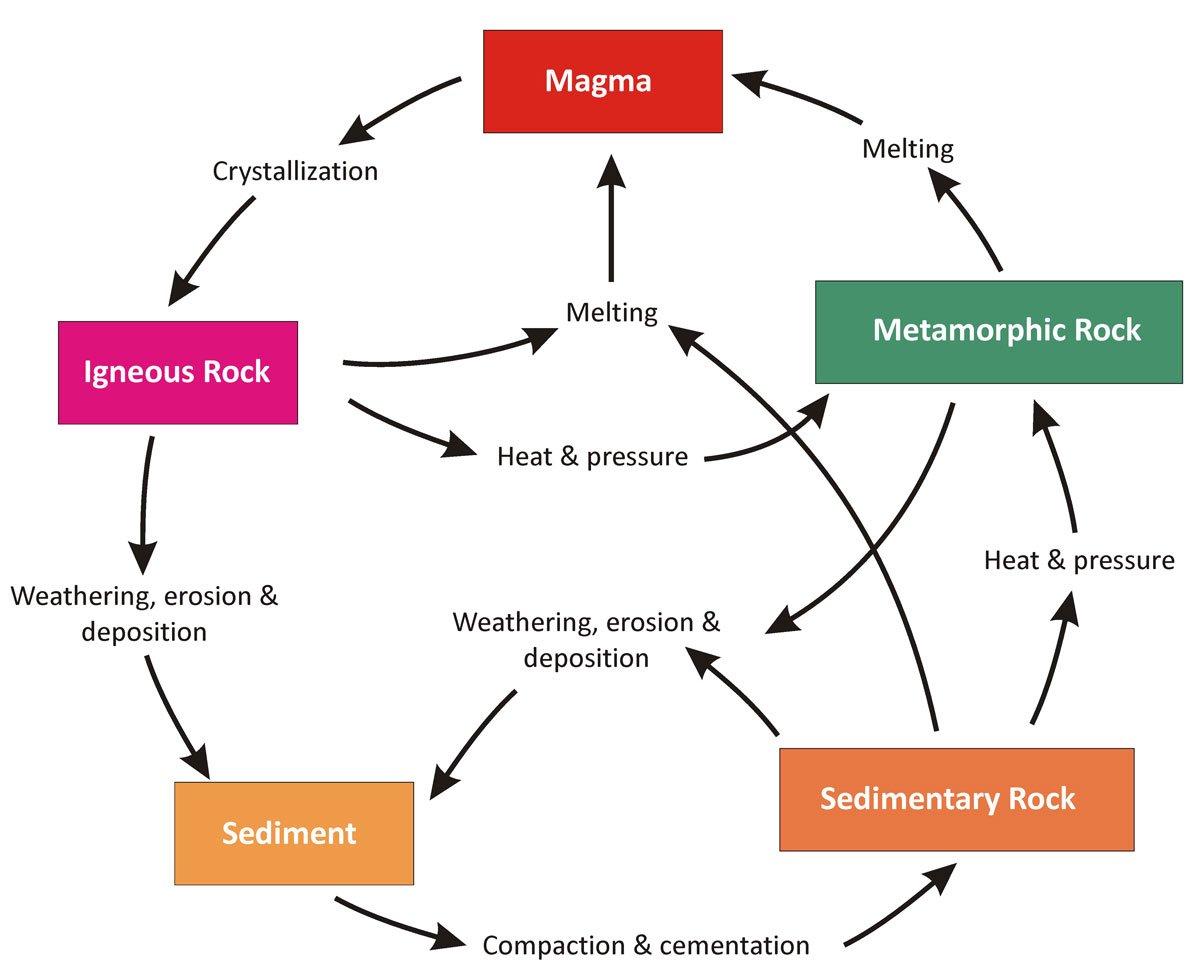
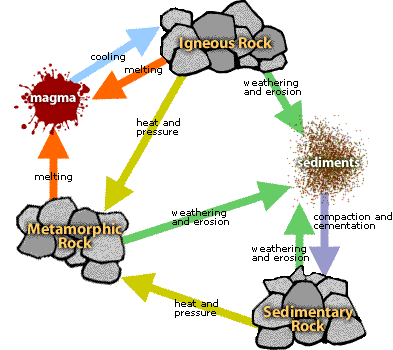
Meter stick
d)
Graduated Cylinder
7.
What is used to measure the volume of liquids more precisely in milliliters?
a)
Beaker
b)
Flask
c)
Graduated Cylinder
d)
Test tubes
8.
Used to measure length and distance in the metric system
a)
Graduated cylinder
b)
Triple beam balance
c)
Thermometer
d)
Meter stick
9.

What is used to measure the volume of liquids?

a)

Flask

b)

Beaker

c)

Graduated Cylinder

d)

Pipette

10.

What is used to transfer small amounts of liquid?

a)

Graduated Cylinder

b)

Medicine Dropper/Pipette

c)

Beaker

d)

Flask

11.

What is used to measure temperature?

a)

Triple Beam Balance

b)

Graduated Cylinder

c)

Stopwatch

d)

Thermometer

12.
The base unit of metric length.
a)
Meter
b)
Liter 
c)
Kilogram
d)
milligram
13.
The basic unit of metric volume is called a_____.
a)
Kilogram
b)
milligram
c)
Liter
d)
milliliter
14.
The base for mass is the
a)
meter
b)
gram
c)
kilogram
d)
liter
15.
The height from floor to ceiling in this room would be about..
a)
10 meters
b)
3 meters
c)
12 meters
d)
25 meters
16.
What is the correct volume of the blue liquid?
a)
5 ml
b)
15 ml
c)
20 ml
d)
25 ml
17.
What is the correct mass in grams?
a)
232.5
b)
237.0
c)
750.
18.

240 cm = ___________ m

a)

2400

b)

24

c)

2.4

d)

0.24

19.
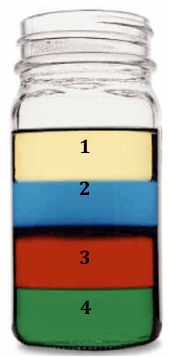
Put the liquids in order from most dense to least dense?
a)
4, 3, 2, 1
b)
1, 2, 3, 4
c)
3, 4, 2, 1, 
d)
4, 3, 1, 2
20.
Why does ice float?
a)
Liquid water is less dense than solid water.
b)
Solid water is less dense than liquid water.
c)
Gaseous water is less dense than solid water.
d)
Liquid water is less dense than gaseous water.
21.
What do we know about the density of lamp oil, rubbing alcohol, and vegetable oil?  
a)
The density is greater than 1.0 g/mL
b)
The density is less than 1.0 g/mL
c)
The density is equal to 1.0 g/mL
d)
The density can not be determined
22.
If an object has a density of .6 g/cm^3 and you put it into water, will it sink or float?  
a)
sink
b)
float
23.
What is the formula for density?
a)
density = mass x volume
b)
density = mass / volume
c)
density = mass + volume
d)
density = mass - volume
24.
Jack has a rock. The rock has a mass of 14 g and a volume of 2 cm3. What is the density of the rock?
a)
7 mL
b)
7 g/cm3
c)
28 g/cm3
d)
1/7 g/cm3
25.
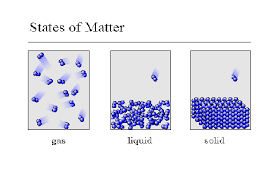
A gas
a)
has a definite shape but no definite volume
b)
has a definite volume but no definite shape
c)
has fast-moving particles
26.
Which state of matter has tightly packed molecules?
a)
solid
b)
liquid
c)
gas
27.
Which state of matter has a definite shape?
a)
solid
b)
liquid
c)
gas
28.
What is happening when my ice cream changes from a solid to a liquid?
a)
freezing
b)
melting
c)
burning
d)
evaporation
29.
The state of matter that has no definite size or shape is
a)
Solid
b)
Liquid
c)
Gas
30.
Particles (molecules) in a ______________________ have more energy than the other states of matter.
a)
gas
b)
solid
c)
liquid
31.
The slower the particles in a substance move,
a)
the colder it is.
b)
the warmer it is.
c)
the more energy it has.
d)
the less energy it has.
32.
Any change in the state of matter of a substance is a...
a)
Physical Change
b)
Chemical Change
33.
Which of the following indicates a chemical change?
a)
Change in state of matter
b)
Temperature change
c)
Change in size 
d)
Change in shape
34.
Which of the following indicates a PHYSICAL change?
a)
Change in temperature
b)
Change in shape
c)
Formation of a precipitate
d)
Change in color
35.
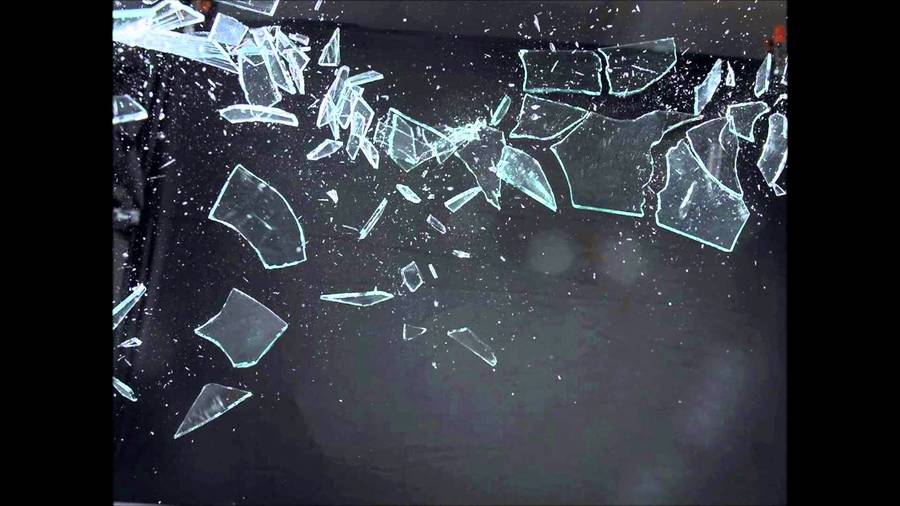
Chemical or Physical?  Glass breaking into tiny shards
a)
Chemical Change
b)
Physical Change
36.
Physical or Chemical Change?  Iron rusts
a)
Physical Change
b)
Chemical Change
37.
Physical or Chemical Change?  Cutting an orange into wedges.
a)
Physical Change
b)
Chemical Change
38.
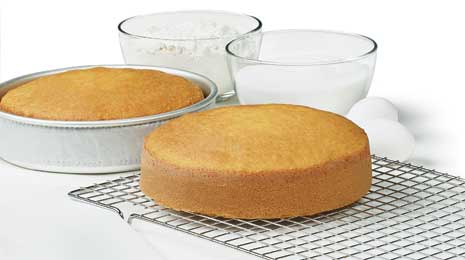
Physical or Chemical Change?  Baking a cake.
a)
Chemical Change
b)
Physical Change
39.
In an exothermic reaction, heat is ...
a)
taken in or absorbed
b)
given out or released
40.
In an endothermic reaction, heat is ...
a)
taken in or absorbed
b)
given out or released 
41.
What is the transfer of heat by direct contact?
a)
conduction
b)
convection
c)
radiation
42.

What is a transfer of heat energy by electromagnetic waves through space?

a)

conduction

b)

convection

c)

radiation

43.

What is a transfer of heat energy by electromagnetic waves through space?

a)

conduction

b)

convection

c)

radiation

44.
What is the transfer of heat by movement of liquids or gases?
a)
conduction
b)
convection
c)
radiation
45.
You are stirring a bowl of hot soup with a metal spoon. The spoon starts to feel warmer because of _?_.
a)
conduction
b)
convection
c)
radiation
46.
You buy a lava lamp from the store. As the lamp heats up, blobs of liquid rise to the top then sink back down to the bottom. This process continues because of _?_.
a)
conduction
b)
convection
c)
radiation
47.
You are doing your homework at a desk that is underneath a lamp. You start to feel hotter because of _?_ from the lamp.
a)
conduction
b)
convection
c)
radiation
48.
Your best friend has a bunk bed. You move from the bottom bunk to the top bunk and notice that the air is warmer. The warm air rises because of _?_.
a)
conduction
b)
convection
c)
radiation
49.

You are in science class and want to see if the hot plates were used recently. You place your hand near the side of the hot plate. Without touching the hot plate, your hand feels warmer. Heat is transferred to your hand by _?_.

a)

conduction

b)

convection

c)

radiation

50.
You are roasting marshmallows at a campfire. The metal skewer (stick) that you’re cooking your marshmallow on burns your hand because of _?_.
a)
conduction
b)
convection
c)
radiation
51.
What happens when ice cubes melt in a glass?
a)
Heat travels from the ice to the warmer water.
b)
No energy is transferred.
c)
Heat is transferred from the warmer water to the ice cubes.
52.

In heat transfer, heat always flows from the _?_ substance to the _?_ substance.

a)

hotter to colder

b)

colder to hotter

c)

hotter to hotter

d)

colder to colder

53.

The outermost layer is the ________.

a)

mantle

b)

crust

c)

inner core

d)

outer core

54.

The layer below the crust is the ____________.

a)

oceanic crust

b)

mantle

c)

inner core

d)

continental crust

55.

The core is made up mostly of _______________.

a)

oxygen

b)

magnesium

c)

iron

d)

carbon

56.

The inner core is as hot as _________.

a)

100 ovens

b)

the surface of the sun

c)

the big bang

d)

Utah in the summer

57.

This layer has the highest pressure of all the layers.

a)

inner core

b)

outer core

c)

crust

d)

mantle

58.
There are how many different types of crust?
a)
1
b)
2
c)
5
d)
3
59.
What is the correct order (starting from the surface) of Earth's layers?
a)
crust, outer core, inner core, mantle
b)
mantle, outer core, inner core, crust
c)
crust, mantle, outer core, inner core
d)
outer core, inner core, crust, mantle
60.
Which layer of Earth has the GREATEST density?
a)
crust
b)
mantle
c)
outer core
d)
inner core
61.
Who is the scientist who proposed Continental Drift Theory?
a)
Albert Einstein
b)
Alfred Wegener
c)
Isaac Newton
d)
John Dalton
62.
What do you call the supercontinent landmass formed million years ago?
a)
Pangea
b)
Asia
c)
Pantallasa
d)
Eurasi
63.
What causes the continents to move?
a)
Magma
b)
Tectonic Plates
c)
Earthquake
d)
All of the choices
64.
What are the three types of Evidence that supports Alfred Wegener's Theory? 
a)
Fossils, Fish, and Land
b)
Sedimentary, Magma, and Climate
c)
Fossils, Land forms, and Climate
d)
Climate, Land forms, and Metamorphic rock 
65.
What evidence did Wegener use to support his theory?
a)
Continents and fossils fitting together/matching-up like puzzle pieces 
b)
glacier scars and other climate evidence from temperature
c)
mountain ranges and rocks line up across continents
d)
all of the above
66.
The type of plate boundary where two plates come together is a .....
a)
Convergent Boundary
b)
Divergent Boundary
c)
Transform Boundary
d)
Plate Boundary
67.
Which of the following causes Earth's tectonic plates to move?
a)
Energy from the Sun
b)
Magnetic Pole Reversal
c)
Convection currents in the mantle
d)
Faults in Mountain Ranges
68.
A divergent boundary occurs when plates ....
a)
Pull apart
b)
Come together
c)
Slide past each other
d)
subducting
69.
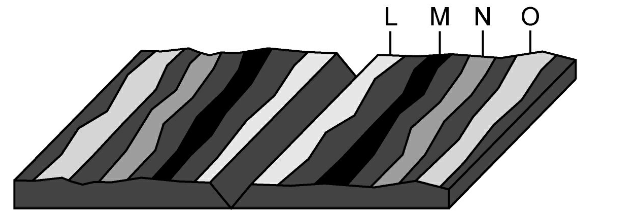
Where would the oldest rock be found?
a)
L
b)
M
c)
N
d)
O
70.
How is it possible for new crust to be formed without increasing the surface area of the Earth?
a)
Crust is destroyed at the same time it is created
b)
New crust is underwater where it sinks
c)
New crust breaks more easily than old crust
71.
A rock formed from fragments of other rocks is a(n)
a)
Metamorphic Rock
b)
Sedimentary Rock
c)
Extrusive Rock
d)
Igneous Rock
72.
Formed by heat and pressure
a)
Sedimentary
b)
Metamorphic
c)
Extrusive Igneous
d)
Intrusive Igneous
73.
Formed by compacting & cementing of sediments
a)
Sedimentary
b)
Metamorphic
c)
Extrusive Igneous
d)
Intrusive Igneous
74.
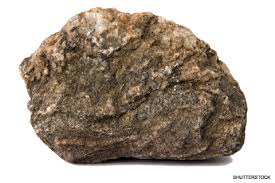
This rock was formed when molten rock cooled into a solid. What type of rock is it?
a)
Igneous Rock
b)
Metamorphic Rock
c)
Sedimentary Rock
75.
What are the 3 major types of rocks?
a)
Igneous, Metamorphic, Sedimentary
b)
Metamorphic, Igneous, Cementation
c)
Brown, Red, Gray
d)
Streak, Hardness, Breakage
76.
The process when rocks break into smaller pieces due to exposure to natural elements is called
a)
erosion
b)
weathering
c)
sediments
77.
The movement of weathered material (sediment) is called?
a)
weathering
b)
erosion
c)
deposition
78.
Each rock type can follow only one pathway of the rock cycle.
a)
True
b)
False
79.
What is deposition?
a)
The process by which
water, ice, wind or gravity
moves fragments of rock
and soil.
b)
The process by which
water, ice, wind or gravity
deposit rock sediments
and soil in a new place.
c)
The breaking down of
Earth’s crust into smaller
and smaller pieces.
80.
The diagrams  shows a natural process that weathers rock.
 Which statement best explains why this process results in weathering?
a)
frozen water acts as a solute
b)
water expands when it freezes
c)
the mass of water increases when it freezes
d)
frozen water dissolves most types of rock
81.

Evolution is best defined as:

a)

the process which organisms die.

b)

the process which organisms change over time.

c)

the process which organisms that are extinct become revived.

d)

the process which non-living things fossilize.

82.
The diagram shows fossils in different rock layers. Which of these statements about the age of these fossils is most likely correct?
a)
Fossil A and C are the same age
b)
Fossil B is older than fossil C
c)
Fossils A is older than fossil B
d)
Fossil D is older than fossil C
83.

Which scientist is known for his work that he did on the Galapagos Islands to develop his theory of natural selection?

a)

Gregor Mendel

b)

Charles Darwin

c)

Anton Van Leewenhoek

d)

Robert Brown

84.
Which of the following is a fossil?
a)
a plant that has recently died
b)
a group of organisms that can reproduce
c)
a structure or organ that no longer functions
d)
a trace of an organisms that existed in the past
85.
Natural selection is
a)
survival of the fittest
b)
humans change
c)
two species are the same
d)
more animals survive