
 Worksheets
Solar System Review
Total questions: 93
Worksheet time: 1hrs 28mins


Revolution
The curved path of a celestial object or spacecraft around a star, planet or moon.
An imaginary line about which a body rotates.
The action of rotating around an axis or center.
The motion of one object around another
Jupiter, Saturn, Uranus, and Neptune are know as ________ planets.
ice giants/gas giants
terrestrial planets
outer planets
inner planets
___________ are objects made of ice, dust, and rocks that orbit the Sun.
dwarf planets
comets
Asteroid belt
Kuiper belt
Oort Cloud
The _________ is a region between the planets Mars and Jupiter containing thousands of rocky objects that orbit the Sun.
dwarf planets
comets
Asteroid belt
Kuiper belt
Oort cloud
What is the correct order of the first five phases of the moon?
new, crescent, quarter, gibbous, full
new, crescent, gibbous, quarter, full
full, crescent, quarter, gibbous, new
full, quarter, gibbous, crescent, new
Our solar system is part of a bigger grouping of stars called the ___________ galaxy.
Milky Way
Andromeda
Messier 63
Whirlpool
All rotation and revolution lengths are the same for each planet.
true
false
Why do we have seasons?
It rotates on its axis as it revolves around the sun
It gets closer and farther from the sun
The tilt of the Earth's axis as it revolves around the sun
Why do we have night and day?
The Earth REVOLVES around the sun.
The Earth ROTATES on it's axis
The Earth ROTATES around the sun
The Earth REVOLVES around it's axis
Mercury, Venus, Earth, and Mars are known as _____________ planets. Mark as many that apply.
terrestrial planets
ice giants
inner planets
outer planets
How long does it take Earth to REVOLVE around the sun?
24 hours
365.25 days
2 years
1 month

Meteoroids
While in space a meteorite is called this.
A small rock or rocky grain that strikes Earth's surface.
Sometimes called a "shooting star"
Bodies in space made of ice, dust and small gritty particles.
Celestial bodies that are burning up in Earth's atmosphere.
Asteroid
Meteor
Comet
Meteorite

Meteor
A small rock or rocky grain that strikes Earth's surface.
While in space a meteorite is called this.
Sometimes called a "shooting star"
Bodies in space made up of ice, dust and small gritty particles.
Newton's Law of Universal Gravitation states in Part 1......
For every action, there is an equal and opposite reaction.
Gravity is a force.
Gravitational forces increase as mass increases.
All objects fall at the same rate.
If one of two objects decreases its mass, it _________ the gravitational pull between the two objects
increases
decreases
has no effect on
eliminates
True or false, planets give off their own light.
True
False
Celestial bodies that have touched down on Earth
Asteroid
Meteor
Comet
Meteorite
What is the order of the INNER planets from closest to farthest from the sun?
Jupiter, Uranus, Neptune, Saturn
Mars, Earth, Venus, Mercury
Mercury, Venus, Earth, Mars
Jupiter, Saturn, Uranus, Neptune
What natural satellites would you find orbiting around a planet?
sun
moons
comets
meteorites
What is the order of the OUTER planets from closest to farthest from the sun?
Jupiter, Uranus, Neptune, Saturn
Mars, Earth, Venus, Mercury
Mercury, Venus, Earth, Mars
Jupiter, Saturn, Uranus, Neptune
The orbits of these planets are much longer and take a lot of time.
Inner Planets
Outer Planets

Orbit
An imaginary line about which a body rotates.
The action of rotating around an axis or center.
The movement of an object in a circular or elliptical course around another or about an axis or center.
The path that a body follows around another body in space.
There are _________ planets in our solar system.
6
7
8
9
What type of eclipse occurs when the earth's shadow is cast on the moon?
solar
lunar

Galaxy
A large collection of stars, gas and dust held together by gravity.
A ball of ice and rock with a tail of light that moves around the sun.
A small asteroid that forms a streak of light as it travels through Earth's atmosphere.
A rocky metallic object that travels around the Sun.
True or False: The moon does not produce its own light.
True
False


Which moon is shown in the picture?
new
crescent
quarter
gibbous
The center of our solar system is the....
Earth
Sun
Moon
Asteroid belt

Which phase of the moon is shown in the picture?
full
gibbous
quarter
crescent
darkest, innermost part of the shadow during an eclipse
penumbra
umbra
lighter, outer part of the shadow during the eclipse
penumbra
umbra

Rotation
An imaginary line about which a body rotates.
The spin of a body on its axis.
The movement of an object in a circular or elliptical course around another or about an axis or center.
The force that attracts a body toward the center of the earth, or towards any other physical body having mass.
True or False: The moon does not create it own light, but reflects light from the sun.
True
False

Axis
An imaginary line about which a body rotates.
The curved path of a celestial object or spacecraft around a star, planet or moon.
The action of rotating around an axis or center.
The force that attracts a body towards the center of the earth, or towards any other physical body having mass.

According to Kepler, planets don't follow a circular path but instead follow an _____________ orbit.
Elliptical
Concentric
Asymmetrical
What time is a solar eclipse visible ?
day
night
varies
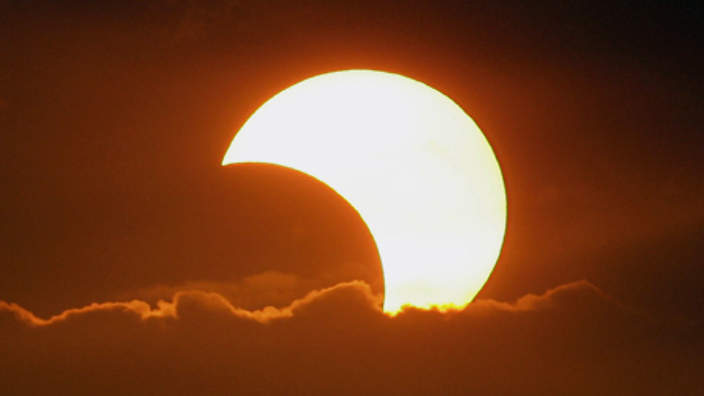

What Moon phase is this?
Full Moon
New Moon
Waxing Gibbous
Half Moon

What Moon phase is this?
old moon
New Moon
Far Side of the Moon
Waxing Gibbous

When is a lunar eclipse visible ?
day
night
varies


The Moon orbits Earth in a _______ direction.
clockwise
upwards
counterclockwise
downwards
What is Part 3 of Kepler's Law of Planetary Motion?
Planets orbit the sun in an elongated circular path called an ellipse.
The farther away a planet is from the Sun the longer it takes to orbit the Sun.
For every action, there is an equal and opposite reaction.
Planets seem to move faster when they are closer to the Sun and slower the farther away they are.
What is special about the length of daylight on the spring EQUINOX?
Day and night are equal
Longest day of the year
Shortest day of the year

What phase is the moon when it is at position 3?
New Moon
First Quarter
Full Moon
Last Quarter
What occurs on March 20th or 21st?
Spring Equinox
Summer Solstice
Fall Equinox
Winter Solstice

What phase is the moon when it is at position 2?
waning gibbous
waxing gibbous
waning crescent
waxing crescent
What is special about the length of daylight on the fall equinox?
Day and night are equal
Longest day of the year
Shortest day of the year
How much is the Earth tilted on its axis?
0 degrees
23.5 degrees
47.2 degrees
98.8 degrees
What causes seasons?
Tilt of the Earth on its axis
Earth's distance from the sun
Each year Earth revolves once around
Mars
Venus
the Sun
the Moon
Approximately how long does it take the moon to make one revolution around Earth?
365.25 days
27.3 days
24 hours
84 years

How long does it take the Earth to rotate once on its axis?
24 days
365 days
24 hours
28 days
What is Part 1 of Kepler's Law of Planetary Motion?
Planets orbit the sun in an elongated circular path called an ellipse.
The farther away a planet is from the Sun the longer it takes to orbit the Sun.
For every action, there is an equal and opposite reaction.
Planets seem to move faster when they are closer to the Sun and slower the farther away they are.
What is Part 2 of Kepler's Law of Planetary Motion?
Planets orbit the sun in an elongated circular path called an ellipse.
The farther away a planet is from the Sun the longer it takes to orbit the Sun.
For every action, there is an equal and opposite reaction.
Planets seem to move faster when they are closer to the Sun and slower the farther away they are.
What makes the Earth habitable?
Liquid Water
Too far from the Sun
The wrong amount of sunshine
Bad Ozone
What is a satellite?
Planet, machine, or moon that orbits a star or planet
A pile of rubbish in space
A planet that sends information to other planets
A moon that has information about other planets
What makes the Earth habitable?
Frozen Water
Too far from the Sun
The wrong amount of sunshine
Breathable Atmopshere

When the moon is at position 5, what moon phase is seen on Earth?
1st quarter
3rd quarter
full moon
new moon
What makes the Earth habitable?
Frozen Water
Too far from the Sun
A suitable amount of sunshine
Bad Ozone
Newton's Law of Universal Gravitation states in Part 2.....
For every action, there is an equal and opposite reaction.
The gravitational force decreases as distance increases.
Gravity is a force.
All objects fall at the same rate.
Which type of galaxy is a flat, rotating disk of billions of stars, gas and dust with a central concentration of stars?
Spiral
Elliptical
Irregular
Triangular

While the Earth ________ on its axis, it also ________ around the Sun.
Revolves, Rotates
Rotates, Revolves
The Earth’s orbit is an _____________ shape.
Elliptical
Rectangular
Spherical
Circular
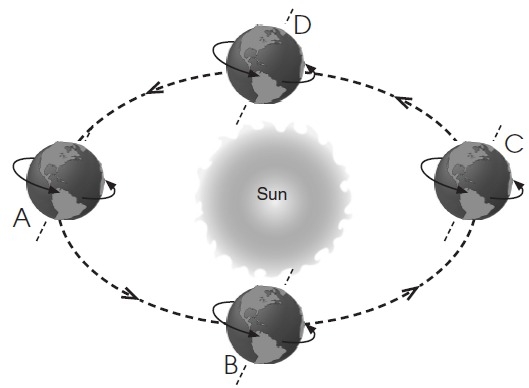
What phase is the moon when it is at position 4?
waning gibbous
waxing gibbous
waning crescent
waxing crescent
What phase is the moon when it is at position 7?
full moon
new moon
last quarter
first quarter
What phase is the moon when it is at position 6?
waning gibbous
waxing gibbous
waning crescent
waxing crescent
This type of galaxy is composed of older stars with a bright center or roundish shape.
Spiral
Elliptical
Irregular
Constellation
What phase is the moon when it is at position 8?
waning gibbous
waxing gibbous
waning crescent
waxing crescent
Another name for the North Star is __________________.
Polaris
Bettleguise
Milky Way
Andromeda
Happening once a day is known as __________________.
Diurnally
Secondary
Annually
Yearly
Happening once a year is known as ____________
Diurnally
Annually
Daily
Monthly
The _____________ is space and all the matter in it.
universe
black hole
planetesimal
dark energy
A large collection of stars held together by gravity are known as ____________.
planet
black hole
corona
galaxy

