wayground logo

Free Printable Worksheets

Font size

S
M
L
XL
Worksheets

Relationships Among Objects in Space

Total questions: 90

Worksheet time: 1hrs 21mins

Name
Class
Date
1.
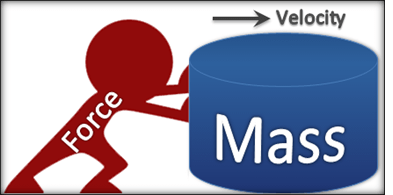
What is the formula for force?
a)
F=M/A
b)
F=A/M
c)
F=M*A
d)
F=M*F
2.

Which law is this picture illustrating?

a)

Law 1

b)

Law 2

c)

Law 3

3.

A rocket pushes burning gases DOWN which causes the rocket to launch UP. Which law is this?

a)

Law 1

b)

Law 2

c)

Law 3

4.

A sports car speeds up much faster than a dump truck when a traffic light turns from red to green. Which law is this?

a)

Law 1

b)

Law 2

c)

Law 3

5.

When a mule stops suddenly, the packages on its back continue to move forward onto the ground. Which law is this?

a)

Law 1

b)

Law 2

c)

Law 3

6.

An object in motion stays in motion and an object at rest stays at rest UNLESS

a)

acted on by a balanced force.

b)

acted on by an unbalanced force.

7.

What is the formula for the 2nd law of motion?

a)

a=lw

b)

F=m/a

c)

F=ma

8.

Force is related to mass and acceleration. Which law is this?

a)

Law 1

b)

Law 2

c)

Law 3

9.

It is much more difficult to move a dresser full of clothes than an empty dresser.

a)

Law 1

b)

Law 2

c)

Law 3

10.

A book sitting on the table does not move.

a)

Law 1

b)

Law 2

c)

Law 3

11.

A skateboarder pushes the ground BACKWARDS which causes the board to move FORWARD.

a)

Law 1

b)

Law 2

c)

Law 3

12.
"For every action, there is an equal and opposite reaction."
a)
Newton's 1st Law
b)
Newton's 2nd Law
c)
Newton's 3rd Law
d)
Newton's 4th Law
13.
Force = Mass x Acceleration
a)
Newton's 1st Law
b)
Newton's 2nd Law
c)
Newton's 3rd Law
d)
Newton's 4th Law
14.
"An object in motion (or at rest) will to stay in motion (or at rest) until an outside force acts upon it."
a)
Newton's 1st Law
b)
Newton's 2nd Law
c)
Newton's 3rd Law
d)
Newton's 4th Law
15.
The tendency of an object to resist changes in its motion is...
a)
inertia
b)
force
c)
acceleration
d)
velocity
16.
Any push or pull on an object.
a)
force
b)
velocity 
c)
inertia
d)
momentum
17.
The force that opposes motion between two surfaces in contact with each other.
a)
inertia
b)
friction
c)
momentum
d)
gravity
18.
The force of attraction between all matter.
a)
inertia
b)
friction
c)
net force
d)
gravity
19.
A force that opposes motion between a surface in contact with the atmosphere.
a)
air resistance
b)
gravity
c)
momentum
d)
terminal velocity
20.
Mass x acceleration = ?
a)
force
b)
inertia
c)
momentum
d)
velocity
21.
In the picture, the blocks are flying out of the truck based on which of Newton's laws?
a)
Newton's 1st Law
b)
Newton's 2nd Law
c)
Newton's 3rd Law
d)
Newton's 6th Law
22.
To compare the two pictures would require...
a)
Newton's 1st Law
b)
Newton's 2nd Law
c)
Newton's 3rd Law
d)
Newton's 11th Law
23.

When an unbalanced force acts on an object, the force ______________________.

a)

changes the motion of the object

b)

is cancelled by another force

c)

does not change the motion of an object

d)

is equal to the weight of the object

24.

According to Newton’s second law of motion, force is equal to mass times ______________________.

a)

inertia

b)

weight

c)

acceleration

d)

direction

25.
What law is best described by inertia?
a)
1st
b)
2nd
c)
3rd
26.

The picture is an example of Newton's...

a)

1st Law

b)

2nd Law

c)

3rd Law

27.

The picture is an example of Newton's...

a)

1st Law

b)

2nd Law

c)

3rd Law

28.

The picture is an example of Newton's...

a)

1st Law

b)

2nd Law

c)

3rd Law

29.
An object at rest will _______ if no outside forces are applied.
a)
Stay at rest
b)
Increase Velocity
c)
Decrease Mass
30.
A greater applied force is required to move an object with a greater mass than one with a smaller mass.
a)
True
b)
False
31.
A crumpled piece of paper hits the ground before a flat sheet of paper because
a)
the acceleration of gravity is greater on the  crumpled paper.
b)
there is more air resistance against the flat paper.
c)
the crumpled paper is more massive
d)
the crumpled paper is less massive.
32.
According to Newton’s first law of motion, a moving object that is not acted on by an unbalanced force will
a)
remain in motion.
b)
eventually come to a stop.
c)
change its momentum.
d)
accelerate.
33.
A sled sliding on a flat, icy surface with a constant velocity is best described by
a)
Newton’s first law of motion for objects at rest.
b)
Newton’s first law of motion for objects in motion.
c)
Newton’s second law of motion.
d)
Newton’s third law of motion.
34.
How does Newton’s third law explain how a rocket takes off?
a)
The rocket’s acceleration is positive, while the gasses acceleration is negative but the direction is the same. 
b)
The rocket is at rest until ignition.
c)
The hot gasses move in one direction, while the rocket moves in the opposite direction but with equal force.
35.
Acceleration is caused by a force acting on a mass.
a)
Newton’s first law of motion
b)
Newton’s second law of motion
c)
Newton’s third law of motion
36.
For a force on an object there is an equal and opposite force.
a)
Newton’s first law of motion
b)
Newton’s second law of motion
c)
Newton’s third law of motion
37.
Without any force to change it, an object at rest stays at rest and an object in motion stays in motion
a)
Newton’s first law of motion
b)
Newton’s second law of motion
c)
Newton’s third law of motion
38.
A greater applied force is required to move an object with a greater mass than one with a smaller mass.
a)
True
b)
False
39.
What is the definition of "weight"?
a)
measure of the force of gravity on your body
b)
the time it takes to get on a ride 
c)
the amount of matter in an object
d)
the size of an object
40.
A measure of how much matter an object has is--
a)
weight
b)
gravity
c)
mass
d)
volume
41.
The weight of an object _________ as it moves away from the center of Earth.
a)
increases
b)
stays the same
c)
triples
d)
decreases
42.
The mass of an object ___________ as it moves away from the center of Earth
a)
stays the same
b)
decreases
c)
increases
d)
doubles
43.

On which celestial object (outer space) would your mass be the greatest?

a)

Earth

b)

Jupiter

c)

Sun

d)

Your mass doesn't change on different celestial objects
44.
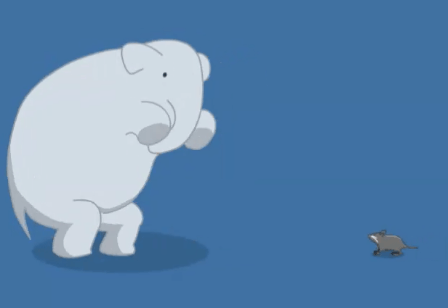
Which objects have a STRONG force of gravity?
a)
Objects with GREATER mass, like elephants
b)
Objects with LESS mass, like mice
45.
The force of gravity acting on an object is the object's ______.
a)
mass
b)
matter
c)
weight 
d)
friction 
46.
The amount of matter in an object is 
a)
pressure
b)
weight
c)
mass
d)
force
47.
Which of the following never changes no matter where in the universe?
a)
weight
b)
force
c)
mass
d)
pounds
48.
A person would weigh less on on the Moon than on the Earth because . . .
a)
Moon has more mass, and therefore more gravity
b)
Moon has less mass, and therefore more gravity
c)
Moon has more mass, and therefore less gravity
d)
Moon has less mass and therefore less gravity
49.
If Earth's mass was cut in half, what would happen to your mass?
a)
increase because gravitational force increases
b)
decrease because gravitational force decreases
c)
decrease because gravitational force increases
d)
nothing, mass is not affected by gravitational force
50.
What does this tool measure?
a)
weight
b)
meters
c)
mass
d)
force
51.
What does this tool measure?
a)
weight
b)
meters
c)
mass
d)
force
52.
What best describes the mass and weight of a person as they move around the universe?
a)
mass and weight changes
b)
Mass and weight stays constant
c)
weight remains constant, mass changes
d)
Mass stays constant, weight changes
53.
What force causes objects falling near Earth's surface to slow down?
a)
Gravity
b)
Air Resistance
c)
Centripetal Force
d)
Newtons
54.
If a bowling ball and a feather were dropped at the same time, in a room with no air resistance (vacuum), which object will hit the ground first?
a)
Bowling Ball
b)
Feather
c)
Both would hit at the same time
d)
Neither one would hit the ground because air is what pushing things down.
55.
What is a PUSH or PULL of an object?
a)
Motion
b)
Force
c)
Friction
d)
Gravity
56.
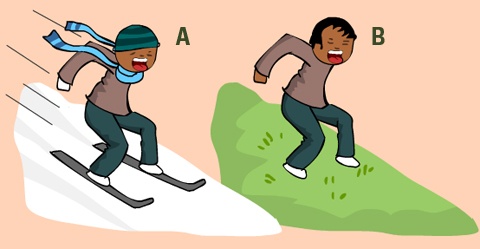
Why is it harder for the boy in Image B to get down the hill?
a)
Motion
b)
Friction
c)
Work
d)
Displacement
57.

Why does a rolling ball stop?

a)

Gravity

b)

Friction

c)

Waterfalls

d)

Sand

58.
1.  It is easier to ride a bicycle down a hill than to ride up a hill because _______ helps the bicycle move down the hill. 
a)
gravity
b)
friction
c)
rotation
59.
A greater applied force is required to move an object with a greater mass than one with a smaller mass.
a)
True
b)
False
60.
True or False: Your hypothesis can never be wrong.
a)
True
b)
False
61.
Should experiments be repeated over and over to see if the results are the same each time?
a)
yes
b)
no
62.

Mrs. Gibson creates an experiment with different heights of ramps to see which height makes a toy car travel farther. What is the independent variable?

a)

Size of the car

b)

Height of the ramp

c)

Distance the car travels

d)

Surface of the ramp

63.

Students roll toy cars down the same ramp with different coverings like carpet, foil, and sandpaper. What are they trying to test?

a)

How does the height of a ramp affect the distance a car will roll?

b)

How does the mass of the car affect the distance a car will roll?

c)

How does the surface of a ramp affect how fast a car will travel?

d)

How does the surface of a ramp affect the distance a car will roll?

64.

In order to test friction, what is needed for the investigation?

a)

Several ramps of different heights

b)

Several cars of different masses

c)

Several ramps with different surfaces

d)

Several cars of different speeds

65.

Scientists form _________ hypothesis to answer questions.

a)

accurate

b)

short

c)

mathematical

d)

testable

66.

Scientists ___________ experiments to make sure the results are accurate.

a)

perform

b)

repeat

c)

conclude

d)

communicate

67.

Before a scientific theory is accepted and supported, it has

a)

been tested by only one scientist.

b)

been published in scientific journals.

c)

been tested many times by different scientists.

d)

been approved by the International Committee of Scientists.

68.
Scientific theories can be tested.
a)
True
b)
False
69.
Scientific theories are based on
a)
general assumptions of how systems work.
b)
mathematical principles that can be proven true.
c)
large amounts of data collected over time.
d)
observations from within only one scientific discipline.
70.

Science can prove anything, solve any problem, or answer any question.

a)

True

b)

False

71.

When writing you hypothesis, what information follows IF?

a)

dependent variable

b)

how you know it will happen

c)

independent variable

d)

anything

72.

When writing a hypothesis, what information do you fill in after THEN?

a)

dependent variable

b)

independent variable

c)

how you know it will happen

d)

anything good

73.

____________ is the ability to do work or cause change.

a)

Energy

b)

Force

c)

Friction

d)

Motion

74.

Energy in motion is ____________ energy.

a)

Potential

b)

Energy

c)

Kinetic

d)

Friction

75.

The faster an object moves, the ________ kinetic energy it has.

a)

more

b)

less

76.

__________ energy is stored energy.

a)

Potential

b)

Kinetic

c)

Force

d)

Gravity

77.

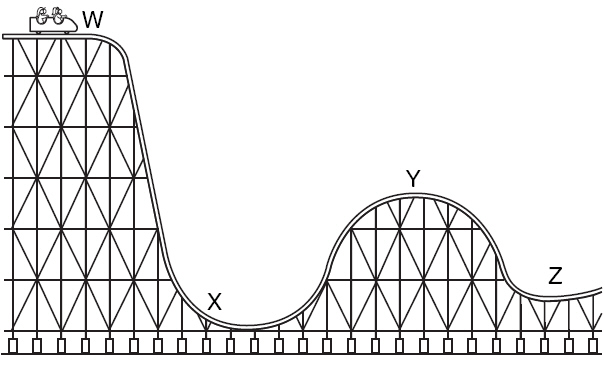
At which point is potential energy greatest?

a)

W

b)

X

c)

Y

d)

Z

78.

What kind of energy is in a moving skateboard?

a)

Potential

b)

Kinetic

79.

What energy does a rock at the edge of a cliff have?

a)

Potential

b)

Kinetic

80.

Which is the best example of an object having kinetic energy?

a)

a car parked on a steep hill

b)

a tennis ball rolling across the court

c)

a picture hanging on the wall

d)

a piece of coal before it's burned

81.

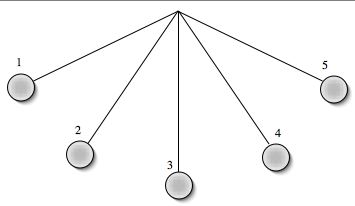
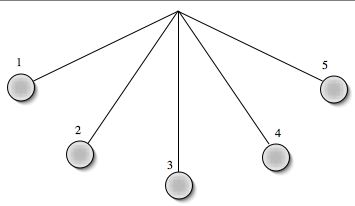
When a pendulum swings, at which point is kinetic energy greatest?

a)

1

b)

2

c)

3

d)

4

82.

What is happening to the potential energy between position 1 to 3?

a)

Decreasing

b)

Increasing

c)

Stays the same

83.

The Law of Conservation of Energy states that energy cannot be ________ or ________, but it can change from one form to another.

a)

created, destroyed

b)

gravity, force

c)

heat, created

84.

What are the two factors that affect kinetic energy?

a)

time and energy

b)

power and mass

c)

mass and velocity (speed)

d)

time and work

85.

Which of the following is an example of kinetic energy decreasing as the potential energy increases?

a)

a person parachuting out of a plane

b)

a car racing around an oval track

c)

a person skiing down a hill

d)

a person walking up a hill

86.

At which point is the kinetic energy the greatest?

a)

W

b)

X

c)

Y

d)

Z

87.

What position has the least amount of potential energy?

a)

W

b)

X

c)

Y

d)

Z

88.

In order to INCREASE the potential energy of an object, you need to:

a)

put the object lower to the ground

b)

raise the object higher

89.
The scientist who is most famous for developing the Laws of Motion is _____.
a)
Albert Einstein
b)
Stephen Hawking
c)
Sir Isaac Newton
d)
Galileo Galilei
90.
 What is the unit called that measures force?
a)
Isaac
b)
Yee
c)
Newton
d)
kilogram