
 Worksheets
crude oil and polymers
Total questions: 47
Worksheet time: 24mins
Crude oil is made up of:
Ethane
Butane
A mixture of different hydrocarbons
Extremely large hydrocarbons which are broken up once extracted
A fraction of crude oil is made up of:
Hydrocarbons of similar chain lengths
Numbers
Large hydrocarbons
Alkenes only
Different fractions in crude oil are separated by:
Cracking
Fractional Distillation
Filtration
Crystalisation
Shorter hydrocarbons have:
Higher boiling points
Lower boiling points
Gases/LPG are used for:
Fuel in cars
Fuel for large ships
Roof and road surfacing
Domestic heating and cooking
Petrol is used for:
Fuel in cars
Fuel in aircraft
Domestic heating and cooking
Road surfacing
Kerosene (paraffin) is used for:
Fuel for cars
Domestic heating and cooking
Fuel in aircraft
Fuel for large ships and in power stations
Diesel oil is used for:
Fuel in cars
Fuel in aircraft
Road and roof surfacing
Fuel in some cars and larger vehicles
Fuel oil is used for:
Fuel in some cars and larger vehicles
Fuel for large ships and in some power stations
Roof and road surfacing
Fuel for cars
Bitumen is used for:
Fuel for large ships and in some power stations
Roof and road surfacing
Fuel in aircraft
Fuel in cars

What is the structure shown?
Methane
Propane
Ethane
Butane

Where do long chain hydrocarbons collect?
At the top
In the middle
At the bottom

Where do short chain hydrocarbons collect?
At the top
In the middle
At the bottom
What does viscosity tell you about a hydrocarbon?
How easy it is to ignite
How runny it is
What is boiling point is
The shorter the hydrocarbon, the more viscous it is
True
False
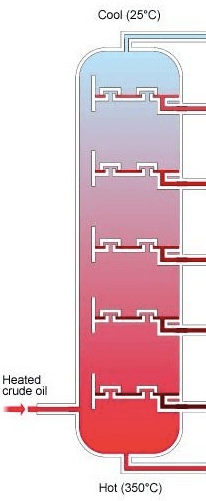
What process happens as the crude oil enters the fractionating column?
Evaporation
Condensation
Combustion
What process happens at each level in the fractionating column?
Evaporation
Condensation
Combustion
Alkenes have the general formula:
CnH2n
CnH2n+1
CnH2n+2
CnHn
Alkanes have the general formula:
CnH2n
CnH2n+1
CnH2n+2
CnHn
What term describes alkane molecules that contain C-C single bonds?
saturated
unsaturated
What are the 2 products of complete combustion?
carbon dioxide + hydrogen
carbon dioxide + water
carbon monoxide + water
carbon monoxide + hydrogen
What are the products of incomplete combustion?
carbon monoxide
water
carbon
hydrogen
What does a fuel react with when it burns?
oxygen
water
carbon dioxide
methane
What is the term given to the process by which longer chain hydrocarbons are broken down into shorter length alkanes and alkenes?
fractional distillation
evaporation
cracking
polymerisation
What conditions are needed for cracking?
high temperature
high pressure
catalyst
low temperature
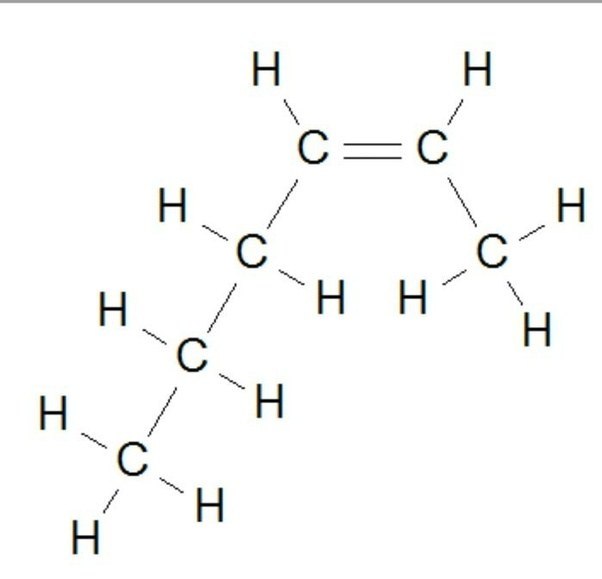
Name the following hydrocarbon
butane
hexane
heptane
hexene
C10H22 --> C5H12 + C3H6 + ?
C2H4
C3H4
CO2
CH4
When testing for alkenes (unsaturation) bromine water turns from...
orange --> blue/black
colourless --> pink
orange --> colourless
orange --> clear
Large molecules made up of small monomers are called
polymers
peptides
peptones
monomers
Monomers of ethene in thousand numbers react together in addition polymerization to produce
polyamides
polyesters
poly(ethene)
all of them

What is the name of the addition polymer?
poly(ethene)
poly(propene)
poly(butene)

What is the name of the addition polymer?
poly(bromoethane)
poly(bromoethene)
poly(bromoethanol)

Identify the type of polymer involved
addition polymer
polyester
polyamide

Identify the type of polymer involved
addition polymer
polyester
polyamide

Identify the type of polymer involved
addition polymer
polyester
polyamide

Identify the type of polymer involved
addition polymer
polyester
polyamide
What is the name given to the small molecules that join together to make a polymer
(a)
What would the polymer formed from ethene monomers be called?
polyethene
poly(ethene)
poly(propene)
polyene
Which one of these could polymerise to make poly(propene)


What are the key points to remember when writing an equation for polymerisation?
Monomer has a C=C
Repeat Unit has C-C
Brackets (with stalks)
n before monomer and after bracket of repeat unit

What monomer forms this polymer chain?


What monomer forms this polymer chain?
Which one of these monomers would form poly(1,2-difluoroethene)?


Polymerisation in which double bonds in monomers break and a polymer with single bonds only is called...
(a)

True of false - this is the repeat unit for poly(propene)?
True
False

