wayground logo

Free Printable Worksheets

Font size

S
M
L
XL
Worksheets

acid + base

Total questions: 180

Worksheet time: 4hrs 13mins

Name
Class
Date
1.

Stronger acids have a pH closer to...

a)

7

b)

0

c)

14

d)

9

2.

Weaker bases have a pH closer to...

a)

8

b)

0

c)

14

d)

4

3.

A pH level of 7 indicates

a)

acid

b)

base

c)

neutral

d)

none of the following

4.

The pH scale is a range from:

a)

1-7

b)

0-14

c)

1-5

d)

1-14

5.
A(n) ______ is a substance with a pH less than 7
a)
Acid
b)
Alkaline
c)
Base
d)
Buffer
6.
A solution with a pH of 8.6 would be...
a)
Acid
b)
Base
c)
Neutral
d)
Acid and Base
7.

Which property is not associated with acids?

a)

Sour taste

b)

strong acids can burn you

c)

turns litmus paper blue

d)

reacts with metals

9.
Ranging from 0 to 14, a pH value indicates how acidic or basic a solution is.  Which of these pH values would be a strong acid?
a)
2
b)
6
c)
9
d)
13
9.
Ranging from 0 to 14, a pH value indicates how acidic or basic a solution is.  Which of these pH values would be a strong acid?
a)
2
b)
6
c)
9
d)
13
10.

What type of paper is used to test for acids and bases?

a)

Red paper

b)

Blue paper

c)

Lined paper

d)

Litmus paper

11.
Accepts a proton (H+ hydrogen ion) 
a)
Lewis Base
b)
Arrhenius Base
c)
Bronstead Lowry Base
d)
Lewis Acid 
12.
Accepts a pair of electrons
a)
Lewis Acid
b)
Arrhenius Acid 
c)
Bronsted Lowry Acid 
d)
Arrhenius Base
13.
Forms a OH- hydroxide ion
a)
Lewis Base
b)
Arrhenius Base
c)
Bronsted Lowry Base
d)
Bronsted Lowry Acid
14.
Select the name for the following acid: H3PO4
a)
Phosphoric acid
b)
Phosphorous acid
c)
Hydrophosphoric acid
15.
Select the formula for the following acid: hydroiodic acid
a)
HI
b)
HIO4
c)
HIO3
d)
H2I
16.
Select the name of the following acid: HCl
a)
Hydrochloric acid
b)
Chlorous acid
c)
Chloric acid
17.

The table shows the pH of several solutions. Which solution has the greatest concentration (amount) of H+ ions?

a)

vinegar

b)

milk

c)

water

d)

bleach

18.
Which of these will react with zinc to produce hydrogen gas?
a)
sulfuric acid
b)
sodium sulfate
c)
ammonium hydroxide 
d)
sodium hydroxide 
19.

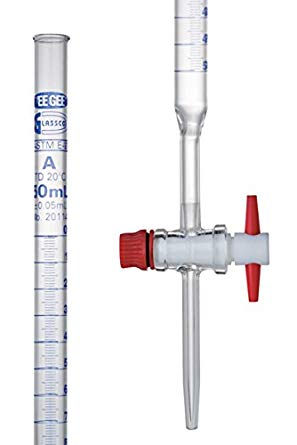
What technique is shown in this image?

a)

filtration

b)

buretting

c)

indicating

d)

titration

20.
pH less than 7.
a)
Acids
b)
Bases
c)
All
21.
What is the pH of a 1 x 10⁻⁸ M solution of HNO3?
a)
8
b)
6
c)
7
d)
7.5
22.
A  pH and a pOH will add up to:
a)
0
b)
7
c)
14
d)
1.0 x 10⁻¹⁴
23.
Select the name for the following acid: HNO3
a)
Nitric acid
b)
Nitrous acid
c)
Hydronitric acid
24.
Select the formula for the following acid: hydrobromic acid
a)
HBr
b)
HBrO4
c)
HBrO3
25.
What is the hydrogen ion concentration if the [OH-] = 1 x 10⁻⁹ M?
a)
1 x 10⁻⁵ M
b)
1 x10-23 M
c)
100000 M
d)
1 x10⁵ M
26.
What is the pH of a 0.111 M nitric acid solution?
a)
9.01 x 10⁻¹⁴ 
b)
13.0
c)
0.955
d)
0.111
27.
What is the molarity of a nitric acid solution if 15.00 mL of the solution is titrated with 32.25 mL of a 0.100 M solution of calcium hydroxide?
a)
0.430 M
b)
4.61 x 10⁻⁴ M
c)
0.0215 M
d)
2.33 M
28.
_________ acids are excellent conductors of electricity
a)
electrolyte
b)
strong
c)
weak
d)
basic
29.
What is the pH range of a base?
a)
0-6.9
b)
7.1-14
c)
0-14
d)
7
30.
What is the pH range of an acid?
a)
0-6.9
b)
7.1-14
c)
0-14
d)
7
31.
What is the pH of a 0.505 M nitric acid solution?
a)
0.297
b)
1.98 x 10⁻¹⁴
c)
13.7
d)
1.98 x 10¹⁴
32.

The pH of a solution is 2.0. What is the [OH-] concentration?

a)

1x10-12M

b)

12 M

c)

1x10⁻²M

d)

2 M

33.
What is the conjugate acid in the following equation?
a)
PO43- 
b)
HNO3 
c)
NO3- 
d)
HPO42-
34.
What is the conjugate base of HCO3-?
a)
HCO3-
b)
H2CO3-
c)
H2CO3
d)
CO32-
35.
What substances increase OH- ion concentrations when dissolved in water?
a)
Brønsted-Lowry Acids
b)
Brønsted-Lowry Bases
c)
Arrhenius Acids
d)
Arrhenius Bases
36.
What substances increase H+ ion concentrations when dissolved in water?
a)
Brønsted-Lowry Acids
b)
Brønsted-Lowry Bases
c)
Arrhenius Acids
d)
Arrhenius Bases
37.
Which accepts protons?
a)
Brønsted-Lowry Acids
b)
Brønsted-Lowry Bases
c)
Arrhenius Acids
d)
Arrhenius Bases
38.
If the [H+] of a solution is 1 x 10⁻² mol/L the pH is
a)
2
b)
12
c)
-2
d)
1
39.
If the pH of a solution is 5 the [H+] is
a)
1.0 x 10 M
b)
1.0 x 10 M
c)
5.0 x 10 M
d)
1.0 x 10⁻⁵  M
40.
If the pH of a solution is 5.6 the pOH is
a)
6.5
b)
12.4
c)
8.4
d)
5.6
41.

What is this piece of apparatus called

a)

Pipette

b)

Burette

c)

Janette

d)

Cuvette

42.
The reaction of hydrochloric acid (HCl) with ammonia (NH3) is described by the equation:
HCl + NH3 → NH4Cl
A student is titrating 100.0 mL of 0.10 M NH3 with 0.5 M HCl. How much hydrochloric acid must be added to react completely with the ammonia?
a)
20.0mL
b)
500.0mL
c)
100.0mL
d)
5.0mL
43.
A 50.0 mL sample of Ca(OH)2 is neutralized by 300.0 mL of HCl solution with a pH of 1.3. Calculate the molarity of the Ca(OH)2 solution.
a)
1.0 M
b)
0.50 M
c)
0.15 M 
d)
0.30 M
44.
If it takes 50 mL of 0.5 M Ca(OH)2 to neutralize 125 mL of sulfuric acid, what is the concentration of the acid?
a)
0.2 M
b)
5 M
c)
0.5 M
45.
What is the molarity of a NaOH solution if 11.6 mL of 3 M HCl was used to neutralize 25 mL of NaOH?
a)
1.392 M
b)
0.155 M
c)
0.718 M
46.
What is the long graduated piece of equipment called?
a)
Pipette
b)
Tube
c)
Burette
d)
Measuring Cylinder
47.
Acid + Base ₋--> 
a)
salt + hydrogen
b)
salt + water
c)
salt + carbon dioxide + water
d)
salt
48.
HCl + NaOH → 
a)
NaH + ClOH
b)
NaCl + H2
c)
NaCl + H2O
d)
NaCl + Cl2
49.
What indicator is commonly used in titrations?
a)
Phenolphthalein
b)
Bromothymol Blue 
c)
Litmus
d)
Universal 
50.
What does pH measure?
a)
Amount of Oxygen Ions
b)
Amount of Hydrogen Ions
c)
The amount of salt in a solution
d)
The density
51.
Forms hydroxide ions in water
a)
Acids
b)
Bases
c)
All
52.
Which is the stronger acid?
a)
pH 1
b)
pH 4
c)
pH 8
d)
pH 13
53.
What is the endpoint of a titration
a)
Where the amount of acid and base are balanced according to the equation
b)
Where there is no base
c)
At the end
54.
I am titrating 1M HCl with 1M NaOH.  I have 25mL of HCl. How much NaOH will I need?
a)
2.5mL
b)
5mL
c)
25mL
d)
50mL
55.
Identify the products of the chemical equation
3 LiOH + H3PO4
a)
Li3PO4 + 3 H2O
b)
LiPO4 + 3 H2O
c)
Li(PO4)3 + 3 H2O
d)
BOY + La + N2
56.
What acid and what base would you choose to prepare the salt potassium chlorate?
a)
KOH and HClO3
b)
KOH and HClO2
c)
HK and OHClO3
d)
HK and OHClO2
57.
Which of the following is a conjugate acid/base pair?
a)
HCl/OCl-
b)
H2SO4/SO42-
c)
NH4+/NH3
d)
H3O+/OH-
58.

The reaction of perchloric acid (HClO4) with lithium hydroxide (LiOH) is described by the equation

HClO4 + LiOH → LiClO4 + H2O

Suppose 100 cm3 of perchloric acid is neutralized by exactly 50.0 cm3 of 1.0 M of lithium hydroxide. What is the concentration of the perchloric acid?

a)

0.5 M

b)

50 M

c)

2.0 M

d)

1.0 M

59.

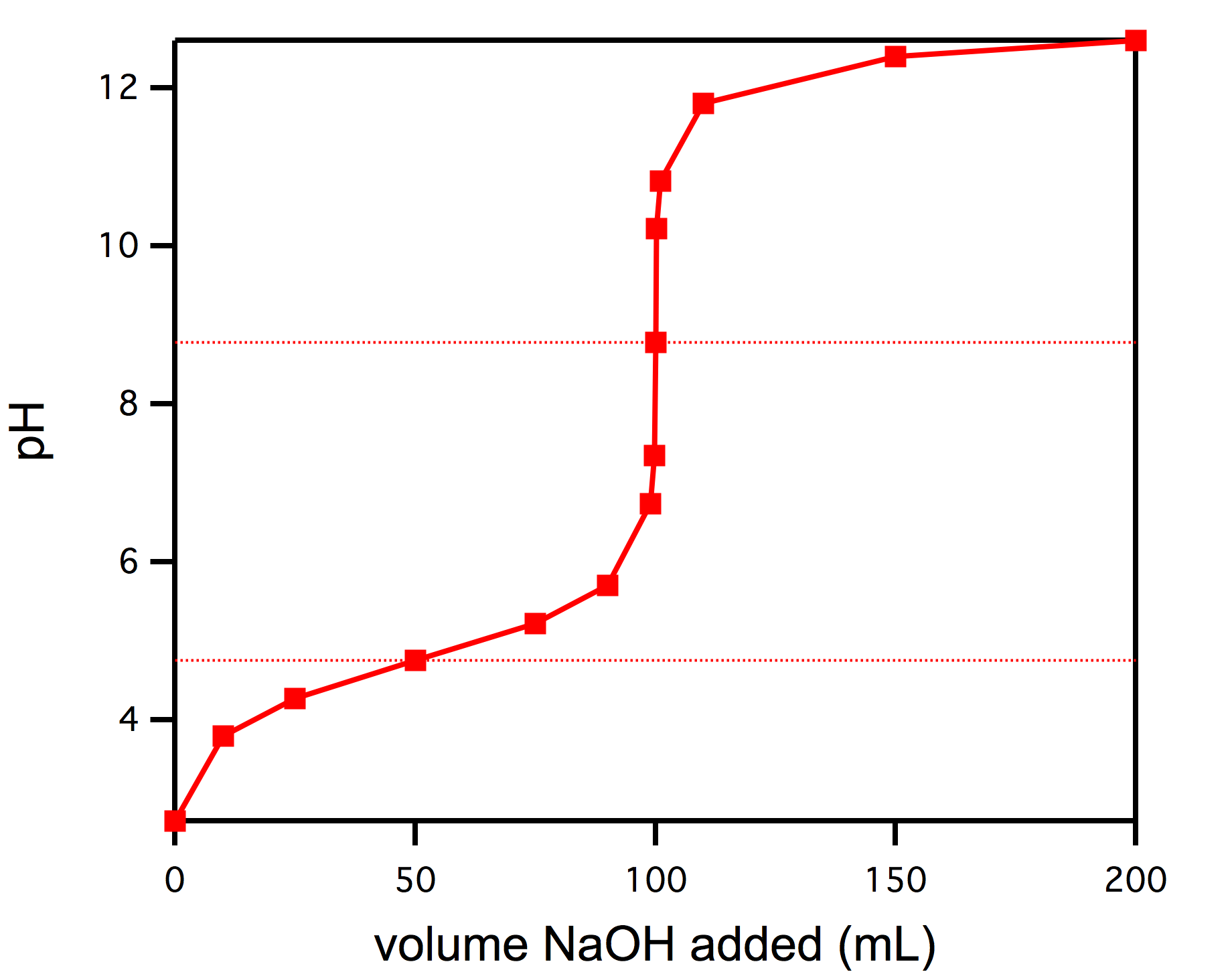
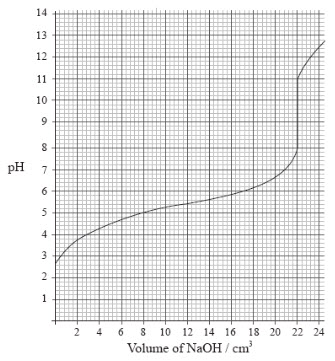
What is the pH at the equivalence point.

a)

The pH is approximately 5

b)

The pH is approximately 6

c)

The pH is approximately 8

d)

The pH is approximately 9

60.
Which type of titration is shown by this titration curve?
a)
Titration of a strong acid by a strong base 
b)
Titration of a weak acid by a strong base 
c)
Titration of a strong base by a strong acid 
d)
Titration of a weak base by a strong acid
61.
The pH at the equivalence point of the titration of a strong acid with a strong base is usually:
a)
acidic 3.9
b)
acidic 4.5
c)
neutral 7.0
d)
basic 8.2
62.

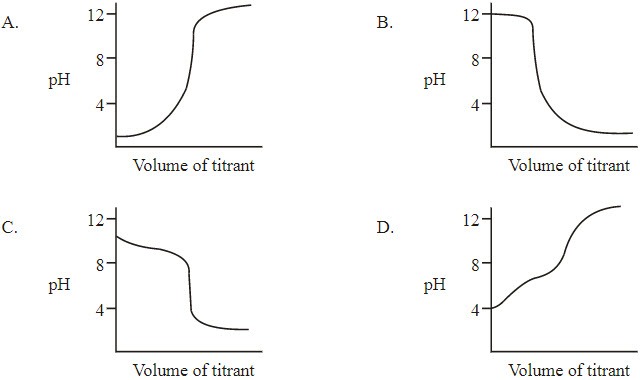
Which curve is produced by the addition of a 0.1 molL-1 strong acid to a 0.1 molL-1 weak base?

a)

A

b)

B

c)

C

d)

D

63.

CH3COOH is titrated with NaOH. Name the salt produced and its pH at the equivalence point.

a)

CH3COONa, pH at 5

b)

CH3COONa, pH at 7

c)

CH3COONa, pH at 9

d)

NaCH3COO, pH at 9

64.

Sodium Chloride crystals could be formed by titrating NaOH with

a)

HCl

b)

NaCl

c)

KOH

65.

What does the following equation represent ?

H+ + OH- --> H2O

a)

Titration

b)

Acid reaction

c)

Hydration

d)

Neutralisation

66.

When should you stop a titration?

a)

When you have added equal volumes

b)

When the indicator changes colour

c)

When you run out of solution

d)

When the solution is no longer acidic

67.
What is the endpoint of a titration
a)
Where the amount of acid and base are equal as shown by a colour change 
b)
Where there is no base
c)
When the volume of base in the burette is used up 
d)
When there is no acid
68.

What technique is shown in this image?

a)

filtration

b)

buretting

c)

indicating

d)

titration

69.
Acids react with
a)
water to produce bases and salts
b)
salts to produce bases and water
c)
neither bases, salts nor water
d)
bases to produce salts and water
70.
Which of the following word pairs correctly completes the sentence below?
_______ are corrosive substances characterized as having a strong smell, a sour taste, and a _______.
a)
Acids; pH less than 7
b)
Acids; pH greater than 7
c)
Bases; pH greater than 7
d)
Bases; pH less than 7
71.
What is the pH of an HCl solution if [H+] = 0.01?
a)
2
b)
1
c)
0,01
d)
3
72.

What is the only substance with a neutral pH of 7?

a)

Milk

b)

Orange Juice

c)

Pure water

d)

Bleach

73.

Ammonia has a pH of 11. Ammonia is __________.

a)

an acid

b)

a base

c)

an element

d)

a metal

74.

In a titration, the ____ is the point at which the indicator changes color and stays that way.

a)

acid point

b)

endpoint

c)

pH point

d)

standard point

75.

In a titration, the ____ is the solution for which the concentration is known.

a)

indicator

b)

normal solution

c)

hydrate

d)

standard solution

76.

A process that uses a solution of known concentration to find the concentration of another solution is called ____.

a)

hydration

b)

ionization

c)

neutralization

d)

titration

77.

____ change color in the presence of an acid or a base.

a)

Acids

b)

Buffers

c)

Glycerins

d)

Indicators

78.

A base that only partly ionizes in a solution is a ____ base.

a)

weak

b)

dilute

c)

concentrated

d)

strong

79.

____ of a solution refers to the ease with which an acid or base forms ions in solution.

a)

Acidity

b)

pH

c)

Concentration

d)

Strength

80.

Blood contains compounds called ____ that allow small amounts of acids or bases to be absorbed without harmful effects.

a)

buffers

b)

enzymes

c)

precipitates

d)

esters

81.
Which type of titration is shown by this titration curve?
a)
Titration of a strong acid by a strong base 
b)
Titration of a weak acid by a strong base 
c)
Titration of a strong base by a strong acid 
d)
Titration of a weak base by a strong acid
82.
The pH at the equivalence point of the titration of a strong acid with a strong base is usually:
a)
acidic 3.9
b)
acidic 4.5
c)
neutral 7.0
d)
basic 8.2
83.
Buffer is defined as
a)
ability to resist pH change
b)
ability to prevent pH from decreasing
c)
ability to resist a pH increase
d)
ability to resist pH change when small amount of acid added
84.
Acidic buffer is made up of
a)
weak acid and weak base
b)
weak acid and its conjugate salt
c)
weak acid and its conjugate base
d)
strong acid and its conjugate base
85.
Basic buffer is made up of
a)
weak base and weak acid
b)
weak base and its conjugate salt
c)
weak base and its conjugate acid
d)
strong base and its conjugate acid
86.
Which combination will form a buffer solution?
a)
100ml of 0.1M HCI with 50ml of 0.1M NaOH
b)
100ml of 0.1M CH3COOH with 50ml of 0.1M NaOH
c)
50ml of 0.1M HCI with 100ml of 0.1M NaOH
d)
50ml of 0.1M CH3COOH with 100ml of 0.1M NaOH
87.

the more H+ ions the

a)

stronger the acid

b)

weaker the acid

c)

it neutralizes

88.
According to the pH range which substance is more acidic than lemon juice
a)
Hydrochloric acid
b)
cabbage
c)
milk
89.
If an acid is combined with a base of equal strength, the result will most likely be
a)
a neutral solution.
b)
a stronger acid.
c)
impossible to tell without testing the pH.
d)
a stronger base
90.

What might happen if buffers did not exist within the human body?

a)

Our blood and other bodily fluids might become too acidic or basic.

b)

Our stomach acid would not be able to break down food.

c)

We would not be able to process glucose within our cells.

d)

We would not be able to inhale oxygen into our lungs.

91.

Why were the biological samples generally good buffers?

a)

Water is a poor buffer

b)

They need to maintain a pH of 8.0 at all times

c)

All living organisms need to maintain homeostasis in terms of pH

d)

The samples came in liquid form

92.

Mixtures that would be considered buffers include which of the following?

a)

0.10 M HCl + 0.10 M NaCl

b)

0.10 M HF + 0.10 M NaF

c)

0.10 M HBr + 0.10 M NaBr

d)

0.10 M HI + 0.10 M NaI

93.

What does a buffer do?

a)

Keeps the pH of a solution relatively constant

b)

Keeps the salt concentration of a solution relatively constant

c)

Keeps the cation concentration constant

d)

Keeps the anion concentration constant

94.
Which mixtures act as buffer solutions?
a)
I and II
b)
I and III
c)
II and III
d)
I, II and III
95.
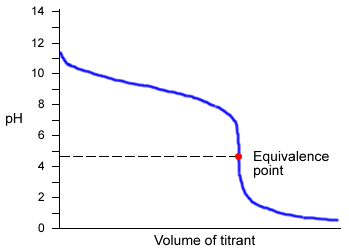
Which acid base pair produce the titration curve shown below?
a)
HCI + KOH
b)
HCI + NH3
c)
CH3COOH + KOH
d)
CH3COOH + NH3
96.
A sample of sulfuric acid is titrated with 0.24 M sodium hydroxide. The titration curve appears below. How much NaOH is needed to reach the equivalence point?
a)
11 mL NaOH
b)
20 mL NaOH
c)
22 mL NaOH
d)
40 mL NaOH
97.
What do acids and bases have in common?
a)
They both eat away at metal.
b)
They can both conduct electricity.
c)
They both have a sour taste.
d)
They both form positively charged ions when dissolved in water.
98.

In a test of pH levels, a baking soda has a pH of 9 and bleach has a pH of 12. What is true about there relationship?

a)

Both of the solution are Bases

b)

Both of the solution are Acids

c)

The Baking soda is an acid and the Bleach is a base

d)

The baking soda is a base and the Bleach is an Acid.

99.

A base is a substance

a)

That releases OH- ions when dissolved in water

b)

That releases H+ ions when dissolved in water

c)

Does not release any ions when dissolved in water

d)

None of the above

100.

An acid

a)

is a substance that releases H+ ions when dissolved in water

b)

is a substance that does not release any ions when dissolved in water

c)

is a substance that releases OH- when dissolved in water

d)

releases an equal amount of OH- and H+ ions when dissolved in water

101.
A solution has a pH of 7.0.  What would happen to the pH if H ions were added?
a)
pH would go up
b)
pH would go down
c)
pH would stay the same
d)
None of these
102.
A solution has a pH of 7.0.  What would happen to the pH if OH ions were added?
a)
pH would go up
b)
pH would go down
c)
pH would stay the same
d)
None of these
103.

What does pH measure?

a)

the amount of hydrogen (H+) ions

b)

the amount of hydroxide (OH-) ions

c)

amount of water

d)

all of the above

104.

Which of the following is the strongest acid?

a)

1

b)

5

c)

3

d)

8

105.

Which of the following is the strongest base?

a)

4

b)

14

c)

7

d)

15

106.
If the [H+] of a solution is 1 x 10⁻² mol/L the pH is
a)
2
b)
12
c)
-2
d)
1
107.
If the pH of a solution is 5 the [H+] is
a)
1.0 x 10 M
b)
1.0 x 10 M
c)
5.0 x 10 M
d)
1.0 x 10⁻⁵  M
108.
A  pH and a pOH will add up to:
a)
0
b)
7
c)
14
d)
1.0 x 10⁻¹⁴
109.
If the [H3O+] of a solution is 1 x 10⁻⁸ mol/L the [OH-] is
a)
1.0 x 10⁻⁶
b)
1.0 x 10⁶
c)
1.0 x 10⁻⁸
d)
1.0 x 10⁸
110.
If the [OH-] of a solution is 2.7 x 10⁻⁴ mol/L the pOH of the solution is
a)
10.44
b)
3.56
c)
1.00
d)
-4.43
111.
A solution with a [H+] of 9.4 x 10⁻⁵ mol/L is said to be
a)
Acidic
b)
Basic
c)
Neutral
d)
negative number, no solution.
112.
If the [H+] of a solution is 6.8 x 10⁻⁹ mol/L the pH is
a)
8.17
b)
8.2
c)
9.99
d)
8.62
113.
if the [H+] of a solution is 8.4 x 10⁻³ mol/L the pOH of the solution will be
a)
2.08
b)
11.92
c)
1.02
d)
12.98
114.
if a solution has a pOH of 5.2 the [OH-] of the solution is
a)
6 x 10 -6 M
b)
6.3 x 10 -6 M
c)
1.58 x 10⁻⁵ M
d)
2 x 10⁻⁵ M
115.
Limes have a [H3O+] of 1.3 x 10⁻² mol/L.  Their pOH is
a)
1.89
b)
12.11
c)
1.03
d)
12.97
116.

What is true when acids and bases neutralize each other.

a)

The concentration of H+ and OH- is the same

b)

Salt Water is produced

c)

[H+] = [OH-]

d)

[H+] > [OH-]

117.
Bases will turn litmus paper __________, while acids will turn litmus paper __________.
a)
blue.....red
b)
red.....blue
c)
pink.........colourless
d)
colourless..........pink
118.
An indicator will ______________ when it is in contact with an acid or base
a)
Bubble
b)
Form a new substance
c)
Change color
d)
Stay the same color
119.
The pH of a weak acid would be:
a)
1-2
b)
5-6
c)
8-9
d)
12-13
120.
How would you classify the substance being tested?
a)
Acid
b)
Base
c)
Both
d)
Neither
121.

Turns indicators different colors

a)

acid

b)

base

c)

both an acid and a base

122.

Compound starts with an "H"

a)

acid

b)

base

c)

both an acid and a base

123.

Conducts electricity (has electrolytes)

a)

acid

b)

base

c)

both an acid and a base

124.

Soap

a)

acid

b)

base

c)

an acid and a base

125.

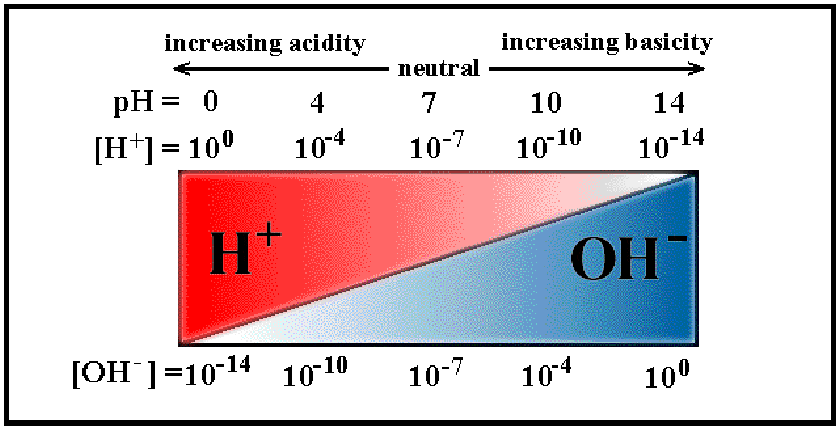
Which is the correct set of acid properties?

a)

sour taste, corrosive, change litmus from red to blue

b)

sour taste, corrosive, change litmus from blue to red

c)

sweet taste, slippery, change litmus from blue to red
d)

sour taste, slippery, change litmus from blue to red

126.

True or false: a neutral solution has equal amounts of H+ and OH-.

a)

True

b)

False

127.
What are properties of a base?
a)
Slippery, bitter, does not react with metals, pH above 7.
b)
Slippery, bitter, reacts with metals, pH below 7.
c)
Sour, reacts with metals, pH below 7
d)
Sour, reacts with metals, pH above 7.
128.
A weak acid would have a pH of...
a)
1
b)
7
c)
6
d)
14
129.
An extremely strong acid would have a pH of...
a)
1
b)
7
c)
9
d)
14
130.
Which of the following statements is correct?
a)
Blue litmus paper turns red when placed in a base.
b)
Red litmus paper turns blue when placed in a base.
c)
Blue litmus paper stays blue when placed in an acid.
d)
Red litmus paper stays red when placed in a base.
131.

NaOH is:

a)

an Arrhenius base

b)

an Arrhenius acid

c)

neither an acid nor a base

d)

both an acid and a base

132.

An Arrhenius base:

a)

donates H+

b)

accepts H+

c)

produces H+

d)

produces OH-

133.

An Arrhenius acid:

a)

donates H+ to another substance

b)

accepts H+ from another substance

c)

produces H+

d)

produces OH-

134.
If a solution is basic which ion will be more present?
a)
H+
b)
K+
c)
OH-
d)
H-
135.
Accepts a pair of electrons
a)
Lewis Acid
b)
Arrhenius Acid 
c)
Bronsted Lowry Acid 
d)
Arrhenius Base
136.

Which of the following is a hydronium ion?

a)

H+

b)

H2O

c)

OH

d)

H3O+

137.
Select the name of the following acid: HCl
a)
Hydrochloric acid
b)
Chlorous acid
c)
Chloric acid
138.

HCl is:

a)

an Arrhenius acid

b)

a Bronsted Lowry acid

c)

both an Arrhenius and Bronsted Lowry acid

d)

a base

139.

NH3 is:

a)

a Bronsted Lowry base

b)

an Arrhenius base

c)

an acid

d)

both an Arrhenius and a Bronsted Lowry base

140.

A Bronsted Lowry acid:

a)

donates H+ to another substance

b)

accepts H+ from another substance

c)

produces H+

d)

produces OH-

141.

A Bronsted Lowry base:

a)

donates H+ to another substance

b)

accepts H+ from another substance

c)

produces H+

d)

produces OH-

142.

In the equation below, what is the Bronsted Lowry base?

HCl + NH3 --> Cl- + NH4+

a)

HCl

b)

NH3

c)

Cl-

d)

NH4+

143.

An acid with three ionizable hydrogens is called

a)

monoprotic acid

b)

diprotic acid

c)

triprotic acid

d)

tetraprotic acid

144.

In ethanoic acid

a)

all the hydrogens are ionizable

b)

non of the hydrogens is ionizable

c)

only one hydrogen (bonded to oxygen) is ionizable

145.
If a solution has a [H+] of 1.2 x 10⁻⁴M what is the [OH-]?
a)
8.3 x 10⁻⁴
b)
8.3 x 10⁻¹¹
c)
1.2 x 10¹⁰
d)
1.2 x 10⁻⁴
146.
What is the conjugate acid in the following equation?
a)
PO43- 
b)
HNO3 
c)
NO3- 
d)
HPO42-
147.
What is the conjugate base in the following reaction?
a)
HCO3- 
b)
HCl
c)
 H2CO3 
d)
Cl-
148.
What is the conjugate base of HCO3-?
a)
HCO3-
b)
H2CO3-
c)
H2CO3
d)
CO32-
149.
Which accepts protons?
a)
Brønsted-Lowry Acids
b)
Brønsted-Lowry Bases
c)
Arrhenius Acids
d)
Arrhenius Bases
150.
In the reaction HCl + H2O --> H3O+ + Cl-, what is the conjugate acid?
a)
HCl
b)
H2O
c)
H3O+
d)
Cl-
151.
What is the conjugate acid to NO3? (HINT...acids contain what ion?)
a)
HNO3
b)
OH-
c)
H+
d)
NO3-2
152.

A substance that increases the concentration of hydrogen ions, H+, in an aqueous solution is called ________.

a)

Arrhenius base

b)

Conjugate acid

c)

Polytropic acid

d)

Arrhenius acid

153.

The proton donor that remains after a Brønsted-Lowry base has received a proton is called ________.

(HINT: Look on the right side of the equation)

a)

complex acid

b)

conjugate acid

c)

conjugate base

d)

polytropic base

154.

CH3COOH dissociates partially and is reversible. Why?

a)

CH3COOH is a strong acid and H3O+ is strong conjugate base

b)

CH3COO- is a weak base and CH3COOH is strong conjugate acid

c)

CH3COOH is weak acid and CH3COO- is strong conjugate base

d)

CH3COOH is a weak acid and CH3COO- is a weak conjugate base

155.

HCI dissociates completely and is irreversible. Why?

a)

HCI is a weak acid and CI- is a weak base

b)

H2O is a weak base

c)

CI- is a strong conjugate base, will not accept H+ from H3O+

d)

CI- is a weak conjugate base, will not accept H+ from H3O+

156.
CH3COOH dissociates partially and is reversible. Why?
a)
CH3COOH is a weak acid and H3O+ is strong conjugate base
b)
CH3COO- is a weak base and CH3COOH is strong conjugate acid
c)
CH3COOH is weak acid and CH3COO- is strong conjugate base
d)
CH3COOH is a weak acid and CH3COO- is a weak conjugate base
157.
NH3 dissociates partially and is reversible. Why ?
a)
NH3 is a weak acid and NH4+ is a strong conjugate base
b)
NH3 is a weak base and NH4+ is a conjugate acid
c)
NH4+ is a strong conjugate acid, donate H+ to form back NH3
d)
NH3 is a weak base and OH- is a strong conjugate acid
158.

In the equation below, what is the Bronsted Lowry conjugate base?

HCl + NH3 --> Cl- + NH4+

a)

HCl

b)

NH3

c)

Cl-

d)

NH4+

159.
Which of these is a MAJOR cause of acid rain?
a)
spraying pesticides on crops
b)
burning fossil fuels for energy
c)
dumping sewage in river systems
d)
using uranium to generate electricity
160.
An acid reacts with metal to produce 
a)
Carbon dioxide 
b)
Hydrogen gas
c)
Hydrogen gas and water 
d)
Salt and hydrogen gas 
161.
An acid reacts with a metal carbonate to produce 
a)
Salt, water and hydrogen gas
b)
Salt, water and carbon dioxide
c)
Limewater
d)
Salt and water 
162.
What type of reaction is the following: 
HCl  + Zn --> ZnCl2 + H2
a)
Neutralisation
b)
Acid and a metal 
c)
Acid and a carbonate 
d)
Ionic 
163.
Complete the following reaction:
Sulphuric acid + sodium carbonate
--> 
a)
Carbon dioxide + water 
b)
calcium carbonate + water + carbon dioxide 
c)
Sodium sulphate + water + carbon dioxide 
d)
Sodium chloride + water + carbon dioxide 
164.
CO32-(aq)+H2O(l)      →              HCO3-(aq)+OH-(aq)
Using the above reaction, which compound is the conjugate base?
a)
CO32-
b)
H2O
c)
HCO3-
d)
OH-
165.
Which of the following is Monoprotic acid?
a)
H2SO4
b)
HCl
c)
NaOH
d)
H3PO4
166.
Which is a diprotic acid?
a)
chlorous acid
b)
nitrous acid
c)
sulfurous acid
d)
phosphorous acid
167.
What is the formula for phosphorous acid?
a)
H3PO4
b)
H2PO4
c)
H3P
d)
H3PO3
168.
What is the formula for Hydrosulfuric Acid?
a)
H2(SO3)
b)
H2S
c)
H2(SO2)
d)
H2(SO4)
169.
What is the formula for Nitric Acid?
a)
HNO2
b)
HNO3
c)
HNO4
d)
H2NO3
170.
Name HF
a)
hydrofluoric acid
b)
Hypofluoric acid
c)
hydrogen fluorine acid
d)
fluoric acid
171.
What is the formula for hydrochloric acid?
a)
HCl
b)
HClO
c)
H3ClO3
d)
HClO3
172.
What is the formula for perchloric acid?
a)
H3ClO3
b)
H3ClO4
c)
HClO3
d)
HClO4
173.
carbonic acid
a)
H2CO3
b)
H2CrO4
c)
H2C2O4
d)
HCO3
174.
Name the acid: HC2H3O2
a)
Acetic Acid
b)
Acetous Acid
c)
Hydrogen Acetate
d)
Hydrogen Dicarbon Trihydrogen Dioxygen
175.
Which of the following is an example of an acid anhydride.
a)
MgO
b)
Na2O
c)
CO2
d)
CaO
176.
What is a base anhydride?
a)
a metal and a non-metal
b)
a metal and an oxide
c)
a non-metal and an oxide
d)
a metal and a hydroxide
177.
Which of the following is an example of a base anhydride?
a)
CO2
b)
CaO
c)
SO3
d)
N2O4
178.
The following statement is true for Lewis bases EXCEPT
a)
Lewis bases are nucleophiles
b)
Lewis bases are proton donors
c)
Lewis bases are electron pair donor
d)
Lewis bases are electron rich
179.
The following is true for Lewis acid and base EXCEPT
a)
BF3 is a Lewis acid
b)
NH3 is Lewis base
c)
BF3 is a electron pair acceptor
d)
NH3 is a lone pair acceptor
180.
The following is true for Lewis acid and base EXCEPT
a)
CO2 is a Lewis acid
b)
H2O is Lewis base
c)
CO2 is a electron pair acceptor
d)
H2O is a lone pair acceptor