wayground logo

Free Printable Worksheets

Font size

S
M
L
XL
Worksheets

Mathematics 7-12 =2

Total questions: 106

Worksheet time: 2hrs 18mins

Name
Class
Date
1.
What is the maximum/minimum of a parabola called?
a)
vertex
b)
point
c)
top
d)
bottom
2.
What do we call the graph of a quadratic function?
a)
parabola
b)
linear
c)
cubic
d)
sinusoidal
3.
What is the green dashed line called?
a)
roots or x-intercepts
b)
parabola
c)
axis of symmetry
d)
y intercept
4.
What is Binary Code?
a)
Is a language that only the Java script code can use
b)
A mathematical language that uses 1 & O's
c)
Is a computer language that use 1-10 numbers to code
5.
Is this table a function or not a function? 
a)
Function
b)
Not a Function
6.
Is this mapping a function or not a function? 
a)
Function
b)
Not a Function
7.
What is the domain of the graph?
a)
y≥1
b)
x ≥ 1
c)
All real numbers
d)
none of these
8.
a)
Function
b)
Not a Function
9.

What is the definition of function?

a)

Has inputs and outputs (Has X and Y Values)

b)

Every input has only ONE output (Only One X-Value for a Y-Value)

c)

Inputs have different outputs every time (Every X-Value gives you a Different Y-Value every time)

d)

x-values and y-values

10.
Is this table a function or not a function? 
a)
Function
b)
Not a Function
11.
Is this mapping a function or not a function? 
a)
Function
b)
Not a Function 
12.
A triangle with NO congruent sides is called what?
a)
Scalene
b)
Isosceles
c)
Equilateral
d)
Obtuse
13.
A triangle with 2 congruent sides is called what?
a)
Scalene
b)
Isosceles
c)
Equilateral
d)
Obtuse
14.
A triangle with 3 congruent sides is called what?
a)
Scalene
b)
Isosceles
c)
Equilateral
d)
Obtuse
15.
A triangle with one angle greater than 90 degrees is called what?
a)
Right Triangle
b)
Acute Triangle
c)
Obtuse Triangle
16.
A triangle with one angle less than 90 degrees is called what?
a)
Right Triangle
b)
Acute Triangle
c)
Obtuse Triangle
17.
A triangle with one angle equal  90 degrees is called what?
a)
Right Triangle
b)
Acute Triangle
c)
Obtuse Triangle
18.
A quadrilateral with 1 pair of parallel sides.
a)
Rectangle
b)
Rhombus
c)
Trapezoid
d)
Kite
19.
A quadrilateral where all sides are congruent
a)
Rectangle
b)
Rhombus
c)
Trapezoid
d)
Kite
20.
A quadrilateral where all angles are congruent
a)
Rectangle
b)
Rhombus
c)
Trapezoid
d)
Kite
21.
A quadrilateral with no parallel sides
a)
Rectangle
b)
Rhombus
c)
Trapezoid
d)
Kite
22.
Angles 1 and 3 are called _______.
a)
Supplementary Angles
b)
Vertical Angles
c)
Linear Pair of Angles
d)
Adjacent Angles
23.
Which angles would be considered adjacent?
a)
1 and 2
b)
1 and 3
24.
Angles 3 and 4 form what?
a)
Complementary Angles
b)
Vertical Angles
c)
A Linear Pair
d)
Parallel Angles
25.
The compliment of 40 is what?
a)
50
b)
140
c)
40
d)
80
26.
The suppliment of 40 is what?
a)
50
b)
40
c)
80
d)
140
27.

Which angles are Vertical Angles?

a)

∠1 and ∠4

b)

∠2 and ∠3

c)

∠1 and ∠7

d)

∠5 and ∠8

28.

Which angles are Supplementary Angles?

a)

∠1 and ∠4

b)

∠1 and ∠6

c)

∠1 and ∠7

d)

∠1 and ∠3

29.

Which angles are Same-Side Interior Angles?

a)

∠1 and ∠7

b)

∠2 and ∠3

c)

∠3 and ∠7

d)

∠6 and ∠8

30.

Which angles are Alternate Interior Angles ?

a)

∠2 and ∠7

b)

∠1 and ∠7

c)

∠3 and ∠7

d)

∠6 and ∠7

31.

Which angles are Alternate Exterior Angles ?

a)

∠2 and ∠6

b)

∠1 and ∠6

c)

∠3 and ∠6

d)

∠4 and ∠6

32.
WHAT IS THE VALUE OF X
a)
-7
b)
9.4
c)
7
d)
-9.4
33.

WHAT IS THE CORRECT EQUATION TO FIND THE VALUE OF X?

a)

x = 12

b)

8x - 17 + 5x +19 = 180

c)

8x - 17 = 5x +19

d)

x = -12

34.
What are complementary angles?
a)
Angles that add up to 180°
b)
Angles that add up to 90°
c)
Angles that are equal to each other
d)
Angles that are opposite of each other when lines intersect.
35.
What are supplementary angles?
a)
Angles that add up to 180°
b)
Angles that add up to 90°
c)
Angles that are equal to each other
d)
Angles that are opposite of each other when lines intersect
36.

The word congruent means that the angles are

a)

equal to each other

b)

add to 180

c)

add to 90

d)

parallel

37.

A _________ is a line that crosses at least two other lines.

a)

transversal

b)

parallel line

c)

coplanar line

d)

perpendicular line

38.

Suppose m∠2 = 80°. Find m∠5.

a)

m∠5 = 80 by Corresponding Angles

b)

m∠5 = 50 by Alternate Exterior Angles

c)

m∠5 = 100 by Same-Side Interior Angles

d)

m∠5 = 20 by Vertical Angles Theorem

39.

The measures of two vertical angles are 74° and (4x + 2)°. Find the value of x.

a)

x = 16

b)

x = 18

c)

x = 19

d)

x = 17

40.
If m∠1 = 30°, then m∠3 = 
a)
30°
b)
60°
c)
150°
d)
undetermined
41.

Which angles are Corresponding Angles ?

a)

∠2 and ∠6

b)

∠1 and ∠6

c)

∠3 and ∠6

d)

∠4 and ∠6

42.

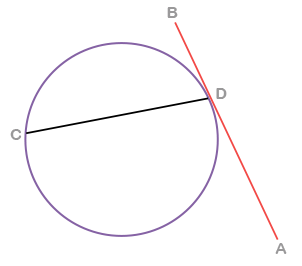
What is the mathematical name given for the line OA?

a)

Diameter

b)

Radius

c)

Tangent

d)

Chord

43.

What is the mathematical name given for the line ACB?

a)

Diameter

b)

Radius

c)

Tangent

d)

Chord

44.

What is the mathematical name given for the line AB?

a)

Radius

b)

Diamter

c)

Tangent

d)

Chord

45.

What is the mathematical name given for the line AB?

a)

Diameter

b)

Radius

c)

Tangent

d)

Chord

46.

This formula is used to find what?

a)

Area

b)

Circumference

47.

This formula is used to find what?

a)

Circumference

b)

Area

48.

If the radius of a circle is 6 what is the area?

a)

b)

36π

c)

12π

d)

24π

49.

If the radius of a circle is 6, what is the circumference?

a)

24π

b)

36π

c)

d)

12π

50.

What is the Area of a circle with diameter 8?

a)

16π

b)

c)

d)

64π

51.

What is the circumference of a circle with diameter 8

a)

b)

64π

c)

d)

16π

52.
Which two figures can always be described as quadrilaterals with all sides congruent?
a)
square and rhombus
b)
square and rectangle
c)
rhombus and parallelogram
d)
rectangle and parallelogram
53.
If a quadrilateral has 4 equal sides, then it is a square. 
a)
TRUE
b)
FALSE
54.
A trapezoid is a quadrilateral with exactly ONE set of parallel sides. 
a)
TRUE
b)
FALSE
55.
A _______________ is a quadrilateral with two sets of parallel sides.
a)
trapezoid
b)
parallelogram
c)
kite
d)
triangle
56.
What is unique about a kite?
a)
All angles are 90 degrees.
b)
All sides have equal length.
c)
Two pairs of adjacent sides have equal length.
d)
One pair of opposite sides is parallel.
57.
What is unique about a trapezoid?
a)
All angles are 90 degrees.
b)
All sides have equal length.
c)
Two pairs of adjacent sides have equal length.
d)
One pair of opposite sides is parallel.
58.
What is unique about a parallelogram?
a)
All angles are 90 degrees & all sides have equal length.
b)
All sides have equal length.
c)
Two pairs of adjacent sides have equal length.
d)
Two pairs of opposite sides are parallel.
59.
A square is a mix between...
a)
A rectangle and rhombus.
b)
A rectangle and kite.
c)
A rectangle and parallelogram.
d)
A rhombus and kite.
60.
I am a rhombus with 4 900 angles, what am I?
a)
a rectangle
b)
a kite
c)
a square
d)
a pentagon
61.
Which quadrilateral always has 4 congruent sides?
a)
trapezoid
b)
rectangle
c)
parallelogram
d)
rhombus
62.
Which quadrilateral has exactly one pair of parallel sides?
a)
trapezoid
b)
rectangle
c)
parallelogram
d)
rhombus
63.
Which quadrilateral has four congruent sides and four right angles?
a)
trapezoid
b)
square
c)
parallelogram
d)
rhombus
64.
Which quadrilaterals always have 4 congruent sides?
a)
trapezoid and rhombus
b)
square and rhombus
c)
parallelogram and square
d)
rhombus and rectangle
65.
Which attribute do squares and rectangles have in common?
a)
diagonals perpendicular
b)
one pair of parallel sides
c)
four congruent sides
d)
four right angles
66.
A _______________ is a quadrilateral with two sets of parallel sides.
a)
trapezoid
b)
parallelogram
c)
kite
d)
triangle
67.

What is a Closed Interval

a)

Has inputs and outputs (Has X and Y Values)

b)

includes both of its ending points and all the points between the ending points

c)

Inputs have different outputs every time (Every X-Value gives you a Different Y-Value every time)

d)

x-values and y-values

68.

What is a Open Interval

a)

Has inputs and outputs (Has X and Y Values)

b)

includes all the points in between the ending points but does not include either of its ending points

c)

Inputs have different outputs every time (Every X-Value gives you a Different Y-Value every time)

d)

x-values and y-values

69.
The natural logarithm has what base?
a)
10
b)
0
c)
e
d)
-e
70.
Log with a base "e" (loge) is the same thing as...
a)
"e"
b)
Natural Logarithm (LN)
c)
Common Logarithm (Log)
d)
Natural Log, base "e"
LNe
71.

Simplify the logarithm.

(write in exponential notation with common bases)

a)

x = 1

b)

x = 7

c)

x = 823543

d)

x = 49

72.

Simplify

a)

e

b)

0

c)

1

d)

-1

73.

Simplify

a)

e/15

b)

e

c)

15

d)

1

74.

Solve. Leave answers in terms of e

a)

5/e

b)

5e

c)

e/5

d)

1/5e

75.

Solve. Leave in terms of e

a)

e + 4

b)

4 + 1/e

c)

e - 4

d)

4 - 1/e

76.

Solve. Leave in terms of a natural logarithm.

a)

x = Ln e/ Ln 15

b)

x = 15

c)

x = Ln 15/ Ln e

d)

x = Ln 15

77.

Solve. Leave in terms of a natural logarithm

a)

x = Ln 3

b)

x = - Ln 3

c)

x = Ln 1/3

d)

x = 1/Ln 3

78.
The common logarithm has what base?
a)
10
b)
0
c)
e
d)
-e
79.

What is a natural logarithm

a)

base e

b)

base a

c)

base c

d)

base b

80.

Write this Natural Logarithmic function into Base "e" form:

ln15 = 2.71

a)

loge 15 = 2.71

b)

e2.71 = 15

c)

e15 = 2.71

d)

e = 15

81.
Solve for x:
ex=7
a)
x=ln7
b)
x=ln7
c)
x=7ln
d)
No solution
82.
What is the value of ln(e7)
a)
2.718...
b)
1
c)
7
d)
Does not exist
83.
Rewrite in exponential form:
ln(2) = x
a)
2= 10
b)
102 = x
c)
e= 2
d)
e2 = x
84.
Solve for x:
5 e6x+3 = 0.1
a)
-1.152
b)
0.232
c)
-3.077
d)
-0.854
85.

Write this Base "e" function into a Natural Log expression:

e3 = 5x

a)

ln(3) = 5x

b)

ln(5x) = 3

c)

loge (5x) = 3

d)

ln (3) = e

86.
When would we use this formula? A = Pe rt
a)
interest increases by fixed amount
b)
compound interest 
c)
compound continuously 
d)
decreases by fixed percent
87.

What is the base: ln(x-4) = 7

a)

4

b)

7

c)

e

d)

10

88.

ln (5x + 6) = 5

a)

154.413

b)

30.883

c)

147.213

d)

28.483

89.

3e2x + 10 = 25

a)

{-3.940}

b)

{1.228}

c)

{0.451}

d)

{0.805}

90.
Solve:
62x + 1 = 5x
a)
x = -1
b)
x = -.0509
c)
x = -2.4702
d)
x = -.9076
91.
Rewrite in exponential form:
ln(2) = x
a)
2= 10
b)
102 = x
c)
e= 2
d)
e2 = x
92.
What is the log form of a = ey ?
a)
ln(a) = y
b)
ln(y) = a
c)
log(a) = y
d)
log(y) = a
93.
The compound interest formula is:
A = P(1 + r)t

What does the A represent?
a)
The amount of interest earned.
b)
The amount of time that has passed.
c)
The total amount of money after a certain amount of time.
d)
The amount required to invest.
94.
Bruno was given $2000 when he turned 3 years old.  His parents invested it at a 2% interest rate compounded annually.  No deposits or withdrawls were made.  Which expression can be used to determine how much money Bruno had in the account when he turned 16? 
a)
2000(1+0.02)13
b)
2000(1-0.02)13
c)
2000(1+0.02)16
d)
2000(1-0.02)16
95.
What is the domain of the graph?
a)
(-∞,∞)
b)
(-2, ∞)
c)
(0,∞)
d)
(-∞,2)
96.
Solve 5e3x - 2 + 15 = 35
a)
1.13
b)
1.29
c)
1.10
d)
0.87
97.
A value of x which makes a function f(x) equal 0.
a)
Natural Logarithm
b)
Asymptotes
c)
Zeros of a Function
d)
Solution to Equation
98.
Interest that is, hypothetically, computed and added to the balance of an account every instant.
a)
Continuous Compounding
b)
Simple Interest
c)
Compound Interest
d)
Average Value
99.
Log with a base "e" (loge) is the same thing as...
a)
"e"
b)
Natural Logarithm (LN)
c)
Common Logarithm (Log)
d)
Natural Log, base "e"
LNe
100.
Find the domain and range of:
f(x) = ln(x)
a)
D: all real numbers
R: y > 0
b)
Domain: all real numbers
Range: all real numbers
c)
Domain: x > 0
Range: all real numbers
d)
Domain: all real numbers
Range: y < 0
101.
Describe the transformations of f(x)= -log2(x+1)
a)
left one & y-axis reflection
b)
right one & y-axis reflection
c)
left one & x-axis reflection
d)
right one & x-axis reflection
102.
What is the base of the natural log (ln)?
a)
10
b)
e
c)
2.7
d)
x
103.
What is the inverse of the function
y = 2x?
a)
y = log2(x)
b)
y = logx(2)
c)
y = 2-x
d)
2 = logy(x)
104.
What is the range of 
y = log(x) + 2?
a)
All real numbers y
b)
y ≥ 2
c)
y > 2
d)
−2 < y < 2
105.
What is the inverse of the function
y = ln(x)?
a)
y = ex
b)
x = ey
c)
y = e(x)
d)
y = ex
106.
Which equation matches the graph?
a)
y = ln(x)
b)
y = log(x)
c)
y = log2(x)
d)
y = xe