
 Worksheets
BIO 156 Quiz 9
Total questions: 20
Worksheet time: 20mins
Name
Class
Date
1.

Which process and type of resulting cells are represented?
a)
mitosis, gametes
b)
mitosis, body cells
c)
meiosis, gametes
d)
meiosis, body cells
2.
Which process is necessary for the inherited traits of an organism to be passed along by sexual reproduction?
a)
mitosis
b)
meiosis
c)
mutation
d)
fission
3.

Which cellular process is shown?
a)
meiosis
b)
endocytosis
c)
mitosis
d)
phagocytosis
4.
Which statement correctly describes meiosis?
a)
cells divide only once
b)
meiosis does not occur in reproductive cells
c)
the cells produced at the end of meiosis are genetically identical to the parent cell
d)
The cells produced at the end of meiosis contain half the number of chromosomes as the parent cell
5.

Which best describes the process shown?
a)
mutation in which the DNA content of the gene is ltered
b)
segregation of sister chromatids
c)
condensation and segregation of the alleles
d)
crossing-over which alleles are exchanged
6.
Which of the following represents chromosome # during fertilization?
a)
n+n=2n
b)
n=n
c)
2n=n+n
d)
2n=2n
7.
Which of the following best explains why the chromosome number is an even number in organisms?
a)
It is only by coincidence, many organisms have an odd number
b)
The diploid number is always even so that when mitosis occurs each cell gets the same number of chromosmes
c)
The diploid chromosome number represents pairs of chromosomes, one from ech parent, so that it is always an even number
d)
Chromosomes double very time the cell divides, so after the first division, the number is always even
8.
Based only on the sex chromosomes in typical human egg and sperm cells at fertilization, the probability of producing a female is
a)
25%
b)
50%
c)
75%
d)
90%
9.
If an intestinal cell in a butterfly contains 24 chromosomes, a butterfly egg would contain
a)
3
b)
6
c)
12
d)
24
10.
Mitosis is essential to life because it
a)
contains four stages for gametes
b)
maintains genetic continuity from one generation to the next
c)
controls cell functions
d)
provides energy for cell
11.
Body cells of fruit flies contain 8 chromosomes. Scientists used studies of flies to discover how egg and sperm are formed. What did they observe?
a)
Body cell of offspring flies have 16 chromosomes
b)
Sperm cells have 8 chromosomes
c)
Egg cells have 4 chromosomes
d)
Body cells of offspring have 4 chromosomes
12.
What is one advantage of sexual reproduction?
a)
offspring are identical to parents
b)
offspring are resistant to viruses
c)
offspring are born live, rather than from eggs
d)
offspring inherit a wider variety of genetic information
13.
What is meiosis?
a)
It is asexual reproduction
b)
It is sexual reproduction
14.
What is something that happens in meiosis, and not in mitosis?
a)
Synapsis/crossing over occurs
b)
The cell is split into two cells
c)
There is no genetic variety
d)
Copying of DNA
15.
What is a source of genetic variation in meiosis?
a)
Asexual reproduction
b)
Split from one cell
c)
S phase
d)
Random fertiliztion
16.
A cell with 22 autosomes and a Y chromosome would be.....
a)
A sperm
b)
A male somatic cell
c)
A male ovum
17.
What is the primary cause of genetic variation during meiosis?
a)
chromosomes lining up
b)
"crossing over" of chromosomes
c)
separation of chromosomes
d)
chromosomes pulling apart
18.
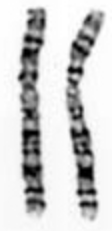
A pair of identical chromosomes (one inherited from mom and one inherited from dad) are called ______________________________.
a)
sister chromotids
b)
centromeres
c)
homologous chromosomes
d)
autosomes
19.
The failure of one or more pairs of homologous chromosomes or sister chromatids to separate "normally" during meiosis is called _____________________.
a)
nondisjunction
b)
anaphase I
c)
nondiploidy
d)
karyotype
20.

How many chromosomes do humans have?
a)
46
b)
21
c)
10
100 %

