wayground logo

Free Printable Worksheets

NEW

Font size

S
M
L
XL
Worksheets

Periodic Table (EC015)

Total questions: 30

Worksheet time: 3600secs

Name
Class
Date
1.

Atom A with 20 proton number is located in group

a)

1

b)

2

c)

4

d)

14

2.

The following pairs are isoelectronic EXCEPT

a)

Na+ and F-

b)

Al3+ and N3-

c)

Mg2+ and S2-

d)

Na+ and Mg2+

3.

Electronic configuration atom P is 1s2 2s2 2p6 3s2 3p3. In periodic table, P located in period

a)

1

b)

2

c)

3

d)

4

4.

Which of the following elements has smallest atomic size?

a)

Na

b)

K

c)

Mg

d)

Al

5.

Which of the following arrangements shows the order of increasing ionic radius

a)

K+ < Cl- < S2- <P3-

b)

K+ < P3- < S2- <Cl-

c)

P3- < S2- < Cl- < K+

d)

Cl- < S-2 < K+ < P3-

6.

Which of the following elements has the highest ratio second ionisation energy to the first ionisation energy?

a)

Magnesium

b)

Chlorine

c)

Sodium

d)

Sulphur

7.

Which of the species has the smallest size?

a)

Mg2+

b)

O2-

c)

Na

d)

Mg

8.

Which ion has the smallest ionic radius? [proton number : K = 19; Ca = 20; P = 15; S = 16; Cl = 17]

a)

K+

b)

P3-

c)

Cl-

d)

Ca2+

9.

Choose the CORRECT statement

a)

The atomic size of aluminium is smaller than that of magnesium

b)

The electronegativity of phosphorus is higher than that sulphur

c)

The first ionization energy of sodium is lower than that magnesium

d)

The melting point of the element increases from element with Z = 13 to Z = 18

10.

Element M forms ion M2- with the electronic configuration 1s2 2s2 2p6 3s2 3p6. Element N is located on the right and besides element M in periodic table. Which of the following is the electronic configuration of valence shell of the element N?

a)

3s2 3p3

b)

3s2 3p4

c)

4s1

d)

3s2 3p5

11.

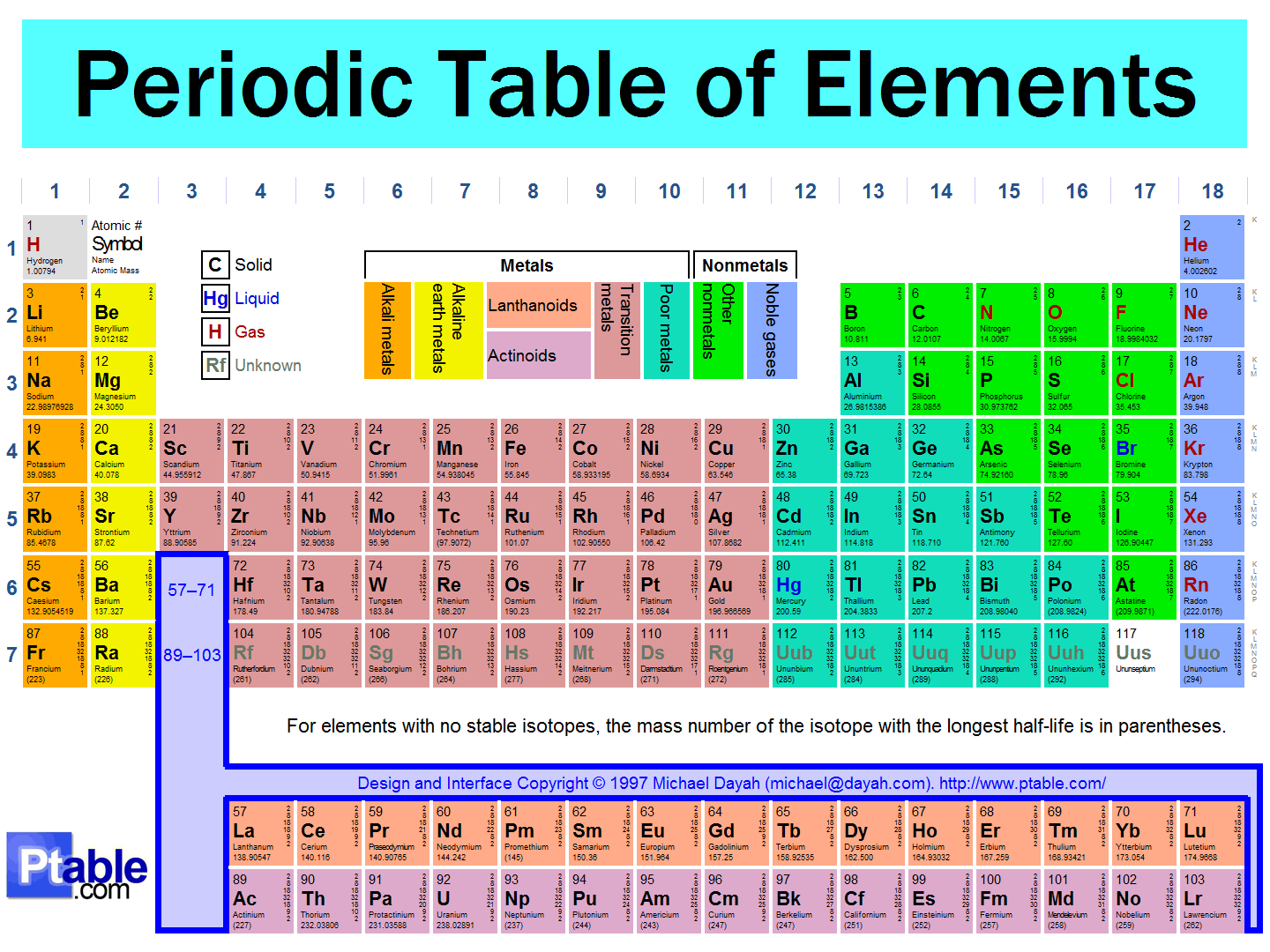
Which color on the image of the periodic table corresponds with the halogens.

a)

red

b)

black

c)

blue

d)

orange

12.

Vertical columns on the periodic table are called ___?

a)

groups

b)

periods

c)

rows

d)

families

13.

Which color on the image of the periodic table corresponds with the noble gases.

a)

red

b)

black

c)

blue

d)

orange

14.

Horizontal rows on the periodic table are called ___?

a)

groups

b)

periods

c)

rows

d)

families

15.

Which family of elements does not combine with other elements unless under special conditions in a laboratory?

a)

Noble gases

b)

Halogens

c)

Metalloids

d)

Alkaline earth metals

e)

Actinides

16.
The horizontal row on the periodic table is called a
a)
group
b)
family
c)
period
d)
atomic number
17.
A vertical column is called...
a)
group
b)
tower
c)
period
d)
crew
18.
As you move down the periodic table atoms get bigger.  This is because ____________.
a)
The atoms have more mass.
b)
The atoms have more protons.
c)
The atoms have more energy levels
d)
The atoms have more neutrons
19.
As you move across the periodic table atoms tend to get smaller because, ______________.
a)
the atoms have more mass.
b)
the atoms have less mass
c)
the atoms have more protons.
d)
the atoms have less electrons.
20.
Electronegativity is...
a)
the ability of an atom to attract/ accept electrons
b)
the ability of an atom to lose electrons
c)
the energy required to remove an electron from a specific atom
d)
how easy it is to make friends. 
21.
Ionization energy is...
a)
the energy required to add an electron to a specific atom
b)
how much energy it takes to remove an electron from an atom
c)
the energy required to shield the outer electrons from the nucleus
d)
a measure of the ability of an atom to attract electrons
22.
The atom with the largest atomic radius in Group 18 is - 
a)
Ar
b)
He
c)
Kr
d)
Rn
23.
Which statement correctly and completely identifies a trend?
a)
Atomic radius decreases across a period and increases down a group.
b)
Electronegativity decreases across a period and decreases down a group.
c)
Ionization energy increases across a period and increases down a group.
d)
Ionic radius increases across a period and increases down a group.
24.

Electronegativity __________ from left to right within a period and __________ from top to bottom within a group.

a)

decreases, increases

b)

increases, increases

c)

increases, decreases

d)

stays the same, increases

25.

Which periodic trend has to do with the width of a given atom?

a)

Ionic Radius

b)

Atomic Radius

c)

Electronegativity

d)

Reactivity

26.

The element with the highest electronegativity in the halogen group?

a)

At

b)

F

c)

Cl

d)

Br

27.

The minimum energy required to remove an electron from the ground state of an atom

a)

electron configuration

b)

energy levels

c)

ionization energy

d)

ionic bond

28.
As you move down the periodic table atoms get bigger.  This is because ____________.
a)
The atoms have more mass.
b)
The atoms have more protons.
c)
The atoms have more energy levels
d)
The atoms have more neutrons
29.
As you move across the periodic table atoms tend to get smaller because, ______________.
a)
the atoms have more mass.
b)
the atoms have less mass
c)
the atoms have more protons.
d)
the atoms have less electrons.
30.
Atomic radius generally increases as we move __________.  
a)
down a group and from right to left across a period 
b)
up a group and from left to right across a period 
c)
down a group and from left to right across a period 
d)
up a group and from right to left across a period