
 Worksheets
Haemoglobin
Total questions: 27
Worksheet time: 13mins

The ion found in the haem group is what
Mg2+
O2-
Fe2+
Fe3+
Which of the following is NOT the structure of haemoglobin?
Each haemoglobin molecule contains 4 haem groups
Haemoglobin has a quaternary structure
Each haem group in haemoglobin can bind with 4 molecules of oxygen
Each haemoglobin molecule has 2 α-chain and 2 β-chain polypeptide subunits
The main blood vessel responsible for taking oxygenated blood to the body is the
pulmonary artery
aorta
vena cava
pulmonary veins
What is the name of the molecule formed when oxygen binds to haemoglobin?
oxyhaemoglobin
oxygen-haemoglobin
carbaminohaemlobin
oxyglobin
Carbon dioxide and water combine to form
hydrogen carbonate ions
hydrogen ions
carbonic acid
hydrogen bicarbonate
Oxyhaemoglobin gives up O2 when …
CO2 partial pressures are high
Body temperature is lowered
pH values are high
O2 partial pressure are high
The Bohr Effect/Shift moves the oxygen saturation curve in what direction
up and left
down and right
down and left
up and right
At the highest partial pressures of oxygen, the saturation of oxygen slows down because
the haemoglobin becomes saturated
the haemoglobin becomes denatured
the haemoglobin is too cold
the oxygen is displaced by carbon dioxide
which of the following explains the meaning of the Bohr effect?
The effect of the partial pressure of oxygen in blood on the affinity of haemoglobin towards carbon dioxide.
The effect of the partial pressure of carbon dioxide on the dissociation of oxyhaemoglobin.
The affinity of haemoglobin toward oxygen.
The affinity of haemoglobin towards carbon dioxide.
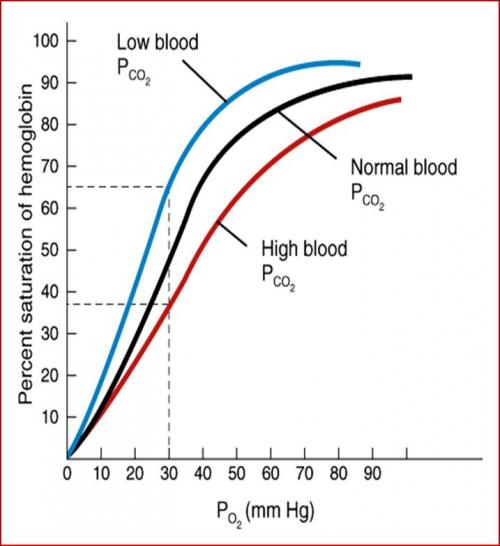
The blue line on the graph indicates
the Bohr effect
regular haemoglobin
fetal haemoglobin
haemoglobin during exercise
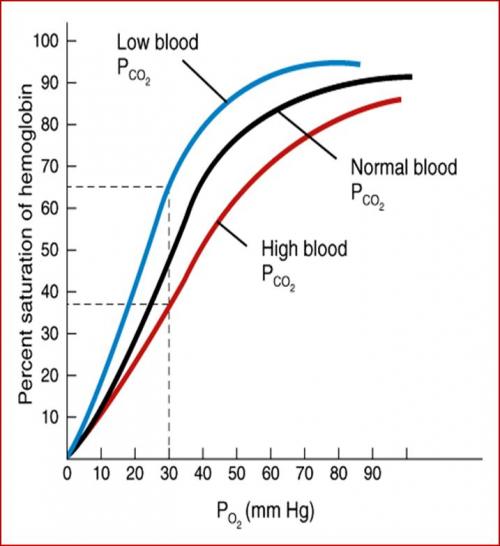
What colour line represents the oxygen saturation curve during intense exercise?
blue
black
red
The blood vessel responsible for taking deoxygenated blood to the lungs for excretion is the
pulmonary artery
pulmonary vein
aorta
vena cava
When carbon dioxide binds directly with haemoglobin it forms
carbaminohaemoglobin
carboxyhaemoglobin
carbon diooxyhaemoglobin
carboglobin
Each haemoglobin molecule can bind reversibly with
one atom of oxygen
one molecule of oxygen
two molecules of oxygen
four molecules of oxygen
1 = disulfide 2 = hydrogen 3 = ionic
4 = peptide
Which bond types are involved in maintaining the different levels of structural complexity of a globular protein?
Secondary:3
Tertiary:1,2,3
Secondary:1
Tertiary:2,3,4
Secondary:4
Tertiary:2,3,4
Secondary:2
Tertiary:1,2,3
When CO2 partial pressures are increased, how does this affect the affinity of Hb to oxygen?
It increases
It decreases
It stays the same

Which statement truly represents the difference between the two curves?
Curve A represents an haemoglobin that has higher affinity for oxygen at all partial pressures of oxygen
Curve A represents a curve that has higher affinity for haemobloby at only at low partial pressures of oxygen
Curve A represents haemoglobin that will readily release oxygen at all partial pressures
Curve A represents haemoglobin that will not readily bind to oxygen even at high partial pressure of oxygen

At partial pressure of 20mmHg, ………………………
Adult haemoglobin has a higher affinity for oxygen than myoglobin
Adult haemoglobin is less saturated with oxygen compared to myoglobin
Adult haemoglobin is completely deoxygenated while myoglobin is not
Adult haemoglobin still has capacity to release a large amount of oxygen compared to myoglobin
Gaseous exchange happens because of...
Osmosis
Respiration
Diffusion
Semi-permeable membranes
Normal hemoglobin content in blood is
18g%
25g%
15g%
50g%
Oxygen-hemoglobin dissociation curve is shifted to right in the following conditions:
Decrease in partial pressure of oxygen
Bohr effect
Increase in hydrogen ion concentration and decrease in pH
Excess of DPG in RBC
All of the above
Oxygen-hemoglobin dissociation curve is shifted to left or right by various factors
Shift to left indicates acceptance (association) of oxygen by hemoglobin
Shift to left indicates dissociation of oxygen from hemoglobin.
Shift to right indicates acceptance (association) of oxygen from hemoglobin.
Shift to right indicates dissociation of oxygen from hemoglobin.
Oxygen-hemoglobin dissociation curve is shifted to left in the following conditions:
Decrease in hydrogen ion concentration and increase in pH
Decrease in partial pressure of oxygen
In fetal blood because, fetal hemoglobin has got more affinity for oxygen than the adult haemoglobin
Increase in partial pressure of carbon dioxide
Normally in the blood, hemoglobin is saturated with oxygen only up to
80%
95%
75%
50%

