wayground logo

Free Printable Worksheets

Font size

S
M
L
XL
Worksheets

Unit 2 Biology - Sexual Reproduction

Total questions: 60

Worksheet time: 34mins
Name
Class
Date
1.
If two organisms reproduce sexually, then their offspring will exhibit a genetic makeup that is -
a)
identical to only one parent
b)
identical to all of its siblings
c)
a unique combination of traits
d)
the recessive traits of each parent
2.

Some advantages of sexual reproduction include: (select all that apply)

a)

genetic variation

b)

improves chances of adapting to the environment

c)

helps species survive catastrophes

d)

it doesn't take as much energy as asexual reproduction

3.

What are some disadvantages to sexual reproduction? (select all that apply)

a)

it takes a lot of energy to find a mate

b)

you don't need another mate

c)

it requires a male and a female

d)

more genetic errors can occur

4.

Male and female reproductive cells are collectively known as:

a)

spores

b)

pollen

c)

gametes

d)

offspring

5.

____________________ occurs when a male gamete (sperm) combines with a female gamete (egg).

a)

sporulation

b)

fertilization

c)

fission

d)

regeneration

6.

How many parents are required for sexual reproduction?

a)

0

b)

1

c)

2

d)

3

7.

If a sex cell has 10 chromosomes, how many chromosomes will there be after fertilization?

a)

5

b)

10

c)

15

d)

20

8.
What are some of the facts about sexual reproduction?
a)
Takes two mates to reproduce and takes a longer time to reproduce
b)
Takes one mate to reproduce and takes a shorter amount of time to reproduce
c)
Takes two mates to reproduce and takes a shorter amount of time to reproduce
d)
Takes one mate to reproduce and takes a shorter amount of time to reproduce
9.
Sexual reproduction requires _____ parents and asexual reproduction requires ___ parents
a)
1,1
b)
2,2
c)
2,1
d)
1,2 
10.
If an environment suddenly changes, which type of reproduction would be most beneficial? Why?
a)
Asexual, because asexual organisms always have variation within species.
b)
Sexual, because sexual organisms have variation within species.
c)
Both Asexual and Sexual reproduction would be beneficial, because they both have variation within species.
d)
Asexual, because asexual organisms have no variation, so they can adapt to a changing environment.
11.
2 dogs reproduce, 2 sex cells join together & form offspring. The resulting offspring is likely
a)
to express only recessive traits
b)
to be identical to ONE parent
c)
to share some traits from BOTH of its parents
12.
The genetic instructions are found in ---- within the DNA
a)
traits
b)
chromosomes
c)
genes
d)
DNA
13.
Which of the following describes the main advantages of sexual reproduction
a)
requires lots of time/energy
b)
no new gene combos can arise 
c)
diversity
d)
looks identical to the parent
14.
 A general name for a sex cell (egg or sperm) is a: 
a)
zygote
b)
gene
c)
offspring
d)
gamete
15.
Passes genetic information
onto future generations
a)
sexual reproduction
b)
asexual reproduction
c)
both
16.
What percentage of chromosomes are handed down by a sperm cell?
a)
75%
b)
25%
c)
50%
d)
100%
17.

A mode of reproduction in which an organism arises from two organisms and inherits half of its DNA from each parent

a)

Sexual Reproduction

b)

Asexual Reproduction

c)

Cloning

d)

Fragmentation

18.
The part of the flower where the ovules or egg cells are found
     
a)
Ovary
b)
stigma
c)
Seed   
d)
style
19.
The part of stamen where the pollen grains are produced
a)
style
b)
filament
c)
anther
d)
stigma
20.
The male reproductive organ in plants
a)
anther
b)
stigma
c)
pistil
d)
stamen
21.
The female reproductive organ in plants
a)
pistil
b)
stamen
c)
filament
d)
anther
22.
The female sex cell
a)
sperm cell
b)
egg cell
c)
sex cell
d)
female cell
23.
The transfer of pollen grain from the anther to the stigma of the flower
a)
pollination
b)
pollen grain
c)
fertilization
d)
ovary
24.
In sexual reproduction, what is the source of the genetic material in a zygote? 
a)
 An egg cell only
b)
A pollen and a sperm cell
c)
 A sperm cell only 
d)
An egg cell and a sperm cell
25.
Which species can produce offspring that are genetically different from their parents?
a)
A species that has few variations 
b)
A species that reproduces asexually 
c)
A species that reproduces sexually 
d)
A species that competes with a similar species
26.
What causes genetic variation in meiosis?
a)
chromosomes lining up
b)
crossing over of chromosomes
c)
separation of chromosomes
d)
chromosomes pulling apart
27.
What kind of cells are made in MEIOSIS?
a)
Haploid cells
b)
Diploid Cells
c)
Skin Cells
d)
Liver Cells
28.
Diploid Cells are represented by
a)
2n
b)
n
c)
4n
d)
1/2 n
29.
If the Diploid number of Carrots is 18, the haploid number is
a)
18
b)
9
c)
27
d)
36
30.
The process of crossing over occurs in what phase of meiosis?
a)
anaphase 1
b)
prophase 1
c)
prophase 2
d)
telophase 1
31.
The chromosomes that pair up during meiosis, are called __________ chromosomes.  
a)
homozygous 
b)
asexual
c)
homologous
d)
genes
32.
Crossing over creates
a)
male genotype
b)
genetic variation (differences)
c)
DNA replication
d)
mitosis
33.
Which of the following best describes meiosis?
a)
It is carried out in all tissues theat require cell replacement
b)
It occurs only in cells in the reproductive structures of an organism
c)
It happens in all of the tissues except the brain and spinal cord
d)
It is the first stage of mitosis
34.
What phase is represented?
a)
metaphase 1
b)
metaphase 2
c)
anaphase 1
d)
anaphase 2
35.
What phase is  shown in the picture?
a)
metaphase 2
b)
anaphase 2
c)
metaphase 1
d)
telophase 1
36.
products of meiosis are genetically
a)
different
b)
identical
37.
A human zygote should have _____ chromosomes inside.
a)
46
b)
23
c)
92
d)
64
38.
Which of the following represents chromosome # during fertilization?
a)
n+n=2n
b)
n=n
c)
2n=n+n
d)
2n=2n
39.
Meiosis makes sperm and egg cells. In humans, sperm and egg cells each have _____ chromosomes. Therefore a fertilized human egg cell (sperm and egg cell combined) would create a cell with _____ chromosomes.
a)
23, 46
b)
46, 23
c)
2, 4
d)
50, 100
40.
How many daughter cells does Meiosis create?
a)
2
b)
4
c)
8
d)
1
41.
A human usually has ______ chromosomes in their body cells.
a)
6
b)
22
c)
4
d)
46
42.
Asexual reproduction and mitosis occur in...
a)
Body Cells
b)
Sex Cells or Gametes
43.
In meiosis, Prophase 1 is when chromosomes...
a)
cross over
b)
mutate
c)
hybridize
d)
fertilize
44.
What causes genetic variation in meiosis?
a)
chromosomes lining up
b)
crossing over of chromosomes
c)
separation of chromosomes
d)
chromosomes pulling apart
45.
What is one reason why we need meiosis?
a)
To double the number of chromosomes going into sex cells
b)
To halve the number of chromosomes going into sex cells
c)
To triple the number of chromosomes going into sex cells
d)
To not change the number of chromosomes going into sex cells
46.
What is one of the advantages, of reproducing sexually versus asexually?
a)
survival of the fittest
b)
overproduction
c)
genetic variation
d)
cloning
47.
Identify the phase.
a)
Metaphase I
b)
Metaphase II
c)
Anaphase I
d)
Anaphase II
48.
Identify the process.
a)
Mitosis
b)
Meiosis I
c)
Meiosis II
d)
Interphase
49.
After meiosis II the daughter cells will contain ____ chromosomes if the original cell contained 78.
a)
78
b)
39
c)
23
d)
46
50.
Which of the following cells is a gamete?
a)
egg
b)
bone
c)
heart
d)
muscle
51.
The fertilized egg is termed a/an _____.
a)
gamete
b)
allele
c)
homolog
d)
zygote
52.
In mitosis cells are genetically _______, but in meiosis cells are genetically ______.
a)
diverse, identical
b)
identical, diverse/different
53.
When does replication of chromosomes occur in animal cell meiosis?
a)
Before Meiosis I and Meiosis II
b)
Before Meiosis II Only
c)
Before Meiosis I Only
d)
During Prophase I and Prophase II
54.
Identify the phase.
a)
Telophase I
b)
Telophase II
c)
Metaphase I
d)
Metaphase II
55.
In sexual reproduction, chromosome reduction is necessary to ___.
a)
ensure that all offspring have the correct diploid number of chromosomes
b)
ensure that all offspring have the correct haploid number of chromosomes
c)
ensure that all daughter cells are identical
56.

1n indicates that the cell is ____.

a)

Diploid

b)

Haploid

57.
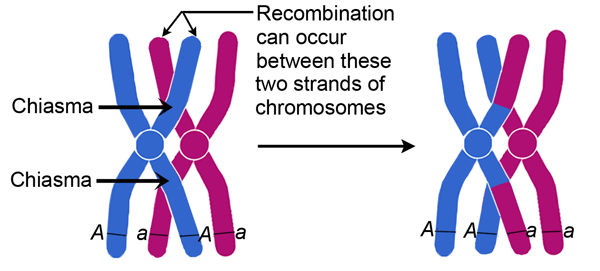
This image shows chromosomes during Prophase 1. Which of the following correctly describes the process shown?
a)
segregation of sister chromatids
b)
condensation and segregation of alleles
c)
mutationin which the DNA content of the gene is altered
d)
crossing - over in which alleles are exchanged
58.
Which of the following statements correctly describes meiosis?
a)
Meiosis does not occur in reproductive cells.
b)
The cells produced at the end are identical 
c)
the cells produced at the end contain half the # of chromosomes
d)
cells divide only once during meiosis
59.
What is one advantage of sexual reproduction?
a)
The offspring are identical to the parents
b)
the offspring are resistant to viruses
c)
the offspring are born live, instead of from eggs
d)
The offspring inherit a wider variety of genetic information
60.
Which of the following best explains why the chromosome number is an even number in organisms?
a)
It is only by coincidence, many organisms have an odd number
b)
The diploid number is always even so that when mitosis occurs each cell gets the same number of chromosmes
c)
The diploid chromosome number represents pairs of chromosomes, one from ech parent, so that it is always an even number
d)
Chromosomes double very time the cell divides, so after the first division, the number is always even