wayground logo

Free Printable Worksheets

Font size

S
M
L
XL
Worksheets

DC Bio Take Home Test Ch. 1-3

Total questions: 100

Worksheet time: 4hrs 53mins

Name
Class
Date
1.
Large bodies of water, such as lakes and oceans, do not quickly fluctuate in temperature. What is the reason for this phenomenon?
a)
Water is an acid.
b)
Water is a versatile solvent.
c)
Water has a high heat capacity.
d)
 Water acts as a buffer.
2.
Why does ice stay at the top of oceans instead of sinking to the bottom?
a)
 Ice is colder than liquid water.
b)
Ice is less dense than liquid water.
c)
Ice is more dense than liquid water.
d)
Ice is warmer than liquid water.
3.
 Small insects can walk across the surface of calm water. Their feet push the surface of the water down slightly, somewhat like a person walking across a trampoline, but they do not break the surface. What is the best explanation for why this happens?
a)
The insects are light enough so that they do not break the hydrogen bonds holding the water molecules together
b)
The insects actually use their wings to hover slightly above the water's surface and they only skim it with their feet
c)
The insects' feet are non-polar, so they are repelled by the polar water molecules and are pushed away from the water's surface
d)
The insects are small enough to see the individual water molecules, so they are able to step carefully from one molecule to the next
4.
A florist places a bouquet of white carnations in water containing blue dye. After a time, the flowers turn blue. What process helped the carnations to change color?
a)
Specific heat 
b)
Surface tension
c)
Cohesion and adhesion of water molecules 
d)
Formation of covalent bonds between hydrogen and oxygen molecules
5.
Water has a much higher specific heat than most other covalent compounds. What do you predict might happen if water had a low specific heat instead?
a)
Flooding would occur and animals would be forced to migrate
b)
 Harmful organisms living in water would reproduce at a rapid rate
c)
Organisms that are sensitive to changes in temperature would die
d)
Plants would not have enough water to effectively carry out photosynthesis
6.
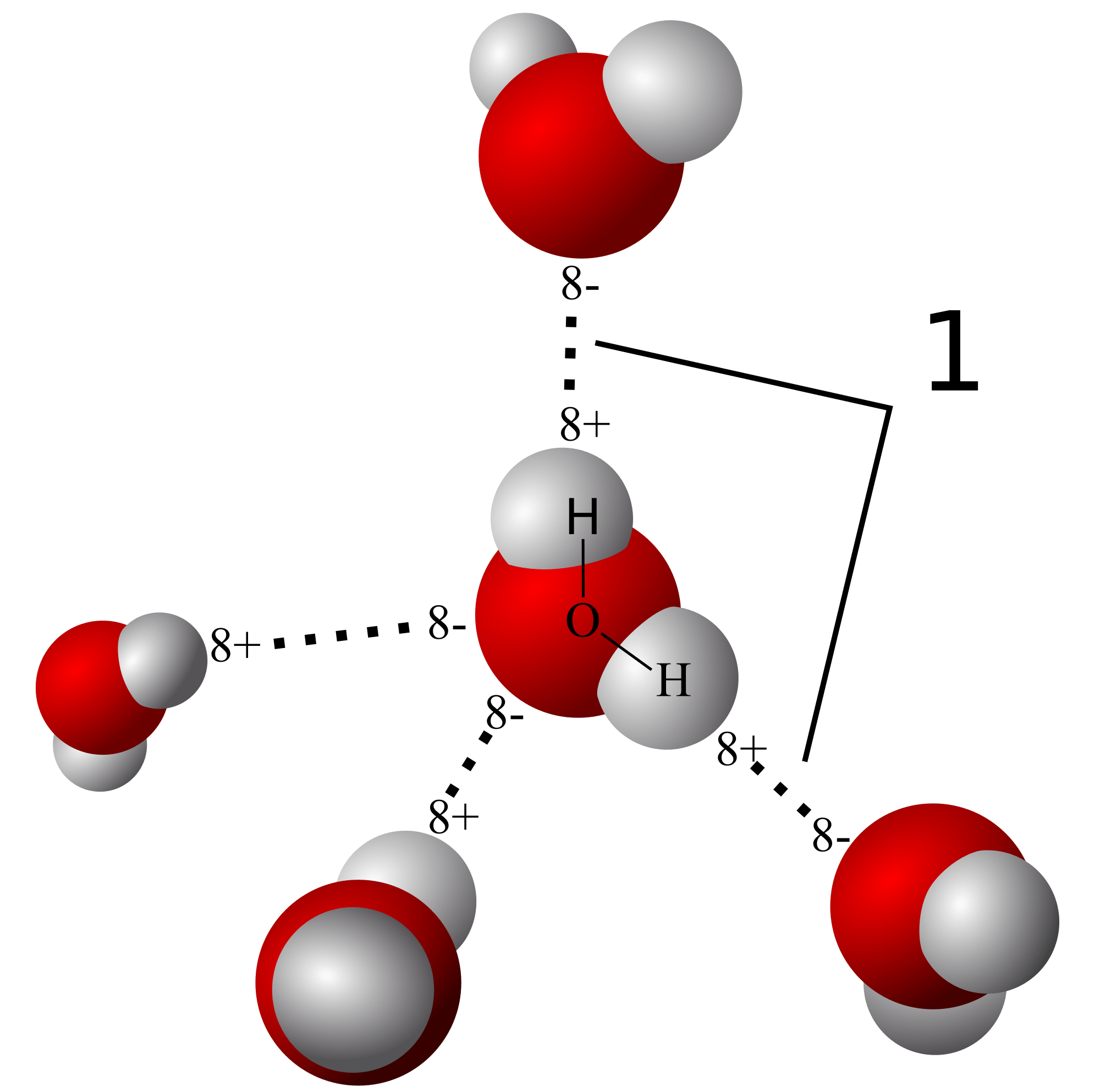
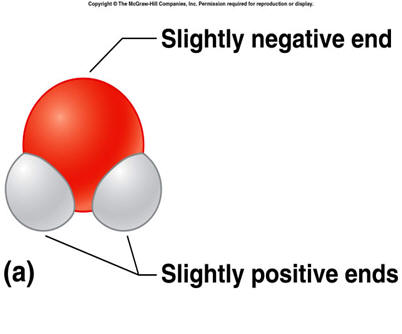
Why can water have no net charge but have slight charges in different parts of the molecule?
a)
The oxygen end is slightly negative and the hydrogen end is slightly positive
b)
The hydrogen end is slightly negative and the oxygen end is slightly positive
c)
The hydrogen and oxygen ends change in polarity
d)
Because it is hydrophobic
7.
Attractions between water molecules are called
a)
Covalent bonds
b)
Ionic bonds
c)
Polar bonds
d)
Hydrogen bonds
8.
molecule in which opposite ends have opposite electric charges
a)
cohesion
b)
polar molecule
c)
hydrogen bond
d)
solution
9.
Why does ice float?
a)
As water freezes, it expands and its density decreases.
b)
As water freezes, it takes up more hydrogen from the atmosphere, causing it to have a greater buoyancy.
c)
As water freezes, air becomes trapped between the hydrogen bonds of water molecules.
d)
As water freezes, it takes up more oxygen from the atmosphere, causing it to have a greater buoyancy.
10.
Which end of the water molecule has a slightly positive charge?
a)
the oxygen end
b)
the hydrogen end
c)
both ends are slightly positive
d)
neither end is positive
11.
Which major macromolecule is being represented in this image? 
a)
carbohydrate
b)
lipid
c)
protein
d)
nucleic acid
12.
Which of the following contains the genetic code for protein synthesis?
a)
carbohydrate
b)
lipid
c)
protein
d)
nucleic acid
13.
Which of the following decreases the activation energy necessary to initiate the chemical change within the body?
a)
nucleotides
b)
enzymes
c)
amino acids
d)
fatty acids
14.
What are the single sugars that are the building blocks of carbohydrates?
a)
monosaccharides
b)
disaccharides
c)
polysaccharides
d)
amino acid
15.
You are analyzing a compound in the laboratory. You find that it is made up of carbon, hydrogen, and oxygen in a ratio of two hydrogen atoms for each carbon atom. How will you classify the compound?
a)
lipid
b)
protein
c)
carbohydrate
d)
nucleic acid
16.
Waxes, oils and fats are examples of
a)
Carbohydrates
b)
Lipids
c)
Proteins
d)
Nucleic Acids
17.
A monomer is ...
a)
a single atom
b)
a building block for polymers
c)
a single element
d)
is an inorganic molecule
18.
The building blocks of carbohydrates are?
a)
amino acids
b)
fatty acids
c)
monosaccharides 
d)
nucleotides
19.
What is the strongest of all the bonding types?
a)
Covalent
b)
Ionic
c)
Hydrogen
d)
Metallic
20.
What is the smallest unit of matter that cannot be broken down by chemical means?
a)
Atom
b)
Element
c)
Ion
d)
Isotope
21.
What are the four elements that all life is made up of?
a)
Hydrogen, Oxygen, Nitrogen and Carbon
b)
Helium, Oxygen, Neon and Carbon
c)
Hydrogen, Titanium, Carbon, Nitrogen
d)
Oxygen, Chlorine, Iron, Nitrogen
22.
This biomolecule is used to make energy for our cells. The simplest is glucose, a monosaccharide.
a)
Carbohydrates
b)
Lipids
c)
Nucleic Acids
d)
Proteins
23.
How many Amino Acids does our body use to make proteins?
a)
20
b)
10
c)
6
d)
2
24.

Enzymes can either...

a)

break things down or put things together

b)

break things down only

c)

put things together only

d)

make cheese

25.

Organic molecules are based on the element _. This element can form an extremely wide variety of molecules due to its ability to form _ covalent bonds

a)

carbon, 4

b)

carbon, 2

c)

oxygen, 4

d)

oxygen, 2

26.

All of the following are bonds a single carbon atom can make except

a)

1 double, 1 triple

b)

2 double

c)

4 single

d)

1 double, 2 single

e)

1 single, 1 triple

27.

Isomers differ in all of the following except

a)

Numbers of each atom

b)

Function

c)

Structure/shape

28.

Cis-trans isomers differ in their organization around a _. The _ isomer has attached groups across from one another (different sides)

a)

central carbon, trans

b)

central carbon, cis

c)

double bond, trans

d)

double bond, cis

29.

Alcohols (-OH) are also known as _ groups. Their important property is _ in water (aqueous solutions)

a)

hydroxyl, forming hydrogen bonds

b)

hydroxyl, donating H+ ions

c)

carbonyl, forming hydrogen bonds

d)

carbonyl, donating H+ ions

30.

Which of the following statements regarding functional groups is true?

a)

They impact the biochemical activity of an organic molecule

b)

They give a molecule unique chemical properties

c)

They are attachments to carbon skeletons

d)

All statements are true

31.

Which carbonyl group is found at the end of a carbon skeleton?

a)

Ketone

b)

Aldehyde

c)

Alcohol

d)

Carboxyl

32.

_ groups create basic conditions in aqueous solutions. This occurs when the group _ H+ ions from the solution

a)

Amino, removes

b)

Amino, adds

c)

Carboxyl, removes

d)

Carboxyl, adds

33.

All of the following are correct pairings of functional groups and functions except

a)

Sulfhydryl group (thiol) - forms bridges that maintain protein structure

b)

Methyl group - increases gene expression when present on chromsomes

c)

Phosphate group - has charged that allows a molecule to react with water

34.

Which of the following statements regarding ATP is false?

a)

It forms ADP when a phosphate group is lost

b)

It is a form of energy

c)

It contains three phosphate groups

d)

It releases energy when it reacts with water

e)

It is required for a plethora of different biochemical reactions/processes needed to maintain metabolism and homeostasis in all living things

35.
Lipids are made up of which of the following?
a)
glycerol and fatty acids tails
b)
glycerol and monolipids
c)
fatty acids and phosolipids
d)
amino acids and nucleotides
36.
Amino acids combine to form which of the following biomolecule?
a)
Carbohydrates
b)
Lipids
c)
Proteins
d)
Nucleic Acids
37.
All of the following are parts of a nucleotide except?
a)
Phosphate Group
b)
Nitrogen Base
c)
Amino Group
d)
Deoxyribose/Ribose sugar
38.

What kind of molecule is represented by the structure below?

CH3CH2CH2CH2CH=CHCH2CH2CH2CH2CH2CH2CH2COOH

a)

a sugar

b)

an unsaturated fatty acid

c)

a saturated fatty acid

d)

a disaccharide

e)

a phospholipid

39.

What type of chemical bond is illustrated below?

a)

a sugar-sugar bond

b)

a glycerol-fatty acid bond

c)

a peptide bond

d)

a phosphate-phosphate bond

e)

a hydrogen bond

40.

The level of polypeptide folding in which the primary sequence coils around itself, stabilized by regularly spaced hydrogen bonds, is called

a)

primary structure

b)

alpha helix

c)

beta sheet

d)

tertiary structure

e)

quaternary structure

41.

What is the highest level of structure represented below? (Note: in this model, different polypeptide chains are represented by different colors)

a)

primary structure

b)

alpha helix

c)

beta sheet

d)

tertiary structure

e)

quaternary structure

42.

The partial negative charge in a molecule of water occurs because

a)

the oxygen atom acquires an additional electron

b)

the electrons shared between the oxygen and hydrogen atoms spend more time around the oxygen atom nucleus than around the hydrogen atom nucleus

c)

the oxygen atom has two pairs of electrons in its valence shell that are not neutralized by hydrogen atoms

d)

the oxygen atom forms hybrid orbitals that distribute electrons unequally around the oxygen nucleus

e)

one of the hydrogen atoms donates an electron to the oxygen atom

43.
A possible explanation to a problem that has not yet been tested. 
a)
data
b)
theory
c)
hypothesis
d)
fact
44.
Shivering is a mechanism for maintaining a constant body temperature. What characteristic of life is represented?
a)
Highly organized
b)
Homeostasis
c)
Growth and developmrnt
d)
Evolve
45.
A characteristic that increases the chances of survival are called
a)
adaptations
b)
homeostasis
c)
extinction
d)
growth
46.
A series of steps used by scientists to solve a problem or answer a question. 
a)
scientific method
b)
recipe
c)
data collection
d)
metric system
47.
The traits of an organism are passed to its offspring on small coded strands of DNA material called
a)
meiosis
b)
recessive traits
c)
genes
d)
heredity
48.

What is a species?

a)

particular type of living things that can breed and reproduce

b)

characteristic of life

c)

study of life

d)

step in scientific method

49.

Evolution is

a)

a characterisitic of life

b)

possible answer to a scientific question

c)

change in living things over time

d)

recorded observations

50.

A microscope

a)

is unnecessary.

b)

is a basic unit of life.

c)

provides an enlarged image of an object.

d)

allows you to see bones inside your body.

51.
1000 mg = how many grams
a)
1
b)
10
c)
100
d)
1000
52.
What are the three components of a nucleotide?
a)
sugar, hydrogen, nitrogen base
b)
sugar, oxygen, nitrogen base
c)
sugar, phosphate, nitrogen base
d)
sugar, phosphate, protein
53.

When focusing a microscope, which objective should you always start with?

a)

4X

b)

10X

c)

40X

d)

100X

54.
Water changing from a liquid into a gas is called...
a)
condensation
b)
evaporation
c)
precipitation
d)
runoff
55.
Water changing from a gas into a  liquid is called...
a)
condensation
b)
evaporation
c)
precipitation
d)
runoff
56.
In order to change from a solid to a liquid to a gas, water must absorb a large amount of heat energy.  
Water can absorb a large amount of energy while producing only small changes in temperature because water has a 
a)
low particle density.
b)
high particle density.
c)
high specific heat.
d)
low specific heat.
57.

Covalent bonds involve a _ of electrons. In a triple covalent bond (represented by three lines) there are _ total electrons involved in the bond

a)

Sharing, 6

b)

Sharing, 3

c)

Transfer, 6

d)

Transfer, 3

58.

Water is essential for life. Its special properties make water the single most important molecule in plant life. Which of the following properties of water enables it to move from the roots to the leaves of plants?

a)

Water expands as it freezes.

b)

Water is an excellent solvent.

c)

Water exhibits cohesive and adhesive behaviors.

d)

Water is able to moderate temperature.

59.
Why does ice stay at the top of oceans instead of sinking to the bottom?
a)
 Ice is colder than liquid water.
b)
Ice is less dense than liquid water.
c)
Ice is more dense than liquid water.
d)
Ice is warmer than liquid water.
60.
 Small insects can walk across the surface of calm water. Their feet push the surface of the water down slightly, somewhat like a person walking across a trampoline, but they do not break the surface. What is the best explanation for why this happens?
a)
The insects are light enough so that they do not break the hydrogen bonds holding the water molecules together
b)
The insects actually use their wings to hover slightly above the water's surface and they only skim it with their feet
c)
The insects' feet are non-polar, so they are repelled by the polar water molecules and are pushed away from the water's surface
d)
The insects are small enough to see the individual water molecules, so they are able to step carefully from one molecule to the next
61.
A florist places a bouquet of white carnations in water containing blue dye. After a time, the flowers turn blue. What process helped the carnations to change color?
a)
Specific heat 
b)
Surface tension
c)
Cohesion and adhesion of water molecules 
d)
Formation of covalent bonds between hydrogen and oxygen molecules
62.

Water makes up approximately 60% of the human body and plays a vital role in regulating body temperature. Which property of water makes it good at regulating temperature?

a)

Water is a good solvent.

b)

Water exhibits strong cohesion.

c)

Water has an unusual crystalline structure.

d)

Water has a high capacity for heat.

63.
Water has a much higher specific heat than most other covalent compounds. What do you predict might happen if water had a low specific heat instead?
a)
Flooding would occur and animals would be forced to migrate
b)
 Harmful organisms living in water would reproduce at a rapid rate
c)
Organisms that are sensitive to changes in temperature would die
d)
Plants would not have enough water to effectively carry out photosynthesis
64.
 Many fish and aquatic plants can survive a cold winter because the layer of ice that forms at the top of the lake insulates the water below and prevents the lake from freezing solid. What unique property of water contributes to this effect? 
a)
Water absorbs heat when it evaporates and forms a gas 
b)
 Water expands and becomes less dense when it freezes.
c)
Water molecules completely separate into ions in solutions.
d)
 Water forms hydrogen bonds with ions and other polar substances. 
65.
 Which of the following characteristics of water is not a result of hydrogen bonding?
a)
adhesive strength
b)
capillarity
c)
cohesive strength
d)
All of the above are a result of hydrogen bonding.
66.
What is adhesion?
a)
Water's ability to stick to itself
b)
Water's ability to stick to other substances
c)
The strength of the cohesion of all the water molecules combined
d)
Tape, glue and other adhesives
67.
What is cohesion?
a)
Water's ability to stick to itself
b)
Water's ability to stick to other substances
c)
The strength of the cohesion of all the water molecules combined
d)
Tape, glue and other adhesives
68.
What is surface tension?
a)
Water's ability to stick to itself
b)
Water's ability to stick to other substances
c)
The strength of the cohesion of all the water molecules combined
d)
Tape, glue and other adhesives
69.
The pH scale is a range from:
a)
1-7
b)
0-14
c)
1-5
d)
1-20
70.
A(n) ______ is a substance with a pH less than 7
a)
Acid
b)
Alkaline
c)
Base
d)
Buffer
71.
A(n) _______ is a substance with a pH greater than 7.
a)
Base
b)
Acid
c)
Buffer
d)
Water
72.
Complete the sentence.
A substance that is more basic has a _____ pH than a substance that is acidic.
a)
lower
b)
higher
c)
the same
d)
none of the above
73.

Water has a neutral because

a)

it has more H+ ions than OH-

b)

it has more OH- ions than H+

c)

it does not produce any ions

d)

it has an equal amount of H+ and OH- in solution

74.
A solution has a pH of 7.0.  What would happen to the pH if OH ions were added?
a)
pH would go up
b)
pH would go down
c)
pH would stay the same
d)
None of these
75.
A solution has a pH of 7.0.  What would happen to the pH if H ions were added?
a)
pH would go up
b)
pH would go down
c)
pH would stay the same
d)
None of these
76.
To what does the term valance refer?
a)
Electrons in the innermost energy level.
b)
Protons in the innermost energy level.
c)
Electrons in the outermost energy level.
d)
Protons in the outermost energy level.
77.
Which two subatomic particles are located in the nucleus?
a)
Protons and Electrons
b)
Protons and Neutrons
c)
Electrons and Protons
78.
Isotopes of the same element differ in which of the following?
a)
Their number of neutrons.
b)
Their number of protons.
c)
Their number of electrons.
79.
In which type of bond are electrons shared unequally?
a)
Non-polar covalent bond
b)
Polar covalent bond
c)
Ionic bond
d)
Hydrogen bond
80.
What type of bond holds together two or more molecules of water?
a)
Covalent
b)
Hydrogen
c)
Ionic
81.
What term refers to a substance held together by covalent bonds?
a)
Ion
b)
Molecule
c)
Solute
d)
Solvent
82.
What ions does water dissociate into?
a)
H and OH-
b)
H+ and OH
c)
H+ and OH-
d)
H and OH
83.
What is the pH of a neutral substance?
a)
3
b)
7
c)
10
d)
14
84.

pH is...

a)

A measure of how acidic something is

b)

A measure of how basic something is

c)

A measure of how much -OH a substance contains

d)

A measure of how much H+ a substance contains

85.
Each enzyme produced by the body is
a)
specific-meaning it is only able to catalyze a reaction with a certain molecule.
b)
immature-meaning it cannot catalyze a reaction until many years later.
c)
open-meaning it is able to catalyze a reaction with any molecule.
d)
incomplete-meaning it requires other parts before it is able to bind to a molecule.
86.
The molecule pictured is a __________ .
a)
amino acid
b)
nucleic acid
c)
carbohydrate
d)
lipid
87.
Which of the following describes the role that enzymes play in the process of metabolism?
a)
Enzymes provide the chemical energy that is broken down and released during metabolism.
b)
Enzymes increase the rate of the chemical reactions carried out during metabolism.
c)
Enzymes store the chemical energy that is used to construct nucleic acids during metabolism.
d)
Enzymes carry the genetic instructions required for a cell to initiate metabolism.
88.
All living organisms contain carbon atoms.  Which of the following is an important characteristic of carbon?
a)
Carbon atoms can bond with many other kinds of atoms to form very stable molecules.
b)
Carbon atoms can bond with any other atom, but they cannot form bonds with other carbon atoms.
c)
Carbon atoms are very stable and do not easily form bonds with other atoms.
d)
Carbon atoms are highly reactive and form unstable bonds with any available atom.
89.
Nucleic acids are one of the four major macromolecules.  The main functions of nucleic acids are to
a)
store and transport energy and structural components in the cell.
b)
act as enzymes, cell signals, and structural support for the cell.
c)
carry genetic material and create structures inside the cell.
d)
aid in development, the immune system, and blood clotting.
90.
Protein molecules are composed of long chains of __________ .
a)
ribosomes
b)
RNA
c)
amino acids
d)
DNA
91.
Organic macromolecules called __________ are insoluble in water, are often found in biological membranes and other waterproof coverings, and have the ability to store energy for extended periods of time.
a)
carbohydrates
b)
lipids
c)
proteins
d)
nucleic acids
92.
Which reaction is responsible for the production of lipids, when glycerol is joined to three fatty acids?
a)
dehydration
b)
hydrolysis
c)
hydrophilic
d)
hydrophobic
93.
In living things, dehydration synthesis reactions result in the formation of
a)
polymers.
b)
monomers.
c)
carbon atoms.
d)
monosaccharides.
94.
Examine the diagram of the enzyme:
How does the structure of this enzyme help with its function?
a)
The enzyme's shape complements the substrate's shape, so it only catalyzes specific reactions.
b)
The enzyme's active site is amorphous and can change its shape to fit any substrate.
c)
Since the enzyme's shape matches the substrate's shape, it catalyzes only reverse reactions.
d)
Since the enzyme is larger than the substrate, catalytic reactions can occur within the enzyme itself.
95.
Any factor that changes the shape of an enzyme can affect the enzyme's activity.  Which of the following two factors affect an enzyme's operation the most?
a)
blood glucose level and pH
b)
temperature and pH
c)
amount of light and temperature
d)
amount of light and pressure
96.
cellulose, glycogen, starch, or chitin
a)
carbohydrates
b)
lipids
c)
proteins
d)
nucleic acid
97.
control cell functions
a)
carbs
b)
lipids
c)
proteins
d)
nucleic acids
98.
may be saturated or unsaturated
a)
carbs
b)
lipids
c)
proteins
d)
nucleic acids
99.
The digestion of lipids into fatty acids and glycerol is known as: 
a)
anabolism
b)
incredibilism
c)
amazingism 
d)
catabolism 
100.

The production of glycogen by the liver is an example of:

a)

anabolism

b)

amazingism

c)

catabolism

d)

fleekism