wayground logo

Free Printable Worksheets

NEW

Font size

S
M
L
XL
Worksheets

Ecology

Total questions: 37

Worksheet time: 36mins

Name
Class
Date
1.

The primary source of energy for all food webs comes from

a)

predators

b)

the sun

c)

the soil

d)

consumers

2.
All of the living and nonliving things in an area that interact with each other are called a/an ______.
a)
community
b)
habitat
c)
population
d)
ecosystem
3.
Green plants are
a)
producers
b)
consumers
c)
herbivores
d)
omnivores
4.
An organism that produces its own food supply from inorganic compounds is called a(an)
a)
heterotroph
b)
consumer
c)
detritivore
d)
autotroph
5.
What does a food web represent?
a)
All connections of energy flow throughout all organisms in a habitat.
b)
The specific ways that mutualism is carried out.
c)
A single pathway or energy flow between organisms. 
d)
How carnivores get their food. 
6.
What may happen if the snowshoe hare was removed from the food web pictured?
a)
The insects in the habitat would increase.
b)
The shrew population would decrease due to being only hawk food source.
c)
The willow tree population would decrease.
d)
Foxes would dies due to no food source. 
7.
In the food web shown, the snail would be considered...
a)
primary consumer
b)
secondary consumer
c)
tertiary consumer
d)
producer
8.
A farmer plants two species of grass with similar nutrient needs on the same small plot of land.  What kind of interaction will most likely occur between the two species?
a)
parasitism
b)
competition
c)
commensalism
d)
mutualism
9.
Which of the following is NOT an abiotic factor?
a)
sunlight
b)
soil
c)
bacteria
d)
pond water
10.
Which of the following is a biotic factor?
a)
lizards
b)
temperature
c)
clouds
d)
humidity
11.
Which of the following is not a threat to biodiversity?
a)
deforestation
b)
introduction of invasive species
c)
farming and agriculture
d)
protecting natural resources
12.
What do we call organisms that can make their own food?
a)
autotrophs
b)
heterotrophs
c)
carnivores
d)
omnivores
13.

What do the arrows in a food pyramid represent?

a)

an autotrophic relationship

b)

decomposers

c)

the flow of energy

d)

the loss of energy

14.
Which catastrophic event will most likely have the effect of returning an ecosystem to primary succession?
a)
A tornado
b)
A volcanic eruption
c)
A flood
d)
A drought
15.

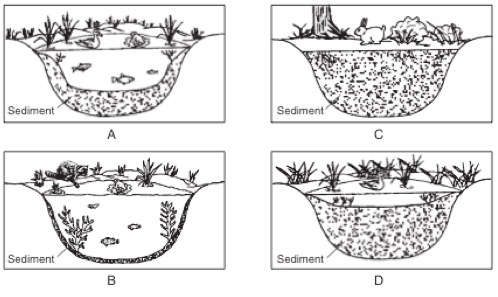
What is the correct order in this pond succession? (YOUNGEST to OLDEST)

a)

A, B, C, D

b)

D, C, B, A

c)

B, A, D, C

d)

C, D, A, B

16.
What is formed during primary succession that doesn't need to be formed during secondary succession?
a)
pioneer species
b)
soil
c)
climax community
d)
lichens
17.

Which experiences the least change over time?

a)

Pioneer Species

b)

Primary Succession

c)

Aquatic Succession

d)

Climax Community

18.

What term best relates to equilibrium?

a)

pioneer species

b)

primary succession

c)

secondary succession

d)

climax community

19.

If farmers use a controlled burn to prevent forest fires, what would most likely be the first plants to return?

a)

trees

b)

shrubs

c)

mosses

d)

grasses

20.

What would happen to the bird if the green fish died out?

a)

the bird population would grow

b)

the bird population would die out

c)

the smaller fish will die out

21.

the top layer of an energy pyramid a primary consumer?

a)

true

b)

false

22.

What is the bottom layer of the an energy pyramid?

a)

producer

b)

tertiary consumer

c)

Secondary consumer

d)

primary consumer

23.

What would happen if their were no producers?

a)

Every population would grow larger

b)

Everything would die out

c)

The animals would make their own food

24.
In an energy pyramid, energy_______ as you move up the pyramid.
a)
Increases
b)
Decreases
c)
Stays the same
d)
Changes up and down
25.
In the energy pyramid here, how much of the energy in the producers gets passed to the herbivores?
a)
10%
b)
20%
c)
80%
d)
90%
26.
The deer, grasshopper, and bird are all examples of which type of consumers on this food pyramid?
a)
decomposers
b)
omnivores
c)
carnivore
d)
herbivore
27.

Which organism in the food web shown to the right would

contain the lowest concentration of chemical pollutants?

a)

producers

b)

primary consumers

c)

secondary consumers

d)

tertiary consumers

28.
Which animal is the apex predator?
a)
hawk
b)
lizard
c)
snake
d)
grass
29.

The phenomenon by which toxins concentrate in the organisms at higher trophic levels within an ecosystem is known as...

a)

Biotoxicity

b)

Biomagnification

c)

Eutrophication

d)

Predation

30.
What does a food web represent?
a)
All connections of energy flow throughout all organisms in a habitat.
b)
The specific ways that mutualism is carried out.
c)
A single pathway or energy flow between organisms. 
d)
How carnivores get their food. 
31.

Which of the following correctly shows an energy pyramid?

a)

A

b)

B

c)

C

d)

D

32.

Consider the following food chain:

Algae > Mayfly > Minnow > Trout

In a polluted ecosystem, which organism would likely have the HIGHEST level of toxic chemicals in its body?

a)

Algae

b)

Mayfly

c)

Minnow

d)

Trout

33.
New fuels are being produced by converting corn and grasses into compounds containing alcohols that can be broken down for energy in various engines. The purpose of this research is to
a)
 reduce the use of nonrenewable resources.
b)
increase the rate of air pollution.
c)
reduce the rate of homeostasis in organisms.
d)
 cause a loss of biodiversity in the rain forests.
34.
The presence of wastes, such as plastic bags and motor oil, in lakes and streams miles away from developed areas suggests that
a)
. ecosystems are interconnected and human action can alter ecosystem equilibrium.
b)
recycling programs have failed to conserve biotic resources.
c)
natural processes can alter ecosystem stability.
d)
 direct harvesting practices have led to irreversible destruction of ecosystems.
35.
A community is concerned about the water quality of a nearby lake. Increased sedimentation in the lake is endangering the native habitat. The increased sedimentation is most likely caused by which of the following?
a)
trees planted along the shore of the lake
b)
construction of homes along the lake
c)
the amount of sunlight on the lake
d)
the amount of fish in the lake
36.
One way that humans could have a positive impact on local environments is to:
a)
generate waste products as a result of technological advances
b)
use resources that are renewable
c)
increase planting large areas of one crop
d)
increase the use of pesticides
37.
Biotic factors would include all but..
a)
humans
b)
fish
c)
Trees
d)
soil