Wayground logo

Free Printable Worksheets

Font size

S
M
L
XL
Worksheets

Transformations Test Review

Total questions: 53

Worksheet time: 2hrs 37mins

Name
Class
Date
1.
Determine how to translate triangle A'B'C' to triangle ABC.
a)
(x+2, y-5)
b)
(x+2, y-9)
c)
(x-2, y-9)
2.
Determine where X' would be if you translated X 3 units to the left and 9 units down.
a)
(-4, 4)
b)
(-10, 2)
c)
(-4, -5)
d)
(-1, 5)
3.
Determine where T' would be if you translated T 3 units to the right and 6 units up.
a)
(5, 1)
b)
(2, -5)
c)
(-1, 1)
d)
(8, -2)
4.
How is trapezoid ABCD translated to trapezoid A'B'C'D'?
a)
Translated 5 units down and 5 units to the right
b)
Translated 5 units down and 1 to the right
c)
Translated 8 units down and 5 units to the right
d)
Translated 5 units down and 4 units to the right
5.
How would you translate point P to P'?
a)
Translate 2 units to the right and  8 units down
b)
Translate 3 units down and 2 units to the right
c)
Translate 4 units down and 4 units to the left
d)
Translate 8 units to the right and 2 units down
6.
How do you represent a translation Algebraically? 
a)
(-y, -x)
b)
(x + a, y + b)
c)
(-x , -y)
d)
(ax, by)
7.
How is Quadrilateral EFGH translated to E'F'G'H'?
a)
6 down
b)
6 down, 1 right
c)
6 down, 3 left
d)
8 down, 1 right
8.
Determine how to translate triangle A'B'C' to triangle ABC.
a)
(x+2, y-5)
b)
(x+2, y-9)
c)
(x-2, y-9)
9.
The original figure prior to a transformation.
a)
Pre-image
b)
Image
10.
The result of a transformation.
a)
Pre-image
b)
Image
11.
What transformation is happening?
(x, y) ----> (x + 2, y - 3) 
a)
slide up 2, left 3
b)
slide right 2, up 3
c)
slide right 2, down 3
d)
slide left 3, right 2
12.
What does this transformation say to do?
(x, y) -----> (x, y +4) 
a)
slide down 4
b)
slide up 4
c)
slide right 4
d)
slide left 4
13.
Identify the transformation.
a)
Reflection across y-axis
b)
90 Rotation counter clockwise
c)
Translation 5 units left, 1 unit up.
d)
Translation 5 units right, 1 unit down
14.

What is the angle of the clockwise rotation?

a)

90°

b)

180°

c)

270°

15.

How many degrees was the figure rotated?

a)

270 degrees clockwise

b)

180 degrees

c)

90 degrees clockwise

16.

What type of rotation does this represent (from red to blue)?

a)

270⁰ clockwise

b)

180⁰

c)

90⁰ clockwise

17.

Triangle A is rotated 270° clockwise with the origin as the center of rotation to create a new figure. Which triangle shows the new location?

a)

A

b)

B

c)

C

d)

D

18.
Triangle B is rotated 180° clockwise with the origin as the center of rotation to create a new figure. Which triangle shows the new location?
a)
A
b)
B
c)
C
d)
D
19.

What is another word for rotation?

a)

Turn

b)

Flip

c)

Slide

d)

Shrink

20.
Identify the transformation from A to D.
a)
90o Clockwise Rotation
b)
180o Rotation
c)
270o  clockwise Rotation
d)
360o Rotation
21.

Find K' if the figure is reflected across the x-axis

a)

(4, 1))

b)

(-1, -4)

c)

(1, -4)

d)

(1, 4)

22.

Where will A' be at, if triangle ABC is reflected over the y axis?

a)

(2,1)

b)

(1,-2)

c)

(-1,2)

d)

(1,2)

23.

T or F: the line of symmetry is an imaginary line where you can fold the image and make both halves match exactly.

a)

True

b)

False

24.

T or F: Rigid motion is another word for transformation.

a)

False

b)

True

25.

T or F: Translation means flipping a shape over a certain line.

a)

False

b)

True

26.

Name this quadrilateral.

a)

square

b)

rhombus

c)

trapezoid

d)

rectangle

27.

What is the name of this quadrilateral?

a)

square

b)

rectangle

c)

rhombus

d)

parallelogram

28.

What is the name of this quadrilateral? (be specific)

a)

isosceles trapezoid

b)

trapezoid

c)

quadrilateral

d)

rhombus

29.

What is this quadrilateral called?

a)

square

b)

parallelogram

c)

trapezoid

d)

rhombus

30.

Classify the quadrilateral.

(For each question use the most specific classification)

a)

parallelogram

b)

rectangle

c)

rhombus

d)

square

e)

kite

31.

Classify the quadrilateral.

a)

trapezoid

b)

rectangle

c)

rhombus

d)

square

e)

kite

32.

Find the unknown value in each quadrilateral.

a)

290

b)

70

c)

92

d)

360

33.

Classify the quadrilateral.

a)

square

b)

kite

c)

rhombus

d)

rectangle

e)

parallelogram

34.

Classify the quadrilateral.

a)

square

b)

rectangle

c)

kite

d)

trapezoid

e)

parallelogram

35.

Classify the quadrilateral.

a)

rhombus

b)

kite

c)

trapezoid

d)

parallelogram

e)

square

36.
Name the transformation.
a)
Translation
b)
Reflection
c)
Rotation
37.
A turn is also called a ___________.
a)
Translation
b)
Reflection
c)
Rotation
d)
Transformation
38.

What type of polygon is this?

a)

parallelogram

b)

rhombus

c)

kite

d)

trapezoid

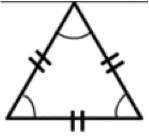
39.
a)
Equilateral Triangle
b)
Scalene Triangle
c)
Isosceles Triangle
d)
Right Triangle
40.

Under what composition of transformations does triangle ABC map onto triangle A''B''C''

a)

Reflection over x-axis, then Rotation of 90 Degrees

b)

Rotation of -90 Degrees, then Reflection over y-axis

c)

Reflection over y-axis, then Rotation of -90 Degrees

d)

Rotation of 90 Degrees, then Reflection over x-axis

41.

If the red triangle is rotated 180 degrees, then reflected over y=2 what is the final image?

a)

Green Triangle

b)

Blue Triangle

c)

Orange Triangle

d)

Red Triangle

42.

What is the transformation from Triangle ABC to Triangle A''B''C''?

a)

Reflection x-axis, then rotation of 180 Degrees

b)

Reflection over y-axis, then rotation of 90 Degrees

c)

Rotation of 90 Degrees, then reflection over x-axis

d)

Rotation of 180 Degrees, then reflection over y-axis

43.

What is the distance between A' and A'' if A is (-3,5) and reflected over x=-5 then over x=-2?

a)

10 units

b)

11 units

c)

7 units

d)

9 units

44.
When you translate, (x,y+6) will move _____.
a)
6 units right
b)
6 units left
c)
6 units up
d)
6 units down
45.
What is the rule for the following reflection? 
a)
Reflection across       y-axis
b)
Reflection across        x-axis
c)
Reflection across            y = x
d)
Reflection across          y = −x
46.
What is the rule for the following reflection? 
a)
Reflection across       y = −2
b)
Reflection across        x = −2
c)
Reflection across            x = 2
d)
Reflection across          y = 2
47.
What is the rule for the following reflection? 
a)
Reflection across       y = −2
b)
Reflection across        y = 2
c)
Reflection across            x = 2
d)
Reflection across          x =  −2
48.
What is the rule for the following reflection? 
a)
Reflection across       y = −1
b)
Reflection across        y = 1
c)
Reflection across            x = −1
d)
Reflection across          x = 1
49.
What is the rule for the following reflection? 
a)
Reflection across       y = −1
b)
Reflection across        y = 1
c)
Reflection across            x = −1
d)
Reflection across          x = 1
50.
What are the series of rigid motions that would map ∆ABC onto ∆A''B''C''?
a)
a reflection followed by a rotation
b)
a reflection followed by a translation
c)
a translation followed by a rotation
d)
a translation followed by a reflection
51.
Which of the following describes the sequence of transformations shown?
a)
Reflect across the x-axis and then rotate -90 degrees around the origin
b)
Rotate -90 degrees around the origin and then translate down.
c)
Reflect across the x-axis and then reflect across the y-axis.
d)
Translate up and then rotate 90 degrees about the origin.
52.
What is the rule for the following reflection? 
a)
Reflection across      x-axis
b)
Reflection across        y-axis
c)
Reflection across            y = x
d)
Reflection across          y = −x
53.
Chose the correct transformation:
(x, y) ----- (x + a, y)
a)
Translation up
b)
Translation left
c)
Translation down
d)
Translation right