wayground logo

Free Printable Worksheets

Font size

S
M
L
XL
Worksheets

QSMA#1Review + Road to Rev., DOI, Art. of Confederation

Total questions: 71

Worksheet time: 1hrs 9mins

Name
Class
Date
1.
Why did England impose taxes on the colonies?
a)
Pay for the cost of a new navy.
b)
Build roads to the Ohio River Valley.
c)
Show colonists who was in charge.
d)
Pay off debts owed from the French and Indian War.
2.
Under the Articles of Confederation Congress could only pass a law if ____________ out 13 states agreed. 
a)
13
b)
8
c)
9
d)
10
3.
The law that required colonists to house & feed British soldiers?
a)
Quartering Act
b)
Sugar Act
c)
Tea Act
d)
Intolerable Acts
4.
One weakness of the Articles of the Confederation was ____________. 
a)
The ability of Congress to tax.
b)
The inability of Congress to tax.
c)
The ability of Congress to declare war.
d)
The ability of Congress to create courts.
5.
In order to change (amend) the Articles of Confederation,  __________ out of 13 states had to agree. 
a)
9
b)
10
c)
13
d)
15
6.
Under the Articles of Confederation, each state got __________ vote. 
a)
b)
2
c)
1
d)
5
7.
The incident where American colonists engaged in conflict with British soldiers on King Street, and British soldiers shot & killed 5 American colonists
a)
Boston Tea Party
b)
Boston Massacre
c)
Battle at Lexington
d)
Boston Red Sox
8.
What did the Stamp Act tax?
a)
Sugar
b)
Animal furs
c)
Paper products
d)
Glass
9.
Colonist were especially upset with the British government because it did not allow the -
a)
colonial business to support royal taxes
b)
colonists to have representation in Parliament
c)
powers of colonial legislatures to increase
d)
laws passed by parliament to govern the colonies
10.
Which of these was a common slogan associated (connected) with the American Revolution?
a)
"Remember the Alamo!"
b)
"No taxation without representation!"
c)
"Fifty-four forty or fight!"
d)
"Remember the Maine!"
11.
What is a refusal to buy goods called?
a)
congress
b)
repeal
c)
boycott
d)
bankrupt
12.
These acts were passed by British Parliament in
order to punish the colonists after the Boston Tea
Party
a)
Tea Act
b)
Intolerable Acts
c)
Stamp Act
d)
Sugar Act
13.
What is the name of the first written plan of government in America?
a)
Constitution
b)
Treaty of Paris
c)
Declaration of Independence
d)
Articles of Confederation
14.
Americans were afraid that a __?__ would lead to tyranny, or oppressive rule.
a)
strong state government
b)
weak government
c)
strong central government
d)
legslature
15.
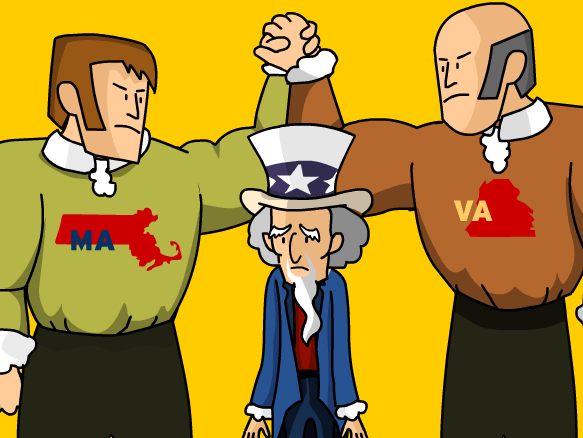
Under the Articles of Confederation, most of the power was where?
a)
Legislative branch
b)
the president
c)
the states
d)
national government
16.
How many branches of government were there under the Articles of Confederation?
a)
One
b)
Zero
c)
Two
d)
Three
17.
Which is a weakness of the Articles of Confederation?
a)
Congress couldn't collect taxes
b)
Weak central government
c)
Provided for no common currency
d)
All of the these
18.
a written set of laws or guidelines
a)
confederation
b)
constitution
c)
federalism
d)
legislation
19.

The sharing of power between central/national and state governments is called ...

a)

legislative

b)

federalism

c)

constitution

d)

nationalism

20.
The Declaration of Independence states the purpose of government is 
a)
to tax and control finances
b)
to provide rules for the people
c)
to regulate trade 
d)
to serve the people
21.
According to the Declaration of Independence, what was an “unalienable right” that all governments should protect?
a)
The right to social equality
b)
The right to elect government officials
c)
The right to religious equality
d)
The right to personal liberty
22.
Which statement best describes the role of government according to the Declaration of Independence?
a)
“The main purpose of government is to expand and glorify the state”
b)
“The main purpose of government is to protect the unalienable rights of individuals”
c)
“The main purpose of government is to protect the rights and privileges of His Majesty, the King”
d)
“The main purpose of government is to promote the general welfare of the community by taking steps toward social equality”
23.
 Who wrote the Declaration of Independence?
a)
Benjamin Franklin
b)
James Madison
c)
Thomas Edison
d)
Thomas Jefferson
24.
Thomas Jefferson was inspired by a famous man of the Enlightenment.  His name was...?
a)
William Penn
b)
Roger Sherman
c)
John Locke
d)
Robert Livingston
25.
What are the three inalienable rights that all people have?
a)
Food, Shelter, and Clothing
b)
Life, Liberty and Death
c)
Life, Liberty and the Pursuit of Happiness
26.
According to the Declaration,  what causes a government to be just? 
a)
powerful institutions
b)
a Bill of Rights 
c)
ease of altering 
d)
Consent of the people being governed
27.
According to the Declaration of Independence, what truth was "self-evident"?
a)
All men are created equal
b)
Rights are given by good kings
c)
Government exists to protect us from ourselves
d)
Only a democracy can protect our rights
28.
The List of Grievances were the part of the Declaration that
a)
detailed the colonists' complaints with King George.
b)
listed a man's natural rights.
c)
introduced the Declaration.
d)
concluded the Declaration, declaring America a free country.
29.
To Great Britain, the signing of the Declaration of Independence was
a)
an act of loyalty.
b)
an act of treason.
c)
an act of bravery.
d)
an act of insanity.
30.
Why is July 4, 1776 an important date in U.S. history?
a)
Common Sense was published.
b)
The Olive Branch Petition sent to King George III.
c)
The American Revolution ends.
d)
The Declaration of Independence is signed.
31.

Which of the following led to the writing of the Declaration of Independence?

a)

Colonists started to trade more

b)

Colonists became more religious

c)

Colonists wanted change in the government

d)

Colonists wanted more help from the military

32.

What did the Colonists do after the Stamp Act?

a)

Boycott British goods

b)

Made their own goods

c)

Decided they didn't need goods

d)

Stopped paying all of their taxes

33.

If people want to change the government, which ideal from the DOI does that represent?

a)

Self-evident

b)

alter or abolish government

c)

Consent of the governed

d)

Unalienable rights

34.

What were the colonists response to the harsh taxes and English policies?

a)

Boycotted buying British stuff

b)

Went back to England

c)

Teamed up with the French and fought the Native Americans

d)

Killed the King

35.

What event resulted in Britain passing the Intolerable Acts?

a)

Boston Massacre

b)

Revolutionary War

c)

Declaration of Independence

d)

Boston Tea Party

36.

Which document argued that King George was a tyrant and the American colonies should rule themselves?

a)

The Constitution

b)

The Articles of Confederation

c)

The Declaration of Independence

d)

The Tea Act

37.

Which document served as the rule book for America's FIRST government (not successful)?

a)

Declaration of Independence

b)

Articles of Confederation

c)

U.S. Constitution

d)

The Federalist Papers

38.

Which of the following powers did the central government NOT have in the Articles of Confederation?

a)

Tax citizens

b)

Run a post office

c)

Make treaties

d)

Deal with Native American nations

39.
Which of the following is an example of a weakness in the Articles of Confederation?
a)
Congress couldn't collect taxes
b)
Weak national government
c)
Provided no common currency/money for all 13 states
d)
All of the  above
40.
Why was this first U.S. government so weak?
a)
King George III  was still in charge of USA
b)
Americans were afraid to give their new government too much power
c)
The American army did not win their independence from Great Britain and King George III
d)
ask; no
41.
The Declaration of Independence states, “That whenever any form of government becomes destructive of these ends, it is the Right of the People to alter or abolish it.” Which Enlightened idea do these words describe?
a)
need to ensure a representative government.
b)
social contract between government and the people.
c)
revolutionary intent to overthrow the current government.
d)
return to a society that has no central authority.
42.
Who wrote a pamphlet called "Common Sense"?
a)
George Washington
b)
Thomas Paine
c)
Thomas Jefferson
d)
Patrick Henry
43.
Who was the primary writer of the Declaration?
a)
Benjamin Franklin
b)
John Adams
c)
George Washington
d)
Thomas Jefferson
44.
What is another word for grievances?
a)
happiness
b)
complaints
c)
abolish
d)
inalienable
45.

The Constitution gives too much power to the central government, overpowering the states.

a)

Federalist

b)

Antifederalist

46.
AntiFederalists criticized the US Constitution because governing power was concentrated in the
a)
National Government
b)
State legislatures
c)
Delegates to the Constitutional Convention
d)
President's Cabinet
47.
Which viewpoint was common among Anti-Federalists?
a)
There is no need for a separate Bill of Rights
b)
The Constitution does not give enough power to states
c)
The Constitution will strengthen the government
d)
A strong national gov't will protect the people in crisis
48.
What document replaced the Articles of Confederation and established a new national government? 
a)
The Declaration of Independence 
b)
The Constitution 
c)
The Magna Carta 
d)
The English Bill of Rights 
49.

I am a poor farmer - which group am I more likely to support?

a)

Patriotst

b)

Antifederalist

c)

Federalist

d)

Loyalist

50.

I am a wealthy businessman - which group am I more likely to support?

a)

Federalist

b)

Anti-federalist

c)

Loyalist

d)

Patriots

51.

Which group opposed the development of a strong federal government?

a)

Anti-Federalist

b)

Loyalist

c)

Federalist

d)

Patriots

52.

Wanted a stronger national government

a)

Loyalist

b)

Federalist

c)

Patriot

d)

Anti-federalist

53.

Which group opposed the Constitution until the Bill of Rights were included?

a)

Anti-federalist

b)

Federalist

c)

Loyalist

d)

Patriots

54.

Which group proposed and supported the Constitution?

a)

Anti-federalist

b)

Federalist

c)

Loyalist

d)

Patriots

55.

Locke argued that we had 3 main natural rights. What are they? (Select 3)

a)

Life

b)

Liberty

c)

Pursuit of Happiness

d)

Property

56.

What is a social contract?

a)

an agreement among the members of a society

b)

book written by Montesquieu

c)

Taylor Swift's next album title

d)

test given to citizens every two years

57.

Which American Founding Father did John Locke influence the most?

a)

Ben Franklin

b)

George Washington

c)

John Adams

d)

Thomas Jefferson

58.

Which American Founding Father did John Locke influence the most?

a)

Ben Franklin

b)

George Washington

c)

John Adams

d)

Thomas Jefferson

59.

What role did the government have, according to John Locke?

a)

Protect the people's natural rights

b)

Take away people's natural rights

c)

Help determine the people's natural rights

60.

Which idea is from the Magna Carta?

a)

The people should be completely free from the government.

b)

The people should support a strong central government.

c)

The government should have unlimited power to tax.

d)

The government should give people a fair and speedy trial.

61.
 Why did the Pilgrims create the Mayflower Compact?
a)
 to show that they opposed representative government.
b)
to establish an orderly community
c)
 to reinforce the laws of England in the new colony
d)
 to guarantee universal religious tolerance in the colony
62.

a pamphlet published by Thomas Paine in 1776 to convince the American colonists to support becoming independent from England

a)

Magna Carta

b)

Mayflower Compact

c)

English Bill of Rights

d)

Common Sense

63.

If the Magna Carta was a symbol for something, it would be _____. (Choose All That Apply)

a)

The King is not above the law

b)

The English people do have rights

c)

The King has absolute power

d)

All of These

64.

a government document that expanded the powers of the English Parliament and expanded the rights of the people, as well as further limited the rights of the king; written by the members of the English Parliament in 1689

a)

Magna Carta

b)

Mayflower Compact

c)

English Bill of Rights

d)

Common Sense

65.

popular or representative system where the people create and run their own government

a)

limited government

b)

rights

c)

due process

d)

rule of law

e)

self-government

66.

All people must follow the laws, and the laws should be enforced fairly.

a)

limited government

b)

rights

c)

due process

d)

rule of law

e)

self-government

67.

People have the right to fair and reasonable laws. Officials have to follow rules when enforcing laws and need to treat all people in the same way.

a)

limited government

b)

rights

c)

due process

d)

rule of law

e)

self-government

68.

What are a few of the documents that influenced the Founding fathers?

a)

Magna Carta, Common Sense, Constitution

b)

Magna Carta, Preamble, English Bill of RIghts

c)

Magna Carta, Common Sense, English Bill of Rights

d)

Magna Carta, Mayflower Compact, Emancipation Proclamation

69.

An agreement made by the people to establish a government and obey its laws

a)

consent of the governed

b)

limited government

c)

self-government

d)

common law

70.

When the Founding Fathers divided our government into three branches and instituted a system of checks and balances in the Constitution of the United States, they were most closely reflecting the ideas of

a)

Thomas Hobbes

b)

John Locke

c)

Montesquieu

d)

Rousseau

71.

When one branch of government uses its power to stop another branch , that is an effect of

a)

Separation of Powers

b)

Check and Balances

c)

Social Contract

d)

Natural Rights