Wayground logo

Free Printable Worksheets

Font size

S
M
L
XL
Worksheets

Characteristics of our Solar System Test

Total questions: 50

Worksheet time: 59mins

Name
Class
Date
1.

Mercury is the planet closet to the Sun. It has frozen water on its poles, and it has an extremely thin atmosphere. During the day, the temperature reaches 850oF. At night, its temperature can drop to -275oF. Could life from Earth survive on Mercury? Why or why not?

a)

Yes, because Mercury has an atmosphere

b)

No, because the temperatures are too extreme

c)

Yes, because Mercury has water and sunlight

d)

No, because life can only exist in the place where it first evolved

2.

Which of these conditions is most responsible for Earth having an environment that supports life?

a)

the percentage of nitrogen in the atmosphere

b)

water that exists in all three physical states of matter

c)

erupting volcanoes moderating atmospheric temperatures

d)

oceans regulating climate on land

3.
Mercury, Venus, Earth, and Mars are called.....?
a)
Jovian Planets
b)
Awesome Sauce Planets
c)
Gas Giants
d)
Inner Planets
4.
What do we call Jupiter, Saturn, Uranus and Neptune?
a)
Outer Planets
b)
Terrestrial Planets
c)
Inner Planets
d)
Oort Cloud
5.
What is the big bang theory?
a)
A movie
b)
A planet
c)
A theory of how Jupiter will crash into Saturn
d)
A theory of how the Universe began
6.
What is the only planet known to contain life?
a)
Mars
b)
Earth
c)
Neptune
d)
Uranus
7.
Which is the largest object in our solar system?
a)
Sun
b)
Jupiter
c)
Earth
d)
Pluto
8.
Which statement best describes a galaxy?
a)
a cluster of millions of stars held together by gravity
b)
a star, with planets, moons and other small space bodies revolving around it
c)
all known objects
d)
all of the above
9.
What is located between the inner and outer planets.
a)
Sun
b)
Asteroid belt
c)
Uranus
d)
Moons
10.
Which planets are terrestrial planets
a)
Inner planets
b)
Outer planets
c)
Both
d)
Asteroid belt
11.
A force of attraction between any two objects is called _____________.
a)
static electricity 
b)
rotation
c)
gravity
d)
orbit
12.

On the Earth, water can exist in all three states of matter- solid (ice), liquid (water), and gas (water vapor).

a)

True

b)

False

13.
The theory that explains the formation of the solar system is called ____.
a)
Nebulis Theory
b)
Nebular Theory
c)
Big Bang Theory
d)
Big Nebulan Theory
14.
Nebulae are primarily composed of what element?
a)
Hydrogen
b)
Helium
c)
Other hard elements
d)
Zinc
15.
A giant sphere of glowing gases is a ___________
a)
Galaxy
b)
Light-year
c)
Star
d)
Magnitude
16.
The __________ has planets, moons, comets, and asteroids.
a)
solar system
b)
earth
c)
rotation
d)
United States
17.
How long ago was our sun formed?
a)
10 million years ago
b)
5 million years ago
c)
4.5 billion years ago
d)
2 billion years ago
18.
What force acted on the massive nebula to collapse it and eventually form our sun?
a)
electrostatic force
b)
strong force
c)
 weak force
d)
gravity
19.
What is the nebular hypothesis?
a)
Prediction about how the universe was formed
b)
Prediction of how the moon was formed
c)
Prediction of how comets were formed
d)
Prediction of how the Solar System was formed
20.
the process that provides the sun with its energy
a)
solar flare
b)
Photosphere
c)
radiative zone
d)
nuclear fusion
21.
Nebula's are mixtures of gases and what?
a)
clouds
b)
stars
c)
tiny particles
d)
dust
22.
The ______is between the orbits of Mars & Jupiter.
a)
solar system
b)
asteroid belt
c)
terrestrial planets
d)
photosphere
23.
Mercury, Venus, Earth and Jupiter are the inner planets
a)
True
b)
False
24.
Planets revolve around the sun.
a)
True
b)
False
25.
The sun is a planet.
a)
True
b)
False
26.
A cloud of gas and dust from which bodies in space are formed
a)
photosphere
b)
nebula
c)
solar flare
d)
Sunspot
27.
the process that provides the sun with its energy
a)
solar flare
b)
Photosphere
c)
radiative zone
d)
nuclear fusion
28.
Energy is created in the core when two _____________ atoms join together to form a ______________ atom.
a)
helium, hydrogen
b)
carbon, hydrogen
c)
nitrogen, helium
d)
hydrogen, helium
29.
Which is not a name that identifies Mercury, Venus, Earth and Mars?
a)
Terrestial
b)
Gas Giant
c)
Inner Planets
d)
Rocky Planets
30.
The universe is expanding!  This means that:
a)
all of the galaxies are spreading out.
b)
the universe must have started from a single point.
c)
the universe is cooling down.
d)
all of the above.
31.
The universe is ____________ years old.
a)
8.13 billion
b)
13.8 billion
c)
1.83 billion
d)
381 million
32.
Without stars, we wouldn't have:
a)
Hydrogen
b)
Quarks
c)
Gold
d)
Protons
33.

The Big Bang Theory explains the formation of the...

a)

Earth

b)

Sun

c)

Universe

d)

Solar System

34.
What does the Big Bang theory suggest?
a)
The universe was just there
b)
The Milky Way is the only solar system
c)
The universe is continually expanding
d)
The universe is collapsing in toward a single point
35.

What are planets outside our solar system officially called?

a)

Ecoplanets

b)

Exoplanets

c)

Alien Worlds

d)

Exoworlds

36.

What is the habitable zone?

a)

too hot

b)

too cold

c)

just right

37.

Which galaxy do we live in?

a)

Andromeda

b)

ESO 146-IG 005

c)

Milky Way

d)

Seque 2

38.

How many stars are in the Milky Way?

a)

Over 400 billion

b)

Over 1 billion

c)

Over 4 million

39.

The Milky Way is a spiral

a)

True

b)

False

40.

How many moons does the Earth have?

a)

zero

b)

nine

c)

one

d)

one hundred

41.

The Milky Way Galaxy would best be classified as…

a)

Barred Galaxies

b)

Spiral Galaxies

c)

Elliptical Galaxies

d)

Irregular Galaxies

42.
Why do other stars appear so much smaller than the sun?
a)
They are much smaller
b)
They are so far away
c)
They are not as bright
d)
They are dwarf stars
43.
What color of star is the hottest?
a)
Blue
b)
Red
c)
Yellow
d)
Orange
44.
What is the name of the largest stars?
a)
Protostars
b)
Supergiants
c)
Red Giants
d)
Dwarf Stars
45.
True or False
Stars are really close together in outer space.
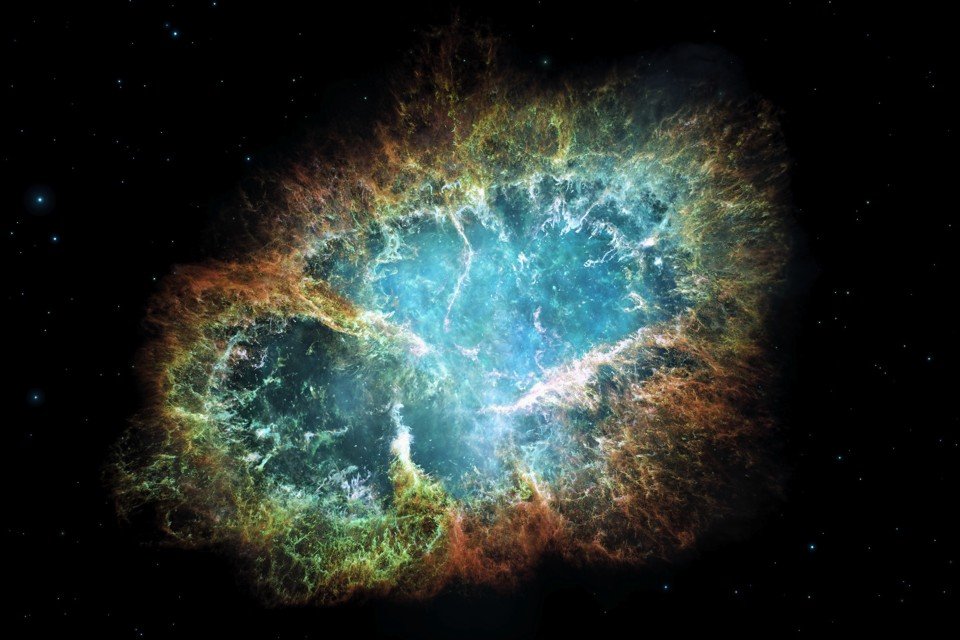
a)
True
b)
False
46.
What is the name of the explosion at the death of a massive star?
a)
Supergiant
b)
Supernova
c)
Black Hole
d)
Nebula
47.
What are stars?
a)
Rocky bodies
b)
Hot exploding balls of gas
c)
5 pointed shapes
d)
Hollywood actors
48.

How many stars are in space?

a)

10,000

b)

millions

c)

trillions

49.

The main gases that burn within the sun are

a)

Oxygen and Nitrogen

b)

Hydrogen and Oxygen

c)

Neon and Sulfur

d)

Hydrogen and Helium

50.
What is the name of the gas/dust clouds where all stars form?
a)
Nebulas
b)
Protostars 
c)
Supernova
d)
Neutron Star