wayground logo

Free Printable Worksheets

NEW

Font size

S
M
L
XL
Worksheets

Civics Unit 1

Total questions: 47

Worksheet time: 45mins

Name
Class
Date
1.
When people agree to have a government
a)
Government
b)
Democracy
c)
Oligarchy
d)
Social Contract
2.
What is Consent of the Governed?
a)
When the people say they do NOT want a government
b)
When the people agree to obey the government
c)
Rights that everyone should have
d)
Declaration of Independence
3.
The Declaration of Independence...
a)
Was the plan for the US government
b)
started the first Democracy
c)
started the first oligarchy
d)
separated the US from England and made it it's own country
4.
Why did the US want to split from England?
a)
The King of England was taxing them too much
b)
The King of England was giving them too much money
c)
The King of England was giving them too much freedom
d)
The King of England was protecting them
5.
Which city in Greece had Democracy?
a)
Chicago
b)
London
c)
Moscow
d)
Athens
6.
Why did the Colonists want to be independent from England?
a)
They felt the King of England was unfair and didn't care about the colonists
b)
They did like the English flag
c)
They wanted to become communist
7.

Obeying the law is a(n) ________ of citizenship.

a)

responsibility

b)

right

c)

duty/obligation

d)

none of the above

8.

As American citizens, we have duties to our country. What does duty mean?

a)

Something a citizen should do because it seems right

b)

Something that a citizen is required to do because it is moral or legal.

c)

Being loyal to America

9.

We also have responsibilities as citizens. What does responsibility mean?

a)

Something a citizen should do because it seems right.

b)

Something that a citizen is required to do because it is moral or legal.

c)

The privileges we have as citizens.

10.

What important theory of government did Thomas Hobbes and John Locke develop?

a)

Evolution Theory

b)

Force Theory

c)

Divine Right Theory

d)

Social Contract Theory

11.
Philosophers of the Enlightenment wanted to use __________ in all areas of life.
a)
A. government
b)
B. economics
c)
C. politics
d)
D. reason
12.
Locke believed that a government's power came from its ___________________.
a)
A. army
b)
B. power
c)
C. people
d)
D. science
13.
American's used _________________'s idea of separation of powers to write the US Constitution. 
a)
A. Montesquieu
b)
B. Hobbes
c)
C. Rousseau
d)
D. Voltaire
14.
The belief that government should be split into three branches to prevent one person or group from becoming corrupt.
a)
A. philosophe
b)
B. natural rights
c)
C. separation of power
d)
D. checks and balances
15.
Related to the idea of separation of powers; each branch of government must have approval from other branches in order to do certain functions.
a)
A. philosophe
b)
B. natural rights
c)
C. separation of power
d)
D. checks and balances
16.
Enlightenment philosopher who believed to limit government, that it should be divided into separate branches that shared power.
a)
John Locke
b)
Montesquieu
c)
Rousseau
d)
Voltaire
17.
According to John Locke, why are governments created?
a)
God gives monarchs a divine right to rule over their people
b)
People are naturally selfish and need a strong ruler to create order
c)
People set up governments to protect their lives and property
d)
Civil government must be established to offset the power of the church
18.
Which Enlightenment philosopher argued that people have the right to abolish their government and create a new one?
a)
Montesquire
b)
Locke
c)
Voltaire
d)
Rousseau
19.
An agreement between people and the government to give up some rights for safety and protection
a)
Philosophers
b)
Democracy
c)
Social Contract
d)
Divine Right of Kings
20.

French Enlightenment philosopher who strongly believed in freedom of speech and religion

a)

Voltaire

b)

Baron de Montesquieu

c)

Jean Jacques Rousseau

d)

John Locke

21.
An agreement between people and the government to give up some rights for safety and protection
a)
Philosophers
b)
Democracy
c)
Social Contract
d)
Divine Right of Kings
22.

Who said all men are created equal?

a)

Issac Newton

b)

George Washington

c)

Christopher Columbus

d)

John Locke

23.

Who wrote the Social Contract?

a)

Galileo Galilei

b)

King Louis XVI

c)

Jean-Jacques Rousseau

d)

Voltaire

24.
According to the Declaration of Independence, what truth was "self-evident"?
a)
All men are created equal
b)
Rights are given by good kings
c)
Government exists to protect us from ourselves
d)
Only a democracy can protect our rights
25.
According to the Declaration of Independence, where does government get its power?
a)
From the King
b)
From the Supreme Court
c)
From God
d)
From the people
26.
The List of Grievances were the part of the Declaration that
a)
detailed the colonists' complaints with King George.
b)
listed a man's natural rights.
c)
introduced the Declaration.
d)
concluded the Declaration, declaring America a free country.
27.
What are our natural rights according to Jefferson?  (He got the idea from John Locke, but he changed the last right.)
a)
Freedom of speech, religion, and press
b)
Life, liberty, and property
c)
Life, liberty, and the pursuit of happiness
d)
Voting, rebelling, and health
28.
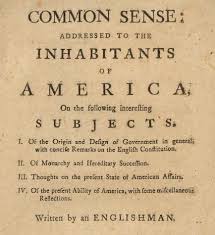
Who wrote a pamphlet called "Common Sense"?
a)
George Washington
b)
Thomas Paine
c)
Thomas Jefferson
d)
Patrick Henry
29.

Who is the main author of the DoI?

a)

George Washington

b)

Thomas Jefferson

c)

John Adams

d)

Obama

30.

This was a direct response to the Boston Tea Party

a)

Declaration of Independence

b)

Intolerable Acts

c)

Stamp Act

d)

Tea Act

31.
After the French and Indian War, Parliament passed new laws for the colonies. These laws were passed because Britain
a)
was afraid the French would support the colonies.
b)
was afraid many of the colonists would return to Britain.
c)
needed the colonists to help pay for the war. 
d)
wanted the Native Americans to return to their lands. 
32.
Parliament passed the Tea Act in 1773. This caused colonists to protest in the form of the Boston Tea Party. What was the Boston Tea Party?
a)
Colonists gave dinners to support the sale of the tea. 
b)
Colonists dressed as Indians destroyed the tea. 
c)
Colonists bought tea from other countries. 
d)
Colonists started growing their own tea. 
33.
In 1765, Parliament and King George passed the Stamp Act. What was the purpose of this act?
a)
It was to get rid of colonists who were willing to support the king. 
b)
It was to raise money by passing a tax on tea, sugar, and molasses. 
c)
It was to get rid of the French colonists in the Northern colonies. 
d)
It was to raise money by passing a tax on newspapers and other paper documents. 
34.
There were many reasons why the American Revolution took place between Britain and the colonies. Some of the colonists were unhappy with "no taxation without representation". What does that mean?
a)
The colonists should not be taxed unless they were represented in Parliament. 
b)
The colonists should not be taxed because they could not vote for the King.
c)
The colonists should not be taxed unless the taxes were used in the colonies. 
d)
The colonists should not be taxed because no one should be taxed. 
35.

This act allowed England to make all decisions for the colonists and tax anything they wanted.

a)

The Declaratory Act

b)

The Townshend Acts

c)

The Sugar Act

d)

The Stamp Act

36.

This law placed a tax on all printed material in the colonies including wills, contracts, newspapers, and playing cards.

a)

The Declaratory Act

b)

The Stamp Act

c)

The Intolerable Acts

d)

The Coercive Acts

37.

This act gave an unfair advantage to a the British East India Company by allowing the British company to not pay tax on tea.

a)

The Tea Act

b)

The Townshend Act

c)

The Coercive Act

d)

The Declaratory Act

38.

These acts placed a tax only on imported goods like paper, glass, tea, and lead.

a)

The Intolerable Acts

b)

The Coercive Acts

c)

The Townshend Acts

d)

Writs of Assistance

39.
Slavery was abolished in 1865 by
a)
Amendment 3
b)
Amendment 4
c)
Amendment 13
d)
Amendment 14
40.
Which amendment protects the freedom of religion, speech, press, assembly, and petition?
a)
Amendment 1
b)
Amendment 17
c)
Amendment 2
d)
Amendment 4
41.
Amendment 15 says that all citizens have the right to ______________ regardless of race
a)
A fair trial
b)
Rebel
c)
Vote
d)
State their opinion
42.
The News Gazette contains a section about opinions and editorials.  What idea in the amendments protects the right to publish opinions and editorials?
a)
Freedom of the Press
b)
Search and Seizure
c)
Rights of People
d)
Trial by Jury in Civil Cases
43.
What freedom gives you the right to say anything you want just long as you are not  threatening safety of anyone?
a)
Press
b)
Petition
c)
Assembly
d)
Speech
44.
Things that we must do are called ___________.
a)
Right
b)
Responsibilities 
c)
Duties 
d)
Concerns 
45.
Things that should do are called
a)
Rights 
b)
Responsibilities 
c)
Duties 
d)
Concerns 
46.

Gave all citizens born in the United States citizenship

a)

13th Amendment

b)

14th Amendment

c)

15th Amendment

d)

16th Amendment

47.

The rights due to all U.S. citizens under the constitution are called

a)

Nonviolent protests

b)

Civil rights

c)

Voting Rights

d)

the Bill of Rights