
 Worksheets
Overreacting
Total questions: 87
Worksheet time: 1hrs 25mins
How many Al atoms are in this compound? 4Al2O3
2
8
6
4
6MgF2

Is this chemical equation balanced? Why or why not? Choose the BEST answer.
Yes, the amount of atoms for each element are equal on both the reactant and product side.
No, the carbons are not the same number on both the reactant and product side.
No, neither the carbons or hydrogens are the same amount on both the reactant and product side.
No, none of the elements (carbon, hydrogen, or oxygen) are the same amount on both the reactant and product side.
KClO3 --> KCl + O2

NaCl + Ca(NO3)2 -->

Why are chemical equations always balanced? Select ALL that apply.
Matter cannot be created.
Matter cannot be destroyed.
Matter can only be rearranged/conserved.
Matter doesn't matter.
What charge do electrons have?
positive
negative
neutral
Subatomic particles with a negative charge
Electrons
Neutrons
Protons
Quarks
An atom has 10 protons and 11 neutrons. What is the atomic number
10
11
21
22
Which of the following elements is a metal?
Sodium
Oxygen
Hydrogen
Argon
An atom has a mass of 35 and an atomic number of 17. How many neutrons does this atom have?
35
17
18
52
How are ions formed?
Gaining or losing protons
Gaining or losing neutrons
Gaining or losing electrons
Gaining of losing mass


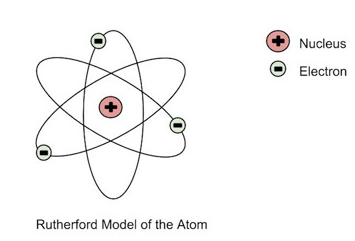


Rutherford, Dalton, Bohr, Thomson

An isotope of an element has the same number of _________, but a different number of _________.
Protons, electrons
Protons, neutrons
Electrons, neutrons
Neutrons, protons


Which type of radiation releases an electron?
Alpha radiation
Beta radiation
Gamma radiation
Theta radiation

What particle is released when an unstable isotope undergoes alpha radiation?
a helium nucleus
an electron
a photon of light
a neutron

What type of decay is shown here
23892U ---> 23490Th + 42He.
alpha
beta
gamma
Name the ionic compound, CaCO3
calcium carbide
calcium carbon trioxide
calcium carbon oxide
calcium carbonate
Name the ionic compound, FeBr3
Iron (II) bromide
Iron (III) bromide
What is the name for AlBr3?
aluminum bromide
aluminum tribromide
aluminum bromine
monoaluminum tribromide

In a chemical reaction, if the reactants are heated, the reaction usually happens
slower
faster
at the same rate
in a smaller volume
What does it mean for a reaction to be endothermic? Choose 2 of the following.
When two substances react, the temperature of the mixture decreases.
When two substances react, the temperature of the mixture increases.
There is less energy going into the reactant to break the bond than there is energy leaving the product.
There is more energy going into the reactant to break the bond than there is energy leaving the product.
The amount of energy entering and leaving is the same.
What does it mean for a reaction to be exothermic? Choose 2 of the following.
When two substances react, the temperature of the mixture decreases.
When two substances react, the temperature of the mixture increases.
There is less energy going into the reactant to break the bond than there is energy leaving the product.
There is more energy going into the reactant to break the bond than there is energy leaving the product.
The amount of energy entering and leaving is the same.
If the temperature at which a reaction occurs increases, the number of collisions decreases.
True
False
Orientation of molecules during a reaction does not affect the production of products.
True
False
Predict the precipitate when you mix silver nitrate and sodium chloride:
AgNO3
No precipitate
AgCl
NaNO3
When you mix magnesium nitrate and sodium hydroxide
No precipitate
NaOH
NaNO3
Mg(OH)2
The collision theory states that atoms, ions, and molecules must collide in order to react.
True
False
HCl + Zn --> ZnCl2 + H2
Hydrochloric acid + magnesium hydroxide -->

In heat transfer, heat always flows from the _______________ substance to the _______________ substance.
Hotter to colder
Colder to hotter
Hotter to hotter
Colder to colder

Look at the solubility curve - as a GENERAL rule (that means there are exceptions, as always, in science) what trend can be states about how temperature affects the solubility of the compounds shown.
Temperature has NO affect.
The relationship is inversely proportional - as temperature increases, the solubility decreases.
The relationship is directly proportional - as temperature increases, the solubility increases.
It varies - the solubility will increase and then decrease when it reaches a certain temperature.

You can buy salt in different forms - granulated (like what you have on your table), course ground (kosher salt) and rock salt (for making ice cream).
If you used the rock salt as the solute in a rate of dissolving investigation, which of the following WOULD NOT increase the rate at which the rock salt would dissolve?
Crushing the solute.
Stirring the solution.
Heating the solution.
Increasing the amount of solute.
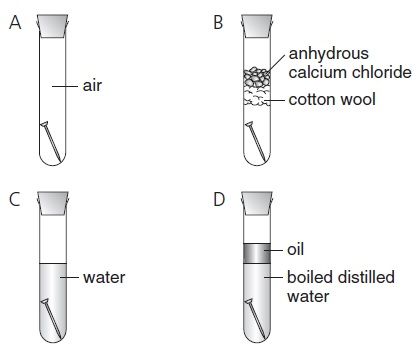
Which diagram shows the most favourable conditions for rust to appear on the nail?
A
B
C
D
Which of the following is / are examples of sacrificial protection against rusting?
(1) Iron object coated with tin
(2) Underground iron pipes connected to magnesium bars
(3) Iron railings coated with paint
(1) only
(2) only
(1) and (3) only
(2) and (3) only
Galvanizing is a process of:
Applying a Zinc coating to bare steel
Washing the body with the phosphate coating
dipping a body in E-COAT
Chemically etching primer to steel

What is the chemical nature of rust?
iron (II) oxide
hydrated iron (II) oxide
iron (III) oxide
hydrated iron(III) oxide

What conditions are required for rusting?
water only
oxygen only
water and oxygen
Which metal is more reactive than calcium?
magnesium
potassium
silver
aluminum
The correct equations for dissolving a salt is
NaOH(s) --> Na+(aq) + OH-(aq)
NaOH(s) --> Na(aq) + OH(aq)
NaOH --> Na + OH
The simplified equation for corrosion:
Fe + O2 -> Fe3O2
Fe + O -> FeO
Fe + O2 -> Fe2O3

