
 Worksheets
24–25 Chemistry Midterm Honors Review
Total questions: 86
Worksheet time: 1hrs 5mins
Olivia is comparing two elements that are in the same group on the periodic table. She wants to know in which property these two elements are MOST similar. Which property should she look at?
atomic mass.
number of protons.
atomic size.
chemical reactivity.
Abigail is learning about the elements in her science class. She notices that a group of elements called noble gases are different from others. What is unique about the noble gases?
They are diatomic elements.
They are highly reactive.
They have a full valence shell and are nonreactive.
They all have the same number of protons.
Benjamin is learning about metals in his science class. He discovers that sodium is a metal with one valence electron. Which of these elements has properties similar to sodium?
magnesium
potassium
aluminum
calcium
James is studying a sample of beryllium in his science class. He finds that each atom has 4 protons, 4 electrons, and 5 neutrons. What is the mass number of the beryllium atom James is studying?
4
5
8
9
Abigail is conducting an experiment and her atom gains 3 electrons. What will the charge be of the ion formed?
0
+3
-3
none of the above
Arjun is helping his younger sibling with chemistry homework. They are looking at the periodic table and come across phosphorus (atomic number 15). Based on its position in the periodic table of the elements, how many valence electrons does phosphorus have?
3
5
8
15
Jackson is working in a chemistry lab and is studying how metal atoms change to form ions. Metal atoms will MOST likely form ions by the
loss of electrons.
loss of protons.
gain of electrons.
gain of protons.
Rohan is studying the periodic table and wants to find out how many neutrons an atom of fluorine, F has. Can you help him?
9
10
7
19
Rohan is comparing the sizes of three different objects made from Silicon (Si), Sulfur (S), and Magnesium (Mg). He wants to rank them from smallest to largest. Help Rohan by choosing the correct order.
Si < S < Mg
S < Si < Mg
Mg < Si < S
S < Mg < Si
Michael is studying the periodic table and learns that chlorine (Cl) has a certain number of protons. He wonders: an atom of which element contains one more proton than one atom of chlorine (Cl)?
sulfur (S)
argon (Ar)
fluorine (F)
bromine (Br)
Arjun is conducting an experiment to find out which set of elements has similar bonding properties. He is comparing the following sets:
Cl, Br, and F
K, Ca, and Sc
Kr, Cl, and O
Be, C, and O
Aria is conducting an experiment in her chemistry class and needs to find an element with chemical properties MOST similar to those of calcium, Ca. Based on their locations in the periodic table, which element should she choose?
beryllium, Be
potassium, K
titanium, Ti
yttrium, Y

James is studying ions in his chemistry class. He looks at a model of a magnesium ion where the rings represent energy levels and the dots represent electrons that reside in those levels. Based on the model, which magnesium ion is represented?
Mg1−
Mg1+
Mg2+
Mg2−
Nora is helping her younger sibling understand the periodic table. She points out that helium (He) is placed at the top of group 18 (8A) and asks, "Can you guess why helium is located here on the periodic table?" What is the reason for helium being at this location?
Helium has a filled outer energy shell.
Helium is a very reactive gas.
Helium loses its electrons easily.
Helium is a transition metal.
Lidia was helping her science teacher organize a display of noble gases for the school science fair. She noticed two models: one labeled He with two electrons around the nucleus and one labeled Ne with a full outer shell of eight electrons. Which is a common property of the two atoms shown?
The electron structure supports inactivity.
The electrons in both are available to bond.
The number of protons is the same in both atoms.
The valence electrons in both atoms bond with metals only.
Imagine Mia is lining up a series of balls, each labeled Na, Mg, Al, Si, P, S, Cl, and Ar, on a table. She notices that as she moves from the ball labeled Na to the one labeled Ar, each ball gets a little smaller. An arrow above the balls is labeled Atomic Radius Decreases. Which BEST describes what tends to occur that results in this decrease in atomic radius?
The elements transition from gases to liquids to solids.
The attraction between the nucleus and electrons increases.
The size of the nucleus increases, forcing electrons outward.
The repulsion between electrons outside the nucleus increases.
Grace is helping her younger sibling with a science project. She shows a model of an atom with a nucleus, inner orbitals, and one valence electron in the outermost shell. She asks, "In which group on the periodic table would this element be found?"
1 (1A)
14 (4A)
17 (7A)
18 (8A)
Charlotte is conducting an experiment where she mixes hydrogen gas and oxygen gas in a sealed container. She observes that after the reaction, the total mass of the container and its contents remains the same, even though water is formed from the gases. Which scientific law BEST demonstrated by Charlotte's experiment?
law of angular momentum
law of universal gravitation
law of conservation of mass
law of conservation of energy
Zoe is conducting an experiment to create an ionic compound. She has samples of potassium (K), vanadium (V), iodine (I), and xenon (Xe). Based on their electron configurations, which element will MOST likely gain electrons from another element during the formation of the ionic compound?
potassium (K)
vanadium (V)
iodine (I)
xenon (Xe)
Jackson is helping his younger sibling with chemistry homework. He needs to identify which electron configuration shows the arrangement of electrons in an atom of bromine. Which option should Jackson choose?
[K]4s2 3d10 4p5
[Ar]4s2 3d0 4p5
1s2 2s2 2p6 3s2 3p6 4s2 4d0 4p5
1s2 2s2 2p6 3s2 3p6 4s2 3d10 4p5
Noah is organizing a collection of different metals for a science project. He notices that lithium, sodium, and potassium all behave in a similar way when placed in water. What observation was likely a factor in Noah's decision to group these elements together?
They all have similar reactivity.
Their mass numbers are almost identical.
Their atomic numbers are separated by eight units.
They all have a single electron in their highest energy level.
Olivia is conducting an experiment and discovers an unknown element with the electron configuration 1s2 2s2 2p5. She wants to find another element that would have chemical properties similar to this unknown element. Which of the following should Olivia choose?
silicon
lithium
oxygen
chlorine

Oliver is learning about how table salt (NaCl) forms. He reads that the following statements are true for ionic bonding EXCEPT
bonding between metal and non metal
electrostatic forces between opposite charges
transferring of electrons
sharing of electrons

Lily and Isla are working on a science project about how different types of chemical bonds form. They are discussing covalent compounds. What do covalent compounds do?
Share electrons
transfer electrons
contain a sea of electrons
conduct electricity

The element rubidium, Rb, is immediately below potassium in the Periodic Table.
It reacts with bromine to form the compound rubidium bromide.
Which descriptions of this compound are correct?
A
B
C
D

Which compound contains ionic bonds?
A
B
C
D

The diagram below represents a chlorine atom. The small dark circles represent electrons surrounding the nucleus.
Which of the atoms pictured would be most likely to bond with a single chlorine atom?


Ionic or Covalent Bonding?
Ionic Bonding
Covalent Bonding

What type of bonding does this picture show?
Ionic
Covalent
Ionic bonds are between...
Metal and Non-metal
Non-metal and Non-metal
Metal and Metal
What is the correct name for NO?
Mononitrogen Monoxide
Nitrogen Monoxide
Mononitrogen Dioxide
Nitrogen Oxide
The chemical formula of sulfur hexabromide is
SBr₆
S₆Br
S(VI)Br
S6Br
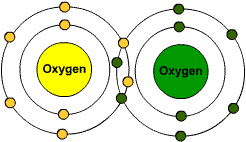
Is this image an example of covalent bonding?
Yes
No


What two types of atoms make a covalent bond?
2 Nonmetals
1 Nonmetal and 1 Metal
2 Metals
2 Noble Gases
Identify the following compound as ionic or covalent: CF4
ionic
covalent
What is the molar mass of C6H12O?
100.61 g/mole
100.11 g/mole
100.16 g/moles
84.18 g/mole
How many moles are in 0.072g of FeCl3?
162.2 moles
0.0004 moles
11.7 moles
0.04 moles
How many molecules are in 3.2x10²² moles?
6.02x10²³ molecules
1.9 molecules
1.9x1046 molecules
0.053 molecules
How many moles are in 2.35g of H2O?
0.13 moles
18.02 moles
42.347 moles
2.35 moles
If there are 9.6x10¹⁵ particles of sugar in a solution, how many moles of sugar are there?
1.59x10⁸ moles
6.02x10²³ moles
1.59x10⁻⁸ moles
What is the molar mass of NaCl?
58.44 g/mol
22.99 g/mol
35.45 g/mol
40.00 g/mol
How many grams are in 1 mole of CO2?
44.01 grams
28.01 grams
60.01 grams
12.01 grams
Disodium sulfide
Disodium sulfide
NaBr
KF
What is the formula for tetranitrogen hexahydride
N5H7
N6H8
N4H6
N3H10
What is the formula for heptacarbon nonaiodide
C8I6
C5I4
C6I10
C7I9
What is the formula for dihydrogen monosulfide?
H2S
H10S9
H3S4
HS2
What is the formula for pentasulfide dichloride?
S5Cl2
S4Cl2
S7Cl2
S4Cl3
Which of the following is the formula of heptacarbon nonachloride?
C9Cl7
C6Cl4
C7Cl9
C5Cl6
NaBr
H2O

