
 Worksheets
Unit 1 - 3 Chem A Review
Total questions: 91
Worksheet time: 8hrs 41mins

Student A
Student B
Student C
Cannot be determined
____________ is a measure of how close measurements come to each other when they are made in the same way.
Accuracy
Precision
How close a measurement is to the accepted value is called ___________.
Accuracy
Precision
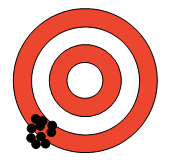
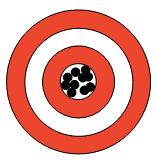
This bullseye demonstrates...
High Accuracy & High Precision
High Accuracy & Low Precision
Low Accuracy & High Precision
Low Accuracy & Low Precision
Which is the more precise measurement?
4 mL
4.3 mL
4.30 mL
4.300 mL
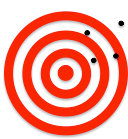
Describe the accuracy and precision of the image
Very accurate and somewhat precise
Very accurate but not precise at all
Not accurate at all but very precise
not accurate and not very precise
A set of data are all close in value to each other, but they are not close to the actual value. This set of data can be described as _________________.
precise
accurate
Accuracy means
the measurements are close to each other
the measurement is close to the true value
the measurements are close to each other
the measurements are close to each other and the true value.
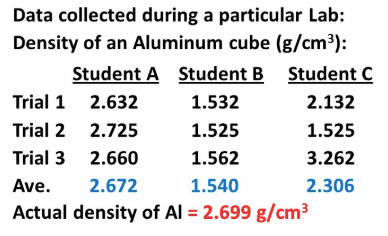
Which student is the most ACCURATE?
A
B
C
The unit for mass is...
Newton
grams
mililiters
centimeters

A graduated cylinder is used to measure...
Volume
mass
weight
density
The unit for volume is
grams
milliliters (mL)
Newton
cubic centimeters
What two types of measurements make up DENSITY?
Volume and Weight
Temperature and Mass
Mass and Volume

Measuring the volume of a block uses which equation
Length ×Width×Height
(radius)2×Length×π
What is the unit for density ?
g/ mL
g
cm3g
cm4
A block has a mass of 20.0 g and a volume of 40.0 cm3. What is its density?
2.0 g/cm3
1.2 g/cm3
0.500 g/cm3
0.5 g/mL
3 g/cm
8 g
If you have a gold brick that is 2.00 cm by 3.00 cm by 4.000 cm and has a density of 19.3 g/cm3, what is its mass?
264 g/cm3
463 g
2.80 g
If a block of wood has a density of 0.6 g/cm3 and a mass of 120 g, what is its volume?
300 cm3
200 cm3
100 mL
150 cm3
The students measured length during a science experiment, they got 12.00 cm. But the actual measurement was 14.25 cm. What was the percent error?
15.8%
18.8%
Find the percent error. Round to the nearest tenth of a percent.
Actual speed: 38 mph
Estimated speed: 35 mph
8.1%
0.79%
7.9%
6.8%
How do you write
8.317 x 10⁶
in standard form?
8, 371, 000
83, 170, 000
837, 100
8, 317, 000
How many sig. fig. are in the number below:
350.540
4
5
6
7
Round 1047.78 to three sig figs
104
105
1050
1050.00
For Fe+2, if the atomic number is 26 and it has 30 neutrons, then the number of protons is
A. 26
B. 28
C. 56
D. 24
Neutral atoms contain equal numbers of
A. electrons and neutrons
B. protons and neutrons
C. protons and electrons
D. protons, electrons and neutrons
The atomic number identifies the number of
A. protons
B. neutrons
C. mass number
D. isotopes
Group 1 elements are called
A. Alkaline earth metals
B. Alkali metals
C. Transition metals
D. Halogens
The least massive particle in an atom is the
A. proton
B. neutron
C. electron
Which of the following is NOT true of Noble gases?
A. They are extremely reactive
B. Colorless, odorless gases at room temperature
C. They are group 18 on the periodic table
D. They used to be referred to as inert gases
Identify the metalloid in group 13.
A. Silicon
B. Boron
C. Aluminum
D. Carbon
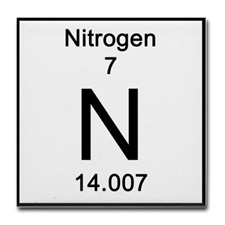
What subatomic particles would you find in the nucleus of an atom?
Protons only
Protons and Neutrons
Neutrons and Electrons
Protons and Electrons
If an atom has 10 protons, 10 neutrons, and 10 electrons, what is the mass of the atom?
10
20
30


Which elements are to the LEFT of the zigzag?
metals
nonmetals
metalloids

Which elements are colored red?
nonmetals
metals
metalloids
Which reaction represents fusion?




____ releases energy when atoms are split, while ______ releases energy when atoms are joined
fusion, fission
fission, fusion
fission, fission
fusion, fusion
Carbon-14 is commonly used in radiocarbon dating. How many protons, neutrons, and electrons does a carbon-14 atom have?
6 protons, 6 neutrons, 6 electrons
6 protons, 8 neutrons, 6 electrons
14 protons, 14 neutrons, 14 electrons
14 protons, 6 neutrons, 14 electrons

The isotope uranium-235 is used as fuel in nuclear reactors. How many protons and neutrons does a uranium-235 atom have?
92 protons, 235 neutrons
143 protons, 92 neutrons
92 protons, 143 neutrons
What is the difference between isotopes of the same element?
They have different atomic numbers.
They have different numbers of neutrons.
They have different numbers of electrons.
They have different numbers of protons.
Isotopes of the same element have different mass numbers
True
False
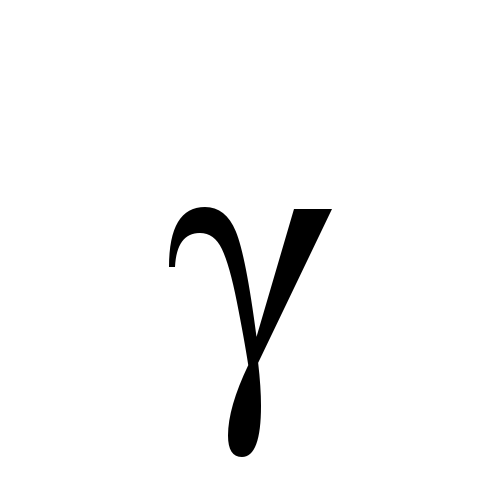
How is the alpha particle written in a nuclear equation?
42He
24He
0-1e
00γ

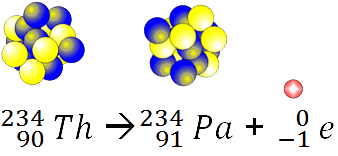
What type of radioactive decay is this example?
alpha
beta minus
beta plus
gamma
146C —› 0-1e + ____
126C
147N
148O
145B
1s22s22p63s23p64s23d10
1s22s22p63s2

How many electrons can the d sublevel(orbital) hold?
8
10
2
4

This shape is that of a/n:
s orbital
p orbital
d orbital
f orbital
What does the 1 in "1s" stand for?
energy level
s orbitals
p orbitals
the number of electrons


Which image shows an electron going to a grounded state?

Image A

Image B
What image shows a wave with a high frequency?


What is an atomic orbital?
Regions of space where electrons are likely to be found.
How many electrons can be held in the s-orbital?
Review: What are valance electrons?
How many valance electrons does Germanium have?
What are oxidation numbers?
Oxidation numbers are the charge an atom would have when it gets a full outer shell.
What is the oxidation number of potassium?
What is the oxidation number of Neon?
What is the oxidation number of Iodine?
When heated, electrons are ____________.
annoyed
irritated
excited
angered
Flame tests are most useful for
blood testing
watching fireworks
identification of elements
none of the above
When electrons change energy levels, when is light emitted?
When the electrons jumps to a higher energy level.
When an electron falls back to the ground state.
When the electrons jump to the excited state.
When electrons are resting.
Explain what was occuring during the flame test that caused the flame change colors.
The electrons gained energy and moved to an excited state.
The electrons gained energy and moved to an ground state.
The electrons released energy and moved to a ground state.
The electrons released energy and moved to an excited state.

