
 Worksheets
12 Regents: Thermodynamics, Kinetics and Equilibrium
Total questions: 85
Worksheet time: 1hrs 2mins
Choose all of the following that affect the rate of reactions?
surface area
temperature
concentration
None of the answers affect rate of reaction
Which of the following is the correct definition of entropy?
equal to the internal energy of the system plus the product of pressure and volume
the degree of disorder or randomness in the system.
accompanied by or requiring the absorption of heat
accompanied by the release of heat.
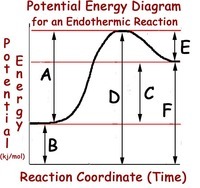
What letter represents the activation energy?
A
B
C
D
Enthalpy deals with the measurement of
Length
Area
Heat energy
Volume
What type of reaction occurs in a hand warmer
exothermic
endothermic
Given the change of phase: CO2(g) —> CO2(s). As CO2(g) changes to CO2(s), the entropy of the system
decreases
increases
remains the same

Which interval represents the heat of reaction for the reaction?
A
B
D
E
Reactions tend to be thermodynamically favored if they are exothermic.
True
False
Which of the following statements about catalysts is true?
It does not take part in the reaction
It increase the yield of the reaction
It provides an alternative pathway for the reaction
It increases the number of collisions between reacting molecules per second
Adding a catalyst to a chemical reaction changes the rate of reaction by causing
a decrease in the activation energy
an increase in the activation energy
a decrease in the heat of reaction
an increase in the heat of reaction

Which letter corresponds to the activation energy of the forward reaction?
A
B
C
D
When Alka-seltzer tablets are dropped in water, a gas is formed and the temperature of the water decreases. Alka-seltzer in water is an example of a
Endothermic reaction
Exothermic reaction
Dissolving a salt
physical change
Activation energy is required to start a chemical reaction. What is activation energy?
The maximum amount of energy used
The minimum amount of energy required to achieve the activated complex.
The energy of the reactants
The energy possessed by the products
During an endothermic reaction in a beaker if we are part of the surroundings and touched the beaker, it would feel _______.
Warm
Cold
The catalyst alters the rate of a chemical reaction by,
providing an alternative pathway with a lower Ea
changing the products formed in the direction of the reaction
providing a surface on which the molecules react
increasing the frequencies of collisions between molecules
Which term refers to the difference between the potential energy of the products and the potential energy of the reactants for any chemical change?
heat of deposition
heat of fusion
heat of reaction
heat of vaporization
In an endothermic reaction the system is releasing energy.
True
False
Decreasing the particle size increases the reaction rate because
It makes particles move faster
It increases the likelihood of collisions with the correct geometry
It decreases the surface area available to react
It increases the surface area of the reactants increasing the number of collisions
Which phase change represents a decrease in entropy?
solid to liquid
gas to liquid
liquid to gas
solid to gas
Temperature is a measure of the...
total energy in a substance
total kinetic energy in a substance
average potential energy in a substance
average kinetic energy of molecules in a substance
Which of the following definitions best describes enthalpy?
a change in pressure, temperature, or concentration of a reactant
the heat energy of the system.
the degree of disorder or randomness in the system.
states that energy can neither be created nor destroyed
If a catalyst is added to a system at equilibrium and the temperature and pressure remain constant, there will be no effect on the
rate of the forward reaction
activation energy of the reaction
rate of the reverse reaction
heat of reaction
As NaCl dissolves according to the equation NaCl(s) → Na+(aq) + Cl-(aq), the entropy of the system
Increases
Decreases
Remains the same
Which of the following would have the highest entropy?
A cold solid
A hot liquid
A hot gas
A cold gas

What kind of reaction is this?
Endothermic
Exothermic
Cannot be determined
ΔH value in an endothermic reaction is a positive number.
True
False
Do reactants in an endothermic reaction have a higher or lower energy than the products?
Higher
Lower
When one mole of a certain compound is formed from its elements under standard conditions, it absorbs 85 kiloJoules of heat. A correct conclusion from this statement is that the reaction has a
ΔH equal to –85 kJ/mole
ΔH equal to +85 kJ/mole
Δequal to –85 kJ/mole
Δequal to +85 kJ/mole
Entropy can be described as
the dispersal of matter
the dispersal of energy
the degree of disorder
all of these

Interval B in this potential energy diagram could be changed by adding a ________?
Cookies
More energy
Catalyst
Changing the temperature
Which of the following best describes Le Chatelier's Principle?
states that energy can neither be created nor destroyed
a thermodynamic quantity equivalent to the total heat content of a system.
a thermodynamic quantity representing the thermal energy in the system
a change in pressure, temperature or concentration of a reactant to a system in equilibrium will cause a shift to move the reaction away from the stress.

The addition of a catalyst to this reaction would cause a change in which of the indicated energy differences?
I
II
III
I and II
Given the reaction: CH4(g) + 2 O2(g) → 2 H2O(g) + CO2(g) According to Table I, what is the overall result when CH4(g) burns according to this reaction?
Energy is absorbed and H is negative.Δ
Energy is absorbed and ΔH is positive.
Energy is released and ΔH is negative.
Energy is released and ΔH is positive

For the reaction: Which direction would the chemical reaction flow if the pressure is increased?
right
left
The entropy will usually increase when
a molecule is broken into two or more smaller molecules
a reaction occurs that results in an increase in the number of moles of gas
a solid changes to a liquid
all of these
Which of these have a DECREASE in entropy?
CaCO3(s) → CaO(s) + CO2(g)
2NO2(g) → N2O4(g)
2NH3(g) → 3H2(g) + N2(g)
C6H6(l) → C6H6(g)
What two factors govern whether a collision between reacting particles will be effective?
orientation and potential energy
kinetic energy and temperature
kinetic energy and orientation
potential energy and kinetic energy
In table I the reaction of hydrogen and oxygen to form water is best described as
exothermic, because energy is released
endothermic, because energy is released
exothermic, because energy is absorbed
endothermic, because energy is absorbed
As NaCl dissolves according to the equation
NaCl(s) → Na+(aq) + Cl-(aq), the entropy of the system
Increases
Decreases
Remains the same
Which of the following would have the highest entropy?
A cold solid
A hot liquid
A hot gas
A cold gas
The entropy will usually increase when
a molecule is broken into two or more smaller molecules
a reaction occurs that results in an increase in the number of moles of gas
a solid changes to a liquid
all of these
Reactions tend to be thermodynamically favored if they are exothermic.
True
False
Systems in nature tend to undergo changes toward
lower energy and less disorder
lower energy and more disorder
higher energy and less disorder
higher energy and more disorder
Identify whether the following result in an increase or decrease in entropy:
3 moles of gas (on reactant side) --> 6 moles of gas (product)
increase
decrease

Entropy increases from solid, liquid to gas. Why?
Molecular disorder increases
Molecular randomness decreases
Molecules are more energetic
Molecules are more reactive
When ammonium nitrate dissolves in water, the solution gets cold. Which is true?
Reaction is ENDOTHERMIC with positive ΔH
Reaction is ENDOTHERMIC with -ΔH
Reaction is EXOTHERMIC with a -ΔH
Reaction is EXOTHERMIC with +ΔH
Solid magnesium dissolves in a hydrochloric acid, releasing hydrogen gas and heat from a solution of magnesium chloride. What is the sign on ΔH for this reaction?
Negative because it is exothermic
Negative because it is endothermic
Positive because it is exothermic
Positive because it is endothermic
High randomness indicates _________.
low entropy
high entropy
Dissolving sugar ________.
decreases the entropy
increases the entropy
Spontaneous reactions are driven by
increasing enthalpy and increasing entropy.
decreasing enthalpy and decreasing entropy.
increasing enthalpy and decreasing entropy.
decreasing enthalpy and increasing entropy.
Based on Table I, what is the ΔH value for the production of 1.00 mole of NO2(g) from its elements at 101.3 kPa and 298 K?
33.2 kJ
-33.2 kJ
132.8 kJ
-132.8 kJ
Systems in nature tend to undergo changes toward
lower energy and lower entropy
lower energy and higher entropy
higher energy and lower entropy
higher energy and higher entropy
A chemical reaction occurs when reactant particles
are separated by great distances
have no attractive forces between them
collide with proper energy and proper orientation
convert chemical energy into nuclear energy
Given the balanced equation representing a reaction:
CH4(g) + 2O2(g) → CO2(g) + 2H2O(g) + energy
Which change in reaction conditions will increase the frequency of effective collisions between reactant molecules?
decreasing the pressure of the reactants
decreasing the temperature of the reactants
increasing the concentration of the reactants
increasing the volume of the reactants
The energy absorbed and the energy released during a chemical reaction are best represented by a
cooling curve
heating curve
kinetic energy diagram
potential energy diagram
The amount of randomness of the atoms in a system is an indication of the
ground state of the atoms
entropy of the system
polarity of the system
excited state of the atoms
The rate of a reaction increases as temperature__________________.
Stays the Same
Increases
Decreases
The rate of a chemical reaction is NOT affected by which of the following:
temperature
concentration
particle size (surface area)
All of these affect reaction rates
A ______________ is a substance that increases the rate of a reaction without being used up during the reaction.
solute
reactant
product
catalyst
Catalysts permit reactions to proceed along a ___________energy path.
higher
lower
Smaller particle size allows for a _________ surface area to be exposed for the reaction.
larger
smaller
The ___________ the surface area of the reactants, the faster the reaction rate.
smaller
greater
Increasing the temperature will increase the kinetic energy of particles, therefore increasing the effectiveness and number of collisions between particles.
false
true
C+ O2 --> CO2 + 60kJ, what is the value for ΔH for the reaction?
+60
-60
there is no way to know

What happens to the equilibrium if we add methane (CH4)?
It shifts left, towards the reactants
It shifts right, towards the products
It does not shift
What happens to the equilibrium if we remove water (H2O)?
It shifts left, towards the reactants
It shifts right, towards the products
It does not shift
What happens to the equilibrium if we remove heat?
It shifts left, towards the reactants
It shifts right, towards the products
It does not shift
What happens to the equilibrium if we add hydrogen (H2)?
It shifts left, towards the reactants
It shifts right, towards the products
It does not shift

What happens when sodium ions (Na+) are added?
The reaction shifts left, towards the reactants
The reaction shifts right, towards the products
There is no shift
What happens when the system is cooled (heat is removed)?
The reaction shifts left, towards the reactants
The reaction shifts right, towards the products
There is no shift

The ratio of reactants to products does not change.
The concentration of the reactants must be equal to the concentration of the products.
N2 (g) + 3 H2 (g) <−> 2 NH3 (g)
If the pressure in the system is increased, the reaction will __________________.
Which of the following statements is CORRECT for a reaction at an equilibrium?
The rate of forward and reverse reactions are equal.
The final concentrations of product and reactant are equal.
The initial concentrations of product and reactant are equal.
The rate constant of the forward and reverse reactions are equal.

For the graph, choose the CORRECT statement.
The rate of reaction slowly increase
The systems never reach equilibrium
At equilibrium, more NO2 is present than N2O4.
At start of reaction, only NO2 was present.


Decreasing volume of container will

