

wayground logo

Free Printable Worksheets

Font size

S
M
L
XL
Worksheets

S21: Unit 5 Review

Total questions: 80

Worksheet time: 2hrs 25mins

Name
Class
Date
1.
How many valence electrons are represented here?
a)
7
b)
5
c)
2
d)
8
2.
How many d orbitals are there in a given sublevel?
a)
1
b)
3
c)
5
d)
7
3.
How many p orbitals are there in a sublevel?
a)
2
b)
1
c)
4
d)
3
4.
How many electrons can the first energy level hold?
a)
1
b)
2
c)
8
d)
0
5.
Which element is pictured?
a)
neon
b)
fluorine
c)
magnesium
d)
argon
6.
What noble gas should be used to write the shorthand configuration for Te?
a)
Ar
b)
Kr
c)
Xe
d)
Sb
7.
Identify the element in Period 5 that has 1 valence electron?
a)
Rb
b)
Nb
c)
Ag
d)
Sb
8.
What element in Period 4 has 5 valence electrons?
a)
Zr
b)
As
c)
V
d)
Sb
9.
Electron arrangement that uses arrows
a)
Electron configuration
b)
Shorthand configuration
c)
Lewis dot structure
d)
Orbital diagram
10.
What atom matches this electron configuration?
1s22s22p63s23p64s23d10
a)
Zinc
b)
Copper
c)
Nickel
d)
Germanium
11.
What atom matches this electron configuration?
1s22s22p63s2
a)
Neon
b)
Magnesium
c)
Aluminum
d)
Potassium
12.
Which electron configuration belongs to Chlorine (Cl)?
a)
1s2s2p3s3p5
b)
1s2s2p3s3p6
c)
1s2s2p3s3p7
13.

What is incorrect about this orbital diagram?

a)

Both arrows in the 2p box should be pointing up

b)

There is nothing incorrect with this diagram

c)

In the 2p box there should only be 1 electron in the first 2p box and one in the 2nd 2p box

d)

All the arrows should be pointing up.

14.
What is the electron configuration of sodium?
a)
2.8
b)
2.8.2
c)
2.8.1
d)
11
15.
What is the electron configuration of calcium?
a)
2.8.8.2
b)
2.8.10
c)
20
d)
2.18.2
16.
What is the electron configuration of Aluminium?
a)
2.8.3
b)
2.11
c)
13
d)
2.8.2
17.
 The diagram above represents two electrons with 
a)
a. opposite spins.
b)
 b. the same spin.
c)
c. different energies.
d)
d. different energy levels.
18.
What is the correct electron configuration for a ground-state atom with 7 electrons? 
a)
 a. 1s2 2s2 2p3
b)
 b. 1s2 2s2 2p2 3s1
c)
c. 1s2 2s3 2p2
d)
 d. 1s2 2s5
19.
Which is associated with more energy? 
a)
2p
b)
2s
c)
3p
d)
1s
20.
What is incorrect about this orbital diagram?
a)
Both arrows in the 2p box should be pointing up
b)
There is nothing incorrect with this diagram
c)
In the there should only be 1 orbital in the first 2p box and one in the 2nd 2p box
d)
All the arrows should be pointing up.
21.
Which is associated with more energy? 
a)
2p
b)
2s
c)
3p
d)
1s
22.
How many total electrons can the f orbitals in a sublevel hold?
a)
2
b)
14
c)
6
d)
10
23.
Rows on the period table are called _____ while columns are called _____.
a)
groups, families
b)
groups, periods
c)
periods, groups
d)
families, groups
24.
Electrons occupy orbitals of lowest energy first is part of what electron configuration rule?
a)
Hund’s Rule
b)
Aufbau Principle
c)
Pauli Exclusion Principle
25.
Electrons are paired based on their spin directions, clockwise and counterclockwise, is what electron configuration rule?
a)
Hund’s Rule
b)
Aufbau Principle
c)
Pauli Exclusion Principle
26.
Why do we use the three electron configuration rules: Hund's Rule, Aufbau Principle, and Pauli Exclusion Principle?
a)
to know where electrons are located
b)
to know how electrons are oriented in space
c)
to know how electrons are used in chemical reactions
d)
all of these
27.
Which orbital shows a violation of the Pauli Exclusion Principle?
a)
A
b)
B
c)
C
d)
D
28.
Which orbital shows a violation of the Aufbau Principle?
a)
A
b)
B
c)
C
d)
D
29.

What is incorrect about this orbital diagram?

a)

Both arrows in the 2p box should be pointing up

b)

There is nothing incorrect with this diagram

c)

In the 2p box there should only be 1 electron in the first 2p box and one in the 2nd 2p box

d)

All the arrows should be pointing up.

30.

This rule describes the order in which electrons are filled in all the orbitals belonging to a subshell.

a)

Aufbau Principle

b)

Hund’s Rule

c)

Pauli Exclusion Principle

d)

Electron Configuration Rule

31.

Pauli Exclusion Principle

a)

This rule describes the order in which electrons are filled in all the orbitals belonging to a subshell.

b)

This principle can also be stated as “no two electrons in the same atom have the same values for all four quantum numbers”.

c)

The Pauli exclusion principle states that a maximum of two electrons, each having opposite spins, can fit in an orbital.

d)

The Pauli exclusion principle states that a maximum of two electrons, each having opposite spins, can fit in an orbital.

32.

Hund’s Rule

a)

This rule describes the order in which electrons are filled in all the orbitals belonging to a subshell.

b)

According to this principle, electrons are filled in the following order: 1s, 2s, 2p, 3s, 3p, 4s, 3d, 4p, 5s, 4d, 5p, 6s, 4f, 5d, 6p, 7s, 5f, 6d, 7p…

c)

It states that every orbital in a given subshell is singly occupied by electrons before a second electron is filled in an orbital.

d)

In order to maximize the total spin, the electrons in the orbitals that only contain one electron all have the same spin (or the same values of the spin quantum number).

33.

Aufbau Principle

a)

According to this principle, electrons are filled in the following order: 1s, 2s, 2p, 3s, 3p, 4s, 3d, 4p, 5s, 4d, 5p, 6s, 4f, 5d, 6p, 7s, 5f, 6d, 7p…

b)

The energy of an orbital is calculated by the sum of the principal and the azimuthal quantum numbers.

c)

This principle is named after the German word ‘Aufbeen’ which means ‘build up’.

d)

The Aufbau principle dictates that electrons will occupy the orbitals having lower energies before occupying higher energy orbitals.

34.
Electrons occupy orbitals of lowest energy first is part of what electron configuration rule?
a)
Hund’s Rule
b)
Aufbau Principle
c)
Pauli Exclusion Principle
35.

What does Pauli exclusion principle state ?

a)

states that each electron occupies the lowest energy orbital available

b)

states that -no two electrons in the same orbital can have the same spin

c)

states that single electrons electrons with the same spin must occupy each-energy orbital before additional electrons with opposite spins can occupy the same orbitals
36.
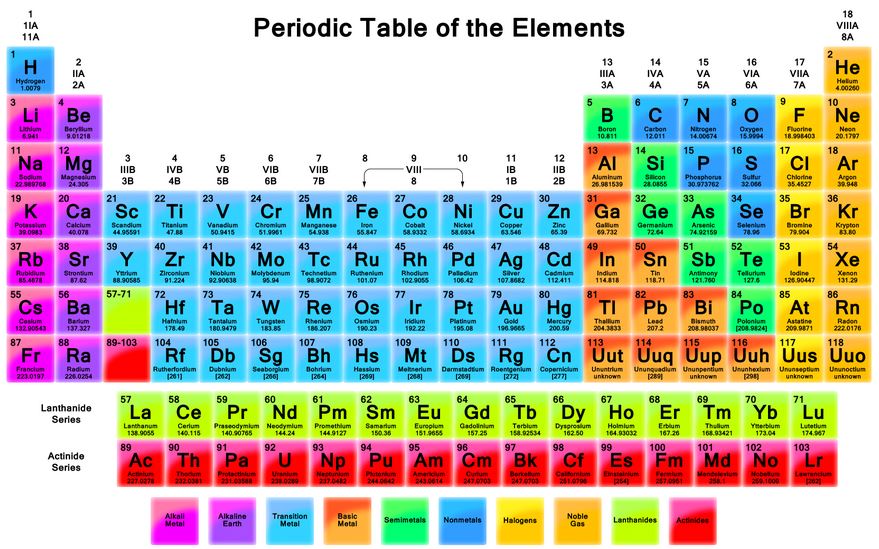
Anions are _______ that form ____________ ions and __________ electrons.
a)
nonmetals, positive, lose
b)
nonmetals, negative, gain
c)
metals, positive, gain
d)
metals, positive, lose
37.
Elements on the LEFT side of the periodic table will most likely form:
a)
Positive ions
b)
Negative ions
c)
Neutral Ions
d)
None of these
38.
Which type of bond has an equal sharing of electrons?
a)
Polar Covalent 
b)
Non Polar Covalent
c)
Ionic
d)
Metallic
39.
Which type of bond has an unequal sharing of electrons?
a)
Polar Covalent 
b)
Non Polar Covalent
c)
Ionic
d)
Metallic
40.
Which type of bond has a transfer of an electron from on atom to another?
a)
Polar Covalent 
b)
Non Polar Covalent
c)
Ionic
d)
Metallic
41.
Chemical bonds form when atoms
a)
combined nuclei
b)
give up neutrons
c)
gain protons
d)
share or transfer electrons
42.
Bonds that form between two metals are called ______________ bonds.
a)
ionic 
b)
covalent
c)
metallic
d)
pervasive
43.
If an atom loses two electrons what charge will it have?
a)
+ 2
b)
 - 2
c)
+1
d)
-1
44.
If an atom gains one electron what charge will it have?
a)
-2
b)
-1
c)
+1
45.
Covalent compounds
a)
Share electrons
b)
transfer electrons
c)
contain a sea of electrons
d)
conduct electricity
46.
What is the number of valence electrons for Oxygen?
a)
8
b)
6
c)
2
d)
1
47.
A bond that forms when electrons are transferred is called a/an
a)
ionic bond
b)
covalent bond
c)
hydrogen bond
48.
When electrons are shared unequally a/an ___________ bond is formed 
a)
ionic 
b)
hydrogen
c)
polar covalent 
49.
How are covalent bonds explained?
a)
When one atom takes the other atom's electron
b)
When the atom shares an electron with an another atom
c)
When the two nucleus merge
d)
When the neutrons leave the nucleus
50.
Which type of bond creates a "pool" of electrons between atoms?
a)
Ionic Bonds
b)
Covalent Bonds
c)
Metallic Bonds
d)
Saving Bonds
51.

Why do atoms bond?

a)

They typically don't bond

b)

To add or take away energy levels

c)

To have a full valence shell.

d)

To have a full inner shell

52.

Which category of elements usually form negative ions?

a)

metals

b)

nonmetals

c)

metalloids

d)

noble gases

53.

Predict the bond between Mg and Cl

a)

covalent

b)

ionic

c)

metallic

d)

none of the above

54.
Which of the following is ionic?
a)
NO2
b)
MgO
c)
CO
d)
CH4
55.

What charge would a potassium (K) ion have?

a)

+1

b)

-1

c)

+2

d)

-2

56.
Which of the following has a full valence shell?
a)
Oxygen
b)
Neon
c)
Barium
d)
Carbon
57.
Chemical bonds form when atoms
a)
combined nuclei
b)
give up neutrons
c)
gain protons
d)
share or transfer electrons
58.
If an atom loses two electrons what charge will it have?
a)
+ 2
b)
 - 2
c)
+1
d)
-1
59.

13. What elements generally make a covalent bond?

a)

metal and nonmetal

b)

2 or more nonmetals

c)

metal

d)

none of the above

60.

What is a valence electron?

a)

an electron that is found in the outermost shell of an atom.

b)

an electron found in the innermost shell of an atom.

c)

an electron found in the middle shell.

61.

What usually forms the positive ion?

a)

Metal

b)

Nonmetals

c)

None

62.

If I was trying to determine if two atoms will bond, what would be helpful to know:

a)

Valence electrons, found by group number

b)

Whether the elements are metals or nonmetals

c)

The electronegativity of the atoms

d)

All of the above, all of which can be found on the Periodic Table

63.

Which sub-atomic particle is involved in chemical bonding?

a)

Proton

b)

Neutron

c)

Electron

d)

Valence Electron

64.
Elements on the LEFT side of the periodic table will most likely form:
a)
Positive ions
b)
Negative ions
c)
Neutral Ions
d)
None of these
65.
Emission of light from an atom occurs when an electron
a)
drops from a higher to a lower energy level.
b)
   jumps from a lower to a higher energy level.   
c)
   moves within its atomic orbital.
d)
falls into the nucleus.
66.
For an electron to change from ground state to an excited stated it must...
a)
Absorb energy
b)
Release energy
67.
When talking about energy levels in an atom, what is an "excited state"?
a)
The highest energy state of an atom.
b)
Any level higher than the ground state.
c)
The lowest energy state of an atom.
d)
When an atom loses an electron
68.
Why are line emission spectra of elements called "atomic fingerprints"?
a)
They are all the same
b)
They are all unique
c)
They are all similar
d)
They all contain colored light
69.

A line spectrum is produced when an electron moves from one energy level

a)

into the nucleus

b)

to a higher energy level

c)

to another position in the same sublevel

d)

to a lower energy level

70.

Emission spectra emitted by an element (or compound) will produce ___ through a spectroscope.

a)

bright lines

b)

a continuous rainbow

c)

dark lines

d)

white light

71.

Which type of spectrum is this?

a)

Emission Spectrum

b)

Absorption Spectrum

c)

Continuous Spectrum

72.

The lowest energy configurations for electrons in an atom is called the

a)

neutral state

b)

home state

c)

ground state

d)

base state

73.
When talking about energy levels in an atom, what is an "excited state"?
a)
The highest energy state of an atom.
b)
Any level higher than the ground state.
c)
The lowest energy state of an atom.
d)
When an atom loses an electron
74.
Why are line emission spectra of elements called "atomic fingerprints"?
a)
They are all the same
b)
They are all unique
c)
They are all similar
d)
They all contain colored light
75.

A line spectrum is produced when an electron moves from one energy level

a)

into the nucleus

b)

to a higher energy level

c)

to another position in the same sublevel

d)

to a lower energy level

76.

Emission spectra emitted by an element (or compound) will produce ___ through a spectroscope.

a)

bright lines

b)

a continuous rainbow

c)

dark lines

d)

white light

77.

Which type of spectrum is this?

a)

Emission Spectrum

b)

Absorption Spectrum

c)

Continuous Spectrum

78.

The lowest energy configurations for electrons in an atom is called the

a)

neutral state

b)

home state

c)

ground state

d)

base state

79.

When a photon is absorbed by an electron and the electron changes energy level, the electron is described as being (a)  

80.

In (a)   spectroscopy the final spectrum is mostly black with some sharp lines of colour
