wayground logo

Free Printable Worksheets

Font size

S
M
L
XL
Worksheets

Midyear review 2025

Total questions: 82

Worksheet time: 2hrs 51mins
Name
Class
Date
1.
A mixture that appears to be evenly mixed throughout:
a)
an atom
b)
a compound
c)
a homogeneous mixture
d)
a heterogeneous mixture
2.
A pure substance...
a)
is an element or a compound
b)
is an element or a mixture
c)
is a compound or a mixture
d)
is a mixture
3.

A substance that cannot be broken down into any other substance by physical or chemical means is called —

a)

molecule

b)

mixture

c)

element

d)

compound

4.

Two or more substances physically put together form ________.

a)

a compoud

b)

an acid

c)

an element

d)

a mixture

5.

Fruit Loops, pizza, and Skittles are examples of ____________________ mixtures.

a)

heterogeneous

b)

homogeneous

c)

pure

6.

How would you classify the air we breathe?

a)

Element

b)

Compound

c)

Mixture

7.
A proton is a _____ charged particle.
a)
Negatively
b)
Positively
8.
An electron has a _____ charge.
a)
negative
b)
positive
c)
neutral
9.
Which particles make up the nucleus of an atom?
a)
protons and neutrons
b)
electrons and protons
c)
electrons, protons, and neutrons
d)
electrons and neutrons
10.
Sodium has an atomic number of 11, how many protons does this atom have?
a)
22
b)
11
c)
12
d)
2
11.
Elements can have the same number of protons?
a)
True
b)
False
12.
The subatomic particle that determines the identity of an element.
a)
neutron
b)
proton
c)
electron
d)
outer shell
13.
What is the mass number defined as?
a)
the number of protons
b)
the number of protons and neutrons
c)
the number of neutrons
d)
the number of protons and electrons
14.
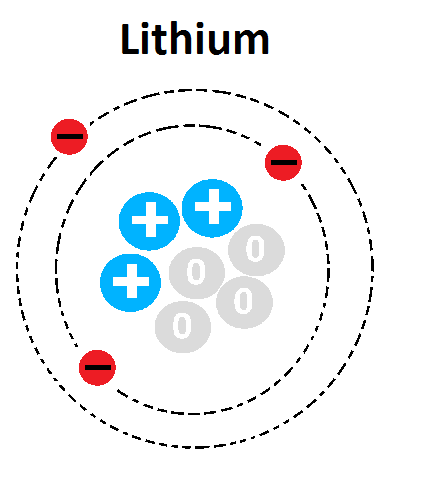
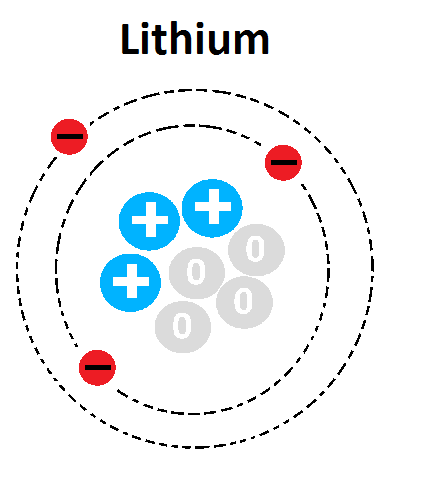
What is the atomic number of this atom?
a)
1
b)
3
c)
4
d)
7
15.

What is the mass number of this atom?

a)

1

b)

3

c)

4

d)

7

16.

An element has the mass number 12 and atomic number 6. The number of neutrons in it is:

a)

6

b)

10

c)

4

d)

8

17.

Atoms of the same element which have a different number of neutrons are called _________________.

a)

ions

b)

isotopes

c)

quarks

d)

molecules

18.

How many neutrons does an atom of the isotope Neon-22 have? (tap to enlarge the image)

a)

12

b)

10

c)

22

d)

20

19.

The number in Kr-84 represents what about Krypton?

a)

The number of electrons

b)

The number of protons

c)

The mass number

20.
Negative ions are called
a)
Cations
b)
Electrons
c)
Anions
d)
Neutrons
21.
Positive ions form when atoms _________ valence electrons.
a)
lose
b)
gain
c)
share
d)
gain or share
22.
When an atom loses a valence electron, it becomes a(n) _____________ ion.
a)
positive
b)
negative
c)
neutral
d)
polyatomic
23.
When an atom LOSES an electron it is a
a)
cation
b)
anion
24.

Elements that belong to the same group have the same number of

a)

valence electrons

b)

neutral electrons

c)

inner electrons

d)

total electrons

25.

Group 17 elements form

a)

anions

b)

cations

c)

metals

d)

semiconductors

26.

Most elements are

a)

metals

b)

nonmetals

c)

metalloids

d)

semiconductors

27.

Most nonmetals are

a)

brittle

b)

good conductors

c)

metalloids

d)

shiny

28.
24.1% of all the isotopes of a an element have a mass of 75.23 amu, 48.7% have a mass of 74.61 amu, and 27.2% have a mass of 75.20 amu.
What is the average mass of this element?
a)
74.92 amu
b)
24.97 amu
c)
75.01 amu
d)
74.51 amu
29.
The molar mass of an element is equal to its...
a)
Atomic mass
b)
Atomic number
c)
Oxidation number
d)
Valence electrons
30.
What is the molar mass of table salt (NaCl)?
a)
116.886 g/mol
b)
35.453 g/mol
c)
22.990 g/mol
d)
58.443 g/mol
31.
What is the molar mass of sodium?
a)
11
b)
23
c)
45.98
d)
3
32.
What is the molar mass of NaOH?
a)
40 g/mol
b)
38.989 g/mol
c)
23.998 g/mol
d)
57.004 g/mol
33.
What is the molar mass of CO2?
a)
12
b)
16
c)
32
d)
44
34.

How many atoms are in one mole of any substance?

a)

6.02 x 10²³

b)

2.06 x 1032

c)

22.4

d)

1

35.

How many atoms are in 9.44 moles of Al?

a)

5.68 atomsAl

b)

5.68x1024 atoms Al

c)

0.705 atoms Al

d)

1.25x10²³ atoms Al

36.

If the molar mass of magnesium (Mg) is 24.305 g/mol, how many grams are in 5 moles of Mg?

a)

121.525 g

b)

24.305 g

c)

121.5 g

d)

122 g

37.

Determine the number of moles in 25.0 grams of potassium sulfide (K2S).

a)

0.23 moles

b)

4.41 moles

c)

110.3 moles

d)

25.0 moles

38.

Which weighs more?

a)

1 mole of lithium

b)

1 moles of carbon

c)

1 mole of sodium

d)

1 mole of silicon

39.

Who developed the planetary model of the atom?

a)

Niels Bohr

b)

Ernest Rutherford

c)

John Dalton

d)

Democritus

40.

Democritus was known for

a)

discovering the electron

b)

discovering the proton

c)

creating the term atom, meaning indivisible

d)

discovering the nucleus

41.

John Dalton said that all atoms of the same element are _________________.

a)

identical

b)

indestructible

c)

indifferent

d)

ironic

42.

JJ Thomson discovered the

a)

nucleus

b)

proton

c)

neutron

d)

electron

43.

Who created the plum pudding model?

a)

JJ Thomson

b)

Ernest Rutherford

c)

Niels Bohr

d)

John Dalton

44.

What did Ernest Rutherford discover about the atom?

a)

The charge of the electron

b)

That the atom is a sphere

c)

The electron

d)

The proton

45.

What did Niels Bohr discover about electrons?

a)

Electrons orbit the nucleus

b)

Protons circle the nucleus

c)

The nucleus circle the atom

d)

Electrons don't exist

46.
The _______________ determines the color of visible light. 
a)
wavelength
b)
speed
c)
amplitude
d)
light
47.
Emission of light from an atom occurs when an electron
a)
drops from a higher to a lower energy level.
b)
   jumps from a lower to a higher energy level.   
c)
   moves within its atomic orbital.
d)
falls into the nucleus.
48.

The ground state is the ______________ energy state of an atom.

a)

highest

b)

lowest

49.
What atom matches this electron configuration?
1s22s22p63s23p64s23d10
a)
Zinc
b)
Copper
c)
Nickel
d)
Germanium
50.

There are __ energy levels

a)

1

b)

2

c)

7

d)

8

51.
How many atomic orbitals are there in the p sublevel?
a)
2
b)
3
c)
4
d)
5
52.
What is the noble gas configuration for phosphorus?
a)
[Ar] 3p5
b)
[He] 3s2 3p5
c)
[Ne] 3s2 3p3
d)
[Na] 3s2 3p5
53.
What is the maximum number of electrons that an orbital can have?
a)
1 electron
b)
2 electrons
c)
3 electrons
d)
4 electrons
54.

In order of increasing energy, the correct order of energy sublevels would be _____.

a)

p, f, s, d

b)

s, p, d, f

c)

f, p, d, s

d)

f, d, p, s

55.

2p orbitals have ____________ a 2s orbital.

a)

higher energy than

b)

lower energy than

c)

the same energy as

56.

How many electrons can an f sublevel hold?

a)

2

b)

6

c)

10

d)

14

57.

How many electrons can a d sublevel hold?

a)

1

b)

2

c)

6

d)

10

58.
Iron is a good conductor, malleable and magnetic. What type of element is Iron? 
a)
Metal
b)
Nonmetal
c)
Metalloid
d)
Pretty
59.
Which of these grouping of elements could have the characteristic of luster (shiny)?
a)
Metal
b)
Nonmetal
c)
metalloids
d)
Both metals and metalloids
60.
Which of these is a property of metals?
a)
It's malleable
b)
It can't conduct electricity
c)
They are used in food
d)
It's very brittle
61.
Brittle
a)
Metal
b)
Nonmetal
62.
Which of the following correctly lists the three main groups of elements from greatest conductivity to least conductivity?
a)
Nonmetals -metalloids-metals
b)
metals-nonmetals-metalloids
c)
metalloids-metals-nonmetals
d)
metals-metalloids-nonmetals
63.
Silicon is a semiconductor and has properties of both metals and nonmetals. What type of element is Silicon? 
a)
Metal
b)
Nonmetal
c)
Metalloid
d)
Pretty
64.
According to the octet rule most elements need _______ valence electrons.
a)
2
b)
8
c)
6
d)
18
65.

How many valence electrons does Lithium (Li) have?

a)

8

b)

1

c)

5

d)

2

66.

How many valence electrons does Bromine (Br) have?

a)

5

b)

6

c)

7

d)

8

67.
The atom with the largest atomic radius in Group 18 is - 
a)
Ar
b)
He
c)
Kr
d)
Rn
68.
As you move down a group, atomic radius increases because - 
a)
you add more and more neutrons
b)
you add more and more protons
c)
you add more and more shells (energy levels)
d)
you add more atomic mass
69.
The element with the smallest ionization energy in Period 6 is - 
a)
Rn
b)
Cs
c)
Os
d)
Tm
70.

Which of the following will have a higher electronegativity than arsenic (As)?

a)

Carbon (C)

b)

Neon (Ne)

c)

Antimony (Sb)

d)

Germanium (Ge)

71.

What is one-half the distance between the nuclei of identical atoms that are bonded together?

a)

atomic radius

b)

atomic diameter

c)

atomic width

d)

atomic length

72.

What is a vertical (up and down) column in the periodic table?

a)

group or family

b)

period

c)

periodic law

d)

octet rule

73.
Covalent bonds are between...
a)
Metal and Non-metal
b)
Non-metal and Non-metal
c)
Metal and Metal
74.
Ionic bonds are between...
a)
Metal and Non-metal
b)
Non-metal and Non-metal
c)
Metal and Metal
75.
How are covalent bonds formed?
a)
Sharing of electrons
b)
Transfer of electrons
76.
How are ionic bonds formed?
a)
Transfer of electrons
b)
Sharing of electrons
77.
Which of these is not a real bond in chemistry?
a)
James
b)
Ionic
c)
Covalent
78.

When an atom of Group 2 becomes an ion, it has a charge of?

a)

+2

b)

-2

c)

+6

d)

-6

79.

When an atom of Group 16 becomes an ion, it has a charge of?

a)

+2

b)

-2

c)

+6

d)

-6

80.

This could be the dot diagram of

a)

Mg

b)

Cl

c)

C

d)

O

81.
Which of the following is the correct Lewis dot structure for the molecule fluorine (F2)?
a)
A
b)
B
c)
C
d)
D
82.

What is the correct Lewis structure for NH3?

a)
b)
c)
d)