Wayground logo

Free Printable Worksheets

Font size

S
M
L
XL
Worksheets

Unit 2: Forces, Comets, Asteroids, Meteoroids Review

Total questions: 37

Worksheet time: 27mins

Name
Class
Date
1.
A small space rock that makes it into Earth’s surface without burning up is called a ...
a)
Meteor
b)
Meteoroid
c)
Asteroid
d)
Meteorite
2.
Which space object is larger?
a)
Asteroid
b)
Meteoroid
3.
Asteroids are made out of...
a)
Stone and metals like Iron
b)
Gases like hydrogen and helium
c)
Rocks and Ice
d)
Coma, helium cloud, nucleus
4.
Ceres is...
a)
The largest asteroid in the Kuiper Belt
b)
The largest asteroid in the asteroid belt
c)
An asteroid in the Oort cloud
d)
A comet in the Oort cloud
5.
What causes meteors to burn up in our atmosphere?
a)
Heat from the Sun
b)
Heat from Earth's atmosphere
c)
They are already so hot that our atmosphere can't handle it
d)
Friction
6.

Which object in space is NOT made of rock and metal/iron?

a)

Asteroid

b)

Meteor

c)

Meteorite

d)

Comet

7.

Select all ingredients a comet is composed (made) of

a)

Dust

b)

Iron

c)

Ice

d)

Small rocky particles

8.

Asteroids are found in a region called the

a)

Kuiper Belt

b)

Asteroid Belt

c)

Oort Cloud

d)

Earth's surface

9.

The asteroid belt is located between which 2 planets?

a)

Mercury and Venus

b)

Jupiter and Saturn

c)

Uranus and Neptune

d)

Mars and Jupiter

10.

Which object in space has a long, narrow orbit around the sun. We never see this object except once every 75 years!

a)

Asteroid

b)

Comet

c)

Meteor

d)

Meteorite

11.

A comet forms a tail when

a)

It is deep in outer space and begins to melt

b)

It gets close to the sun and begins to melt

12.

Where do comets from/where are they found?

a)

Kuiper Belt and Oort Cloud

b)

Asteroid Belt

c)

Earth's atmosphere

d)

Earth's surface

13.

A _____________ bursts through Earth's atmosphere at amazingly fast speeds and appears as a "shooting star"

a)

Meteorite

b)

Meteor

c)

Meteoroid

14.

A meteor that does not burn up in Earth's atmosphere and reaches Earth's surface

a)

Meteorite

b)

Meteoroid

c)

Meteor

15.
Any object with mass has gravity.
a)
True
b)
Sometimes
c)
False
d)
Never
16.
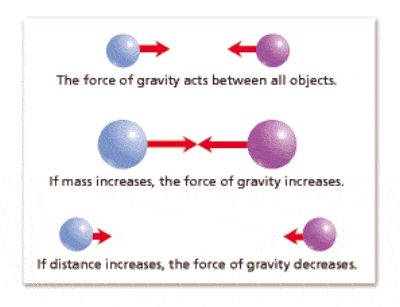
As distance between two objects increase the pull of gravity 
a)
Increases
b)
Decreases
c)
Stays the same
17.
As mass increases, what happens to gravitational force?
a)
increases
b)
decreases
c)
stays the same
d)
i don't know
18.
Which model has greater gravitational attraction (if any)
a)
Model A
b)
Model B
c)
Both Model A and Model B (same gravity)
19.
The force of gravity acting on an object is the object's ______.
a)
mass
b)
matter
c)
weight 
d)
friction 
20.
Which of the following never changes no matter where in the universe?
a)
weight
b)
force
c)
mass
d)
pounds
21.
The amount of matter in an object is 
a)
pressure
b)
weight
c)
mass
d)
force
22.
A person would weigh less on on the Moon than on the Earth because . . .
a)
Moon has more mass, and therefore more gravity
b)
Moon has less mass, and therefore more gravity
c)
Moon has more mass, and therefore less gravity
d)
Moon has less mass and therefore less gravity
23.
The farther apart two objects are, the __ their gravity.
a)
weaker
b)
stronger
c)
more equal
24.
The law of universal gravitation is credited to whom? 
a)
Einstein 
b)
Galileo
c)
Darwin
d)
Newton 
25.
Two factors effecting the magnitude of force of gravity between 2 objects are...
a)
weight and mass 
b)
distance and weight 
c)
mass and matter 
d)
mass and distance 
26.
Which of the following never changes no matter where you are in the universe? 
a)
Pounds 
b)
weight 
c)
Force
d)
Mass
27.
The amount of matter in an object.
a)
force 
b)
mass
c)
weight 
d)
pressure 
28.
A person would weigh less on the moon than on the Earth because...
a)
the moon has less mass, and therefore less gravity
b)
the moon has more mass, and therefore less gravity
c)
the moon has less mass, and therefore more gravity
d)
the moon has more mass, and therefor more gravity
29.
__________holds all of the planets in orbit around the sun.
a)
Force
b)
Motion
c)
Weight
d)
Gravity
30.
Gravity on Mar's surface is much lower than it is here on Earth. This is because the mass is __________than Earth.
a)
less
b)
more
c)
the same 
31.
the tendency of an object to resist a change in its motion
a)
acceleration
b)
inertia
c)
mass
d)
frame of reference
32.
push or pull acting on an object
a)
speed
b)
force
c)
position
d)
mass
33.
True of False?
An object's inertia is effected by its mass.
a)
False
b)
True
34.
Objects with greater _________ also have greater inertia.
a)
speed
b)
mass
c)
temperature
d)
friction
35.
Newton's 1st law is also called....
a)
friction 
b)
inertia
c)
unbalanced forces
d)
Newtons
36.
Because of inertia, a moving object will keep ________.
a)
at rest
b)
moving
c)
in one spot
d)
inertia 
37.

Select all of the following that affect an object's gravitational pull...

a)

force

b)

mass

c)

distance

d)

speed

e)

weight