wayground logo

Free Printable Worksheets

Font size

S
M
L
XL
Worksheets

Matter Review

Total questions: 100

Worksheet time: 59mins

Name
Class
Date
1.

Nitrogen chemically combines with hydrogen to make a new substance. This substance is

a)

an element

b)

a compound

c)

a mixture

d)

your best friend

2.

Oxidation is an example of

a)

cool science stuff

b)

a physical property

c)

a chemical property

d)

a financial property

3.

What describes how much matter is in an object?

a)

volume

b)

density

c)

mass

d)

weight

4.

Two or more substances that are together but NOT chemically combined is a

a)

element

b)

compound

c)

mixture

d)

enigma

5.

Which of the following is a compound?

a)

Nh

b)

NH3

c)

N

d)

Ni

6.

The way an element reflects light is it's

a)

glow up

b)

luster

c)

malleability

d)

density

7.

Rolling up a burrito in foil shows that Aluminum is

a)

malleable

b)

lustrous

c)

very dense

d)

brittle

8.

_________ are the basic units of matter that make up everything.

a)

molecules

b)

atoms

c)

pure substances

d)

legos

9.

In a solid, the molecules

a)

are widely spaced, move quickly (high energy), no definite volume or shape.

b)

are closely spaced, vibrate in place, definite volume and definite shape.

c)

are spread wider apart, in constant contact, medium amount of energy, have a definite volume but no definite shape.

10.

In a liquid, the molecules

a)

are widely spaced, move quickly (high energy), no definite volume or shape.

b)

are closely spaced, vibrate in place, definite volume and definite shape.

c)

are spread wider apart, in constant contact, medium amount of energy, have a definitevolume but no definite shape.

11.

In a gas, the molecules

a)

are widely spaced, move quickly (high energy), no definite volume or shape.

b)

are closely spaced, vibrate in place, definite volume and definite shape.

c)

are spread wider apart, in constant contact, medium amount of energy, have a definite volume but no definite shape.

12.

In order for a solid to melt, or change into a liquid, thermal (heat) energy must ___________.

a)

increase

b)

decrease

c)

stay the same

13.

The density of castor oil is 0.969 g/mL. Does castor oil float on water?

a)

No, because the density is less than that of water.

b)

Yes, it has neutral buoyancy.

c)

Yes, because the density is less than that of water.

d)

No, it dissolves.

14.

Why is density considered an important characteristic in identifying elements?

a)

d. Density is measured in cm3/g.

b)

c. Density equals volume/mass.

c)

b. Each element has its own unique density.

d)

a. All elements have the same density.

15.
Something that takes up space and has mass.
a)
volume
b)
matter
c)
mass
d)
density
16.
A state of matter that has a definite volume and shape.
a)
solid
b)
liquid
c)
gas
d)
matter
17.
What are the three states of matter?
a)
solid, volume, mass
b)
density, volume, mass
c)
solid, liquid, gas
d)
density, gas, volume
18.
______________ does not have a definite shape or volume.
a)
liquid
b)
solid
c)
gas
19.
The amount of matter something contains is its ______________.
a)
gas
b)
solid
c)
weight
d)
mass
20.

A pure substance that cannot be broken down into any other substance by chemical or physical means.

a)

compound

b)

mixture

c)

molecule

d)

element

21.
What does this picture represent? 
a)
solid
b)
liquid 
c)
gas
d)
plasma
22.
What does this picture represent? 
a)
solid
b)
liquid
c)
gas
d)
plasma
23.
All changes in the state of matter of a substance requires
a)
vibration
b)
water
c)
permission
d)
energy
24.
The steam coming off the pot of boiling water is an example of....
a)
a solid becoming a liquid
b)
a liquid becoming a solid
c)
a liquid becoming a gas
d)
a gas becoming a liquid
25.

Chemical changes occur when molecules of one substance are rearranged to form a different substance. Which of the following is a chemical change?

a)

bending

b)

burning

c)

freezing

d)

shredding

26.

Chellie is picking tomatoes from her garden. She finds a tomato on the ground that is soft and runny. Which sentence best describes what happened to the tomato?

a)

The tomato decayed, which is a chemical change

b)

The tomato moved, which is a chemical change

c)

The tomato deflated like a flat tire, which is a physical change

d)

The tomato ignited like a firecracker, which is a chemical change

27.

Water changes states when energy is added or taken away. What happens to liquid water when it is boiled?

a)

It melts into a gas

b)

It freezes into a solid

c)

It evaporates into a gas

d)

It condenses into a solid

28.

Which of the following are examples of compounds?

a)

Oxygen

b)

Carbon

c)

Salt

d)

Water

e)

Helium

29.

What causes matter to change from a liquid to a gas?

a)

Cooling the liquid

b)

Pouring the liquid out

c)

Heating the liquid

d)

Freezing the liquid

30.

Which of the following is not a compound?

a)

NaCl

b)

H2O

c)

He

d)

CO2

31.

What compound is formed when the elements Na(sodium) and Cl (Chloride) are combined?

a)

Table Salt

b)

Carbon Dioxide

c)

Water

d)

Oxygen

32.

If you combine sand and iron fillings in a cup, it forms a -

a)

molecule

b)

mixture

c)

solution

d)

atom

33.

If you dissolve sugar in water, it becomes a -

a)

compound

b)

solid

c)

element

d)

solution

34.

What would be the best and fastest way to separate the sugar out of a sugar-water mixture?

a)

Remove the sugar with a syringe

b)

Freeze the mixture

c)

Boil the mixture

d)

Put the mixture on the window sill

35.
Define a liquid.
a)
Indefinite shape, indefinite volume
b)
Definite shape, definite volume
c)
Found in stars
d)
Definite volume, indefinite shape
36.
The state of matter that has no definite size or shape is
a)
Solid
b)
Liquid
c)
Gas
37.
The amount of space that an object takes is called?
a)
Volume
b)
Mass
c)
Matter 
d)
Meniscus
38.
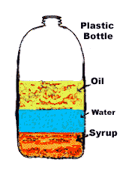
Which liquid is the least dense?
a)
oil
b)
water
c)
syrup 
d)
plastic bottle
39.
Which box has a higher density?  
a)
Box A
b)
Box B
c)
cannot be determined
d)
they are the same
40.
What is the density of water?
a)
0 g/ml
b)
1 g/ml
c)
10 g/ml
d)
100 g/ml
41.
Which one is not a chemical change?
a)
a wick burning
b)

a nail rusting

c)
metal corroding
d)
wax melting
42.
Which one is not a physical change?
a)
paper ripping
b)
chopping wood
c)
gold melting into a liquid
d)
a match burning
43.
If you completely dissolve a powder into water, this is an example of a ___________change.
a)
chemical
b)
physical
44.
A copper penny turning greenish after a few years is an example of...
a)
Chemical Change
b)
Physical Change
45.
 Which is NOT an example of chemical change?
a)
production of gas.
b)
change in color.
c)
change in size.
d)
transfer of energy.
46.
Which of the following could indicate a chemical change? 
a)
All of the answers could indicate Chemical Change 
b)
a color change has occurred 
c)
bubbles appear 
d)
creation of one or more new chemical products 
47.
Which of the following IS a chemical change
a)
using chalk
b)
water freezing
c)
slicing cheese
d)
digestion
48.
How is a physical change different from a chemical change?
a)
There is absolutely no difference
b)
Chemical changes produce a new substance, physical changes stay the same substance
c)
Chemical changes create and destroy matter, physical changes don't
d)
Physical changes create and destroy matter, chemical changes dont
49.
When the temperature decrease the state of matter is losing...
a)
heat
b)
shape
c)
power
d)
mass
50.
Which state of matter has the MOST energy?
a)
Solid
b)
Liquid
c)
Gas
d)
All have the same amount of energy
51.
A mixtures is a combination of two or more____________ in which no new kinds of matter are formed.
a)
 subtances
b)
parts
c)
leaves
d)
pebbles
52.
Making a mixture results in ___________________ only.
a)
chemical reactions
b)
separate parts
c)
physical changes
d)
two subtances
53.
The air around was is  a mixture of gases.
a)
True
b)
False
54.
What are the two types of Mixtures
a)
Elements and Subatomic Particles
b)
Protons and Electrons
c)
Atoms and Compounds
d)
Homogenous and Heterogeneous
55.
Two substances physically combined and that appears the same throughout is classified as
a)
A homogeneous mixture
b)
A heterogeneous mixture
c)
An element
d)
  A compound
56.
Two elements chemically combined defines
a)
A homogeneous mixture
b)
A heterogeneous mixture
c)
An element
d)
A compound
57.
What does it mean if a mixture is heterogeneous?
a)
you can see the different parts
b)
cannot tell one part from another
c)
very well blended
d)
made of elements
58.
What does it mean if a mixture is homogeneous?
a)
you can see the different parts
b)
cannot tell one part from another
c)
chunks of particles
d)
made of elements
59.
What type of mixture is this?
a)
heterogeneous 
b)
homogeneous
60.
What type of mixture is this?
a)
heterogeneous 
b)
homogeneous
61.
What type of mixture is this?
a)
heterogeneous 
b)
homogeneous
62.
What type of mixture is this?
a)
heterogeneous 
b)
homogeneous
63.
What is the measure of how much a substance dissolves in a given volume?
a)
atom
b)
element
c)
solububble
d)
solubility 
64.
A pure substance made up of only one type of atom e.g. oxygen or carbon
a)
element
b)
emulsion
c)
pure substance
d)
compound
65.

Lucky Charms

a)

Heterogeneous

b)

Homogeneous

66.

Dirt

a)

Heterogeneous

b)

Homogeneous

67.

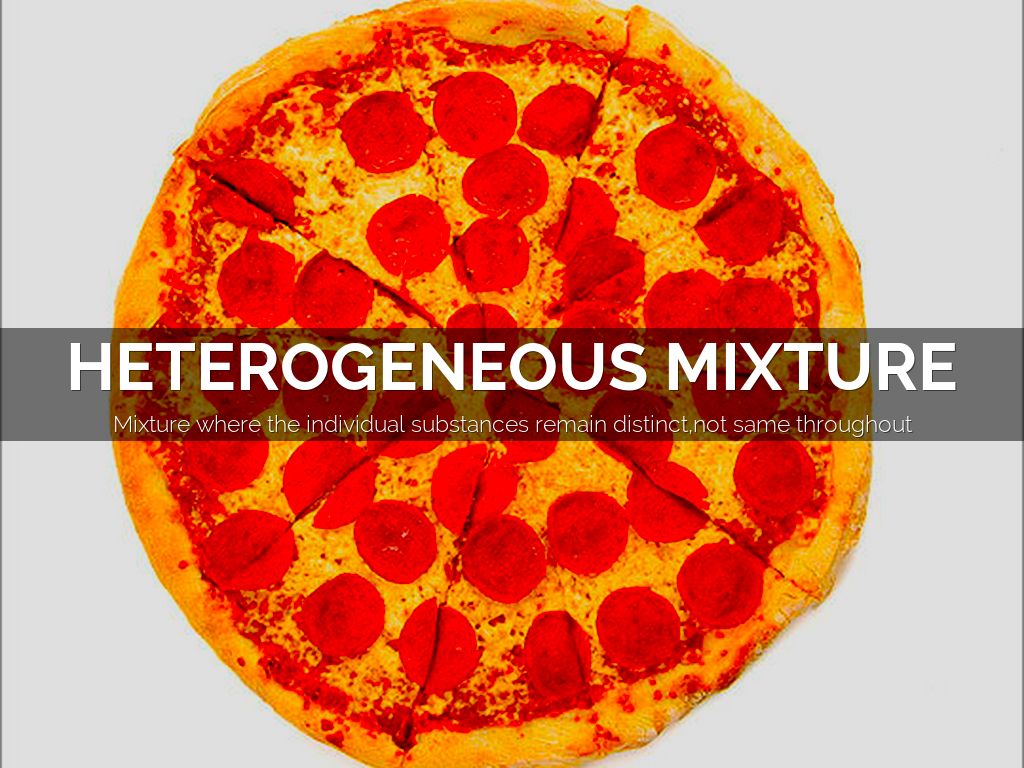
Sausage and mushroom pizza

a)

Heterogeneous

b)

Homogeneous

68.

Blood

a)

Heterogeneous

b)

Homogeneous

69.

Brass (an alloy)

a)

Heterogeneous

b)

Homogeneous

70.

Chicken noodle soup

a)

Heterogeneous

b)

Homogeneous

71.

Jello

a)

Heterogeneous

b)

Homogeneous

72.

Fruit salad

a)

Heterogeneous

b)

Homogeneous

73.

Kool-Aid

a)

Heterogeneous

b)

Homogeneous

74.

Glue

a)

Heterogeneous

b)

Homogeneous

75.

Chocolate chip ice cream

a)

Heterogeneous

b)

Homogeneous

76.

What kind of physical property is this? Color

a)

intensive

b)

extensive

77.

What kind of physical property is this? Hardness

a)

intensive

b)

extensive

78.

What kind of physical property is this? Density

a)

intensive

b)

extensive

79.

What kind of physical property is this? Odor

a)

intensive

b)

extensive

80.

What kind of physical property is this? Boiling Point

a)

intensive

b)

extensive

81.

What kind of physical property is this? Volume

a)

intensive

b)

extensive

82.

What kind of physical property is this? Mass

a)

intensive

b)

extensive

83.

What kind of physical property is this? Melting Point

a)

intensive

b)

extensive

84.
Salt is soluble in water.
a)
chemical change
b)
chemical property
c)
physical intensive property
d)
physical extensive property
85.
Which of the following is a physical change?
a)
corrosion
b)
tarnishing
c)
rotting
d)
cutting
86.

Heat content

a)

Extensive

b)

Intensive

87.

Malleability

a)

Intensive

b)

Extensive

88.

Conductivity

a)

Intensive

b)

Extensive

89.

Ductility

a)

Intensive

b)

Extensive

90.

Weight

a)

Intensive

b)

Extensive

91.
A glass filled with a clear liquid is an example of a.....
a)
element
b)
compound
c)
homogeneous mixture
d)
heterogeneous mixture
92.
Salad is an example of a....
a)
Element
b)
Compound
c)
Homogenous mixture
d)
Heterogeneous mixture
93.
What are you going to make on your test next class? 
a)
?
b)
?
c)
?
d)
An 80 or above :) 
94.
Physical properties of a substance include _________
a)
color and odor
b)
melting and boiling points
c)
density 
d)
all of the choices are correct
95.
Crumpling paper is an example of 
a)
physical change
b)
chemical change
c)
physical property
d)
chemical property
96.
Which of the following is a Physical Property?
a)
Color
b)
Burning
c)
Corroding 
d)
Rusting
97.
Which of these is not an element?
a)
Iron
b)
Gold
c)
Silver
d)
Iron Oxide
98.
Flammability is a
a)
Chemical Property
b)
Physical Property
99.
Luster (how shiny something is) is considered a
a)
Physical property
b)
Chemical Property
100.

How shiny a substance is.

a)

Luster

b)

Conductivity

c)

Hardness

d)

Volume