wayground logo

Free Printable Worksheets

NEW

Font size

S
M
L
XL
Worksheets

Simple Covalent Molecules

Total questions: 77

Worksheet time: 1hrs 2mins

Name
Class
Date
1.
Low melting and boiling points which increase with increasing molecule size due to increased intermolecular forces.
a)
simple covalent molecules
b)
metallic
c)
ionic
d)
giant covalent 
2.
When two atoms share electrons, a chemical bond is formed.  This type of bond is called:
a)
covalent bond
b)
ionic bond
c)
crystal bond
d)
polyatomic bond
3.
Which of the following is a characteristic property of molecular compounds?
a)
low melting points
b)
high melting points
c)
high boiling points
d)
high electric conductivity
4.
What two types of atoms make a covalent bond?
a)
2 Nonmetals
b)
1 Nonmetal and 1 Metal
c)
2 Metals
d)
2 Noble Gases
5.
What is the prefix for 1?
a)
mono
b)
di
c)
tri
d)
tetra
6.
How are covalent bonds explained?
a)
When one atom takes the other atom's electron
b)
When the atom shares an electron with an another atom
c)
When the two nucleus merge
d)
When the neutrons leave the nucleus
7.
How many are shared in a single bond?
a)
2 pairs
b)
4
c)
2
d)
1
8.
How many are shared in a double bond?
a)
2
b)
4 pairs
c)
6
d)
4
9.
How many electrons are shared in a triple bond?
a)
6
b)
3
c)
6 pairs
d)
5
10.
Why do ionic bonds form?
a)
so the number of protons equals the number of electrons
b)
to fill the outermost energy level
c)
so an atom can become unstable
11.
The chemical bond formed when two atoms share electrons  is called a(an) IONIC bond. 
a)
True
b)
False
12.
NaCl
a)
Simple sugar
b)
Nitrogen gas
c)
Table salt
d)
Carbon dioxide
13.
NaCl
a)
ionic
b)
covalent
14.
H2O
a)
carbon dioxide
b)
water
c)
hydrogen gas
d)
simple sugar
15.
H2O
a)
ionic
b)
covalent
16.
O2
a)
hydrogen gas
b)
nitrogen gas
c)
carbon dioxide
d)
oxygen gas
17.
O2
a)
ionic 
b)
covalent
18.
CO2
a)
water
b)
carbon monoxide
c)
tabel salt
d)
carbon dioxide
19.
CO2
a)
ionic
b)
covalent
20.
N2
a)
oxygen gas
b)
nitrogen gas
c)
table salt
d)
hydrogen gas
21.
N2
a)
ionic
b)
covalent
22.
Fe2O3
a)
table salt
b)
simple sugar
c)
carbon dioxide
d)
rust
23.
Fe2O3
a)
ionic
b)
covalent
24.
When an atom loses an electron, it becomes a:
a)
positive ion
b)
negative ion
c)
neutral ion
d)
neutral atom
25.
Which of the following is NOT a property of ionic compounds?
a)
They have very high melting points
b)
They conduct electricity when in solution
c)
They have high boiling points
d)
They are insoluble in water
26.
How are covalent bonds explained?
a)
When one atom takes the other atom's electron
b)
When the atom shares an electron with an another atom
c)
When the two nucleus merge
d)
When the neutrons leave the nucleus
27.
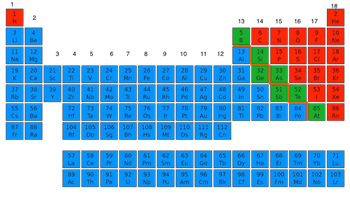
Where are the nonmetals located on the periodic table? 
a)
Blue
b)
Red
c)
Green
28.
What is the correct formula for this molecule?
a)
NH
b)
N3H
c)
NH3
d)
NH4
29.
Ionic bonds exist between a metal with a non-metal.
a)
True
b)
False
30.
Magnesium (Mg) and Oxygen (O) form an ________ bond.
a)
Ionic
b)
Covalent
c)
Metallic
d)
Nothing
31.
Calcium (Ca) and 2 chlorine (Cl) atoms make a covalent compound.
a)
True
b)
False
32.

What usually forms the negative ion?

a)

nonmetals

b)

metal

c)

none

33.
Which of the following is NOT formed by a covalent bond?
a)
K2S
b)
H2O
c)
I2
d)
CO2
34.

NaCl

a)

covalent

b)

ionic

35.

CH4

a)

covalent

b)

ionic

36.

H2O

a)

covalent

b)

ionic

37.

water

a)

covalent

b)

ionic

38.

magnesium oxide

a)

covalent

b)

ionic

39.

calcium fluoride

a)

covalent

b)

ionic

40.

CaF2

a)

covalent

b)

ionic

41.

lithium nitrate

a)

covalent

b)

ionic

42.

H2

a)

covalent

b)

ionic

43.

HCl

a)

covalent

b)

ionic

44.

potassium sulfate

a)

high melting and boiling points

b)

low melting and boiling points

45.

ammonia

a)

high melting and boiling points

b)

low melting and boiling points

46.

methane

a)

high melting and boiling points

b)

low melting and boiling points

47.

oxygen

a)

high melting and boiling points

b)

low melting and boiling points

48.

Cl2

a)

high melting and boiling points

b)

low melting and boiling points

49.

CH4

a)

high melting and boiling points

b)

low melting and boiling points

50.

CH4

a)

always conducts electricity

b)

never conducts electricity

c)

conducts electricity when molten or dissolved
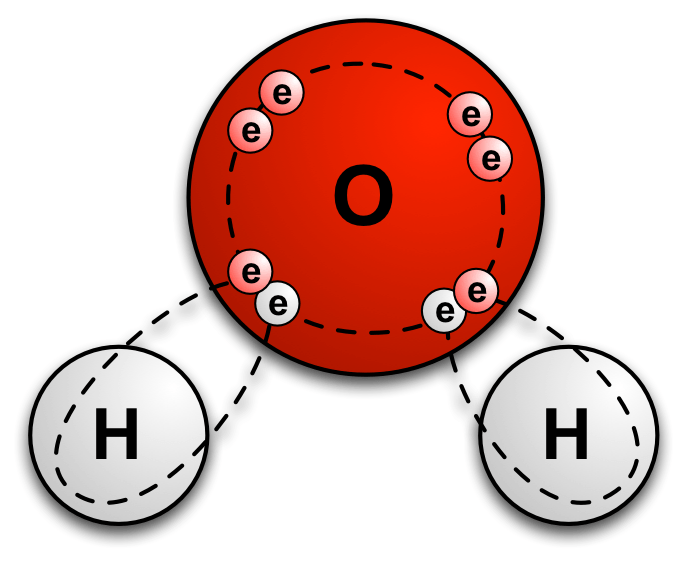
51.

copper

a)

always conducts electricity

b)

never conducts electricity

c)

conducts electricity when molten or dissolved

52.

gold

a)

always conducts electricity

b)

never conducts electricity

c)

conducts electricity when molten or dissolved

53.

sodium chloride

a)

always conducts electricity

b)

never conducts electricity

c)

conducts electricity when molten or dissolved

54.

sodium fluoride

a)

always conducts electricity

b)

never conducts electricity

c)

conducts electricity when molten or dissolved

55.

N2

a)

always conducts electricity

b)

never conducts electricity

c)

conducts electricity when molten or dissolved

56.

CH3Br

a)

always conducts electricity

b)

never conducts electricity

c)

conducts electricity when molten or dissolved

57.

Na2O

a)

always conducts electricity

b)

never conducts electricity

c)

conducts electricity when molten or dissolved

58.

CaCO3

a)

always conducts electricity

b)

never conducts electricity

c)

conducts electricity when molten or dissolved

59.
Giant lattice structure held together by attraction between  positive and negatively charged ions 
a)
simple covalent molecules
b)
metallic
c)
ionic
d)
giant covalent 
60.

What would you name this molecule?

a)

SNa3

b)

H3O

c)

NaCl

d)

H2O

61.
Name the following compound: 
CO2
a)
monocarbon dioxide
b)
carbon oxide
c)
carbon dioxide
d)
oxygen carbonide
62.
Name the following compound: 
CCl4
a)
monocarbon quadchloride
b)
carbon tetrachloride
c)
carbon chloride
d)
monocarbon quadchloide
63.
Name the following compound:
NF3
a)
nitrogen triflouride
b)
mononitrogen triflouride
c)
nitrogen flouride
d)
tetranitroflouide
64.
Write the formula for:
chlorine trifluoride
a)
ClF3
b)
ClF
c)
Cl3F
d)
3ClF
65.
Write the formula for:
trilithium mononitride
a)
Li2N1
b)
Li3N3
c)
LiN3
d)
Li3N
66.
Ionic or covalent?
Na  Br
a)
Ionic
b)
Covalent
67.
Ionic or covalent?
K  Br
a)
Ionic
b)
Covalent
68.
Ionic or covalent?
C  O
a)
Ionic
b)
Covalent
69.
Ionic or covalent?
H  O
a)
Ionic
b)
Covalent
70.
Ionic or covalent?
C  H
a)
Ionic
b)
Covalent
71.
Ionic or covalent?
Na  Cl
a)
Ionic
b)
Covalent
72.
Ionic or covalent?
H  H
a)
Ionic
b)
Covalent
73.
Ionic or covalent?
Ca  Cl
a)
Ionic
b)
Covalent
74.
Ionic or covalent?
N  H
a)
Ionic
b)
Covalent
75.
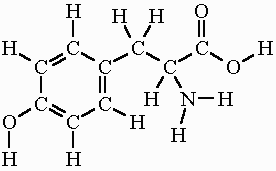
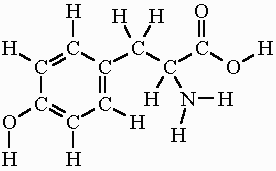
In this molecule, each NITROGEN makes how many bonds?
a)
1
b)
2
c)
3
d)
4
76.
In this molecule, each CARBON makes how many bonds?
a)
1
b)
2
c)
3
d)
4
77.

SO₃

a)

sulfate

b)

sulfur oxide

c)

sulfur trioxide

d)

monosulfur trioxide