Wayground logo

Free Printable Worksheets

Font size

S
M
L
XL
Worksheets

Chemistry Midterm Review (All except balancing)

Total questions: 105

Worksheet time: 1hrs 8mins

Name
Class
Date
1.
a)

Element

b)

Compound

c)

Homogeneous Mixture

d)

Heterogeneous Mixture

2.

Sweet Tea, everything is mixed evenly and looks the same.

a)

Heterogeneous Mixture

b)

Homogeneous Mixture

3.

H2 is an example of a(n)...

a)

Element

b)

Compound

c)

Molecule

d)

Heterogeneous Mixture

4.

A molecule is created when the same _________ is bonded together. For example: C10

a)

Element

b)

Compound

c)

Homogeneous Mixture

d)

Heterogeneous Mixture

5.
A substance that contains only one type of atom is a(n)
a)
compound
b)
element
c)
heterogeneous mixture
d)
homogeneous mixture
6.
Which of the following lists only elements?
a)
H2O + OH, MgCl2
b)
H2O, KF, Ne
c)
KCl, Ag, Au
d)
K, Cl, N
7.
Which of the following selections are the different types of mixtures?
a)
heterogenous, homogenous
b)
acid, base
c)
metal, nonmetal
d)
element, compound
8.

Jay combines water, sugar, and lemon juice to form lemonade. What type of substance was made?

a)

Element

b)

Molecule

c)

Mixture

9.
Is salt (NaCI) a compound or a element
a)
Compound
b)
element
10.
Which of the following is NOT an example of chemical change?
a)
sour milk
b)
burning wood
c)
breaking a pencil
d)
rust
11.
Which of the following IS a physical change?
a)
Getting a haircut
b)
Rusty metal
c)
sour milk
d)
A compound
12.
Ripping up paper ...
a)
Chemical Change
b)
Physical Change
13.
Bubbles form when two or more substances are combined ...
a)
Chemical Change
b)
Physical Change
14.
An explosion occurs ...
a)
Chemical Change
b)
Physical Change
15.
Causes a change in odor ...
a)
Chemical Reaction 
b)
Physical Reaction
16.
Evidence of Chemical Change.
a)
New Substance 
b)
Size change
c)
State change
d)
Mixture 
17.
A change in the size, shape, or state of matter.
a)
chemical change
b)
physical change
18.
When experimenting with the growth of a plant, a scientist uses three (of the same type of) plants, two different fertilizers, equal light, and equal water. What type of variable is the fertilizer?
a)
Dependent
b)
Independent
c)
Control
d)
Compound
19.
Research question: does the distance a person kicks a soccer ball effect how well they will do on their math test.  What is the dependent variable?
a)
How far they kick the soccer ball
b)
who the person is
c)
how well they do on the math test
d)
Type of soccer ball.
20.
Research Question: Does the type of gasoline put in a car effect how fast the car can drive. What is the independent variable?
a)
Type of gasoline
b)
which car the gas is put into
c)
how fast the car can drive
d)
how much gas is put into the car
21.
Ms. S set up an experiment to see how the mass of a ball affects the distance it rolls off a ramp. Identify the independent variable.
a)
Distance traveled by the ball
b)
Height of the ramp
c)
Mass of the ball
d)
Who set up the experiment (Ms. S, etc)
22.
Properties that can be observed without changing the identity of the substance.
a)
Physical
b)
Chemical
23.
What kind of properties can only be observed when a substance changes into a different substance?
a)
physical properties
b)
chemical properties
24.

What are the seven diatomic elements?

a)

H2, Cl2, Br2, O2, N2, I2, F2

b)

H2, Cl2, I2, F2, Hg2, Br2, Fe2

c)

H2, Cu2, Ni2, B2, O2, I2, Fe2

25.
Contains only one kind of atom.
a)
Element
b)
Compund
c)
Mixture
26.
Contains two or more atoms combined
a)
Elements
b)
Compounds
c)
Mixtures
27.
The air is a _________. 
a)
element 
b)
mixture 
c)
compound 
d)
energy 
28.
Elements can be broken down into simpler substances. 
a)
false 
b)
true 
c)
sometimes 
29.

Which contains only elements?

a)

A

b)

B

c)

C

d)

D

30.

Which contains a pure substance? (Choose all)

a)

A

b)

B

c)

C

d)

D

31.

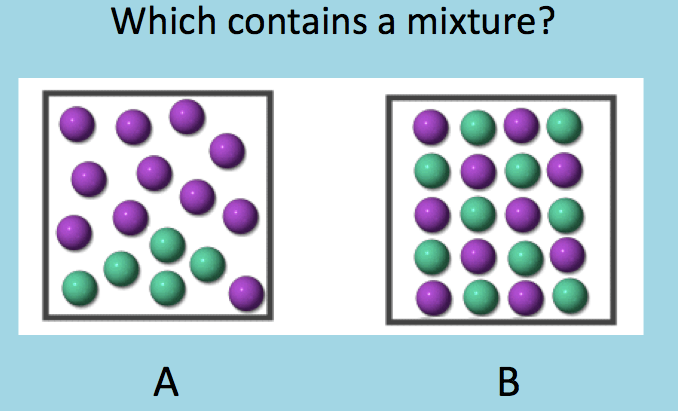
Which contains a mixture? (Choose all)

a)

A

b)

B

32.

Which contains a solution? (Choose all)

a)

A

b)

B

c)

None are solutions

33.

Which contains a solid? (Choose all)

a)

A

b)

B

c)

C

d)

D

34.

Which contains a pure substance? (Choose all)

a)

A

b)

B

c)

C

d)

D

35.

What type of change is this?

a)

Chemical

b)

Melting

c)

Evaporation

d)

Condensation

e)

Sublimation

36.

Which contains only elements (no compounds)? (Choose all)

a)

A

b)

B

c)

C

37.

What type of change?

a)

Chemical

b)

Evaporation

c)

Condensation

d)

Sublimation

e)

Melting

38.

What type of change?

a)

Chemical

b)

Evaporation

c)

Condensation

d)

Sublimation

e)

Melting

39.

Freshly brewed black coffee

a)

Heterogeneous

b)

Homogeneous

40.

Lucky Charms

a)

Heterogeneous

b)

Homogeneous

41.

Dirt

a)

Heterogeneous

b)

Homogeneous

42.

Air

a)

Heterogeneous

b)

Homogeneous

43.

Coca-Cola

a)

Heterogeneous

b)

Homogeneous

44.

M&Ms

a)

Heterogeneous

b)

Homogeneous

45.
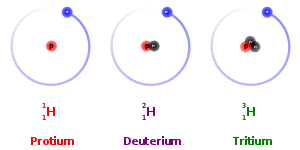
What is an isotope? 
a)
A charged atom
b)
An atom with different amounts of neutrons
c)
An atom with different amounts of protons
d)
A neutral atom
46.
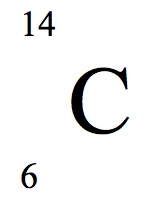
The photo above shows the isotopic notation for which isotope?
a)
Carbon 12
b)
Carbon 13
c)
Carbon 14
d)
Carbon 15
47.
The photo above shows the isotopic notation for which isotope?
a)
Carbon 12
b)
Carbon 13
c)
Carbon 14
d)
Carbon 15
48.
Different isotopes have...
a)
different masses
b)
different atomic numbers
c)
different electrons
d)
different protons
49.
How many neutrons does a Sodium 24 isotope have?
a)
12
b)
13
c)
14
d)
15
50.
How many neutrons does a Carbon 13 atom have?
a)
6
b)
5
c)
7
d)
8
51.
How many neutrons does a Calcium 48 isotope have?
a)
16
b)
20
c)
28
d)
12
52.

Two objects that are similarly charged will...

a)

attract.

b)

repel.

c)

not experience an electric force.

d)

implode.

53.

A positively charged object and a neutral object will...

a)

attract.

b)

repel.

c)

not experience an electric force.

d)

implode.

54.

An object becomes positively charged by...

a)

gaining negative charges.

b)

losing negative charges.

c)

gaining positive charges.

d)

losing positive charged.

55.

Valence electrons are those that are

a)

closest to the nucleus.

b)

freely floating between atoms.

c)

in the outermost energy level of the atom.

d)

unable to become involved in chemical bonding.

56.

Most elements are most stable when their outermost energy levels contain ________ electrons.

a)

2

b)

6

c)

8

d)

18

57.

Atoms that have gained electrons form

a)

cations.

b)

anions.

c)

negions.

d)

positrons.

58.

Which of the following tend to gain electrons when forming ions?

a)

metalloids

b)

metals

c)

nonmetals

d)

cations

59.

Which of the following is not a way that ions can form?

a)

gaining electrons

b)

gaining protons

c)

losing electrons

d)

All of the above are ways that ions can form.

60.

The Atomic number is known as the _______

a)

Number of electrons in an atom

b)

Number of Protons in an atom

c)

Number of neutrons in an atom

d)

Number of Protons and electrons in an atom

61.

What charge do protons have?

a)

Positive

b)

Negative

c)

Neutral

62.

What is atomic number ?

a)

Number of Protons

b)

Number of Electrons

c)

Number of Protons and Electrons

d)

Number of Protons and Neutrons

63.

What is the Atomic Number of this Element

a)

7

b)

3

c)

4

d)

1

64.

What is the Atomic Mass Number of the element mentioned above

a)

12

b)

6

c)

C

d)

16

65.

What is the number of protons in Magnesium atom ?

a)

12

b)

24

c)

23

d)

8

66.

What is the number of electrons in chlorine atom ?

a)

35

b)

11

c)

18

d)

17

67.

CaF2- name?

a)

calcium fluorate

b)

calcium fluoride

c)

fluoride calcite

d)

fluorine calciumate

68.

Na2SO4- name?

a)

sulfur sulfate

b)

sodium sulfide

c)

sodium sulfate

d)

sodium oxygenate

69.

HCl- name?

a)

hydrogen chloride

b)

chlorine hydrogen

c)

hydrogen chlorine

d)

hydrogen chlorate

70.

LiNO3- name?

a)

lithium oxygenate

b)

nitrogen lithate

c)

lithium nitride

d)

lithium nitrate

71.

MgO- name?

a)

oxygen magnesium

b)

magnesium oxide

c)

magnesium oxate

d)

magnesium oxygenate

72.

BaClO3- name?

a)

barium chlorate

b)

barium chloride

c)

chlorine bariate

d)

chlorine baride

73.

LiOH- name?

a)

hydrogen lithium

b)

lithium oxyhydride

c)

lithium oxide

d)

lithium hydroxide

74.

Name the ionic compound, FeBr3

a)

Iron (II) bromide

b)

Iron (III) bromide

75.

What is the correct molecular formula for sodium nitrate?

a)

NaNO2

b)

Na3N

c)

Na3NO

d)

NaNO3

76.

What is the correct formula of phosphorus trichloride?

a)

P2Cl3

b)

P3Cl3

c)

PCl3

d)

PCl5

77.
Name this compound.
MgF2
a)
magnesium fluoride
b)
manganese Phosphide
c)
magnesium(III) fluoride
d)
magnesium fluoride(II)
78.
find the formula zinc sulfate
a)
ZnSO3
b)
ZnSO4
c)
ZnS
d)
Zn(SO4)2
79.
How many significant figures: 216 m
a)
1
b)
2
c)
3
d)
0
80.
How many significant figures: 2016 m
a)
1
b)
2
c)
3
d)
4
81.
How many significant figures: 153.0 mL
a)
1
b)
2
c)
3
d)
4
82.
How many significant figures: 0.012 km
a)
1
b)
2
c)
3
d)
4
83.
How many significant figures: 1000 mL
a)
1
b)
2
c)
3
d)
4
84.
How many significant figures: 100.000 cL
a)
1
b)
3
c)
5
d)
6
85.
How many significant figures: 0.001 g
a)
4
b)
3
c)
2
d)
1
86.
How many significant figures: 4.20 cm
a)
1
b)
2
c)
3
d)
4
87.
How many significant figures: 0.010 L
a)
1
b)
2
c)
3
d)
4
88.
What atom matches this electron configuration?
1s22s22p63s23p64s23d10
a)
Zinc
b)
Copper
c)
Nickel
d)
Germanium
89.
What electron configuration matches an oxygen atom?
a)
1s22s22p63s2, 3p64s23d104p5
b)
1s22s22p4
c)
1s22s22p6
d)
1s22s22p63s23p64s23d1
90.
The electron configuration of an atom is 1s22s22p6.  The number of electrons in the atom is 
a)
3
b)
6
c)
8
d)
10
91.
Which electron configuration belongs to Chlorine (Cl)?
a)
1s2 2s2 2p6 3s2 3p5
b)
1s2 2s2 2p6 3s2 3p6
c)
1s2 2s2 2p6 3s2 3p7
92.
Identify the Electron Configuration for Aluminum (Al)
a)
1s2 2s2 2p6 3s2 3p1
b)
1s2 2s2 2p6 3s2 3p3
c)
1s2 2s2 2p6 3s2 4p1
93.
Identify the Electron Configuration for Aluminum (Al)
a)
1s2 2s2 2p6 3s2 3p1
b)
1s2 2s2 2p6 3s2 3p3
c)
1s2 2s2 2p6 3s2 4p1
94.
What atom matches this electron configuration?
1s2 2s2 2p6 3s2
a)
Neon
b)
Magnesium
c)
Aluminum
d)
Potassium
95.

What is the maximum number of electrons that an S orbital can have?

a)

1 electron

b)

2 electrons

c)

3 electrons

d)

4 electrons

96.

Which has the smaller Electronegativity?

a)

Cl

b)

Al

97.

Which has the larger Electronegativity?

a)

Carbon

b)

Nitrogen

98.

Which of the following will have a larger radius than Gallium (Ga)?

a)

Ge

b)

Al

c)

Mg

d)

Sr

99.

Which of these has the smallest atomic radius?

a)

K

b)

Rb

c)

Fr

d)

Cs

100.
As you move down the periodic table atoms get bigger.  This is because ____________.
a)
The atoms have more mass.
b)
The atoms have more protons.
c)
The atoms have more energy levels
d)
The atoms have more nuetrons
101.

Which has the smaller ionization energy?

a)

P

b)

Mg

102.

Which has the highest ionization energy?

a)

Ca

b)

As

c)

Br

103.

Which would be the easiest to take an electron from?

a)

He

b)

F

c)

Ba

d)

Fr

104.

Which element would want to keep its electrons the most?

a)

O

b)

S

c)

Al

d)

Rb

105.

As you move to the right across the periodic table atoms tend to get smaller because, ______________.

a)

the atoms have more mass.

b)

the atoms have more neutrons

c)

the atoms have more protons.

d)

the atoms have more electrons.