wayground logo

Free Printable Worksheets

Font size

S
M
L
XL
Worksheets

Unit 3: Biochemistry

Total questions: 67

Worksheet time: 42mins

Name
Class
Date
1.
Which of the following would most likely qualify as a macromolecule?
a)
Protein
b)
RNA
c)
Cellulose
d)
All of these are macromolecules
2.
Which of the following is NOT a carbohydrate?
a)
Glucose
b)
Fatty acid
c)
Cellulose
d)
Glycogen
3.
The monomer of a protein is...
a)
Monosaccharides
b)
Nucleic Acids
c)
Enzymes
d)
Amino Acids
4.
What elements are carbohydrates made of?
a)
CHO
b)
CHON
c)
CHONP
d)
SPONCH
5.
Glucose is a...
a)
Protein
b)
Disaccharide
c)
Nucleic Acid`
d)
Monosaccharide
6.
What is the point of enzymes?
a)
Enzymes raise activation energy
b)
Enzymes lower activation energy
c)
Enzymes give long term energy
d)
Enzymes give quick energy
7.
What does letter a stand for?
a)
Enzyme
b)
Substrate
c)
Active Site
d)
Products
8.
What does letter b stand for?
a)
Enzyme
b)
Substrate
c)
Active Site
d)
Products
9.
What does letter c stand for?
a)
Enzyme
b)
Substrate
c)
Active Site
d)
Products
10.
What does letter d stand for?
a)
Enzyme
b)
Substrate
c)
Active Site
d)
Products
11.

Biomolecules are organic molecules.

a)

True

b)

False

12.

Biomolecules contain the elements carbon (C), hydrogen (H), and oxygen (O) in a 1:2:1 ratio.

a)

True

b)

False

13.

A carbohydrate, lipid, protein, and nucleic acid were all looking for jobs at the nearest cell. The following description is posted on the job board. Which biomolecule is best qualified for the jobs listed?

a)

Carbohydrate

b)

Protein

c)

Lipid

d)

Nucleic Acid

14.

Compare the biomolecules listed on the soup labels below. Which soup will provide the most energy per serving?

a)

Regular Soup

b)

Healthy Soup

15.

Choose the biomolecule(s) that ONLY contains the following elements: C, H, O

a)

Carbohydrate

b)

Lipid

c)

Nucleic Acid

d)

Protein

16.

Choose the biomolecule(s) that contains the following elements: C, H, O, N, P

a)

Carbohydrate

b)

Lipid

c)

Nucleic Acid

d)

Protein

17.

What biomolecule is known as the main source of energy for cells?

a)

Carbohydrate

b)

Lipid

c)

Nucleic Acid

d)

Protein

18.

What biomolecule is known for energy storage and is a component of cell membranes?

a)

Carbohydrate

b)

Lipid

c)

Nucleic Acid

d)

Protein

19.

What biomolecule is known for storing and transfering genetic information?

a)

Carbohydrate

b)

Lipid

c)

Nucleic Acid

d)

Protein

20.

Sugar and starch are examples of what biomolecule?

a)

Carbohydrate

b)

Lipid

c)

Nucleic Acid

d)

Protein

21.

Fats, oils, and waxes are examples of what biomolecule?

a)

Carbohydrate

b)

Lipid

c)

Nucleic Acid

d)

Protein

22.

DNA and RNA are examples of what biomolecule?

a)

Carbohydrate

b)

Lipid

c)

Nucleic Acid

d)

Protein

23.

Muscle and enzymes are examples of what biomolecule?

a)

Carbohydrate

b)

Lipid

c)

Nucleic Acid

d)

Protein

24.

Monosaccharides are monomers of...

a)

Carbohydrates

b)

Lipids

c)

Nucleic Acids

d)

Proteins

25.

Fatty acids and glycerol are monomers of...

a)

Carbohydrates

b)

Lipids

c)

Nucleic Acids

d)

Proteins

26.

Nucleotides are monomers of...

a)

Carbohydrates

b)

Lipids

c)

Nucleic Acids

d)

Proteins

27.

A protein's shape determines its function.

a)

True

b)

False

28.
Where do substrates bind on an enzyme?
a)
voltage-gated channels
b)
surface receptor
c)
calcium channels
d)
active site
29.

What is the purpose of an enzyme?

a)

give permission for the reaction

b)

raise the activation energy

c)

speed up reactions

d)

control how many reactions occur

30.
Which of the following conclusions can be drawn from this graph?
a)
The optimum pH of the enzyme is 6.6.
b)
The optimum pH of the enzyme is 5.8
c)
The enzyme’s activity increases as pH increases 5.0 to 9.0
d)
The enzyme’s activity is greater around pH of 8.0 .
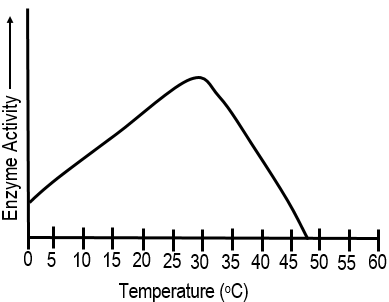
31.
Based on the graph, what is the optimal temperature for this enzyme? 
a)
15oC
b)
40oC
c)
30oC
d)
35oC
32.
An enzyme speeds up a chemical reaction in the cell but can only be used once.  True or False? 
a)
true
b)
false
33.

Ionic Bonds form between two ions (atoms) that have

a)

ionic compounds

b)

negative charges

c)

positive charges

d)

opposite charges

34.
How do covalent bonds form?
a)
Donating & receiving valence e- between atoms.
b)
Opposite slight charges attract each other between compounds.
c)
Scientists are still not sure how they form.
d)
Sharing valence e- between atoms.
35.
Which end of the water molecule has a slightly positive charge?
a)
the oxygen end
b)
the hydrogen end
c)
both ends are slightly positive
d)
neither end is positive
36.
Water is a universal solvent because it...
a)
It can be found anywhere
b)
It freezes when it gets cold
c)
floats when frozen
d)
Dissolves most substances
37.
Which term refers to water having partial positive and a partial negative charge?
a)
cohesion
b)
surface tension
c)
polarity
d)
adhesion
38.
Water is often called the "universal solvent" because many substances can be dissolved in water. What property of water allows it to be such a versatile solvent? 
a)
purity
b)
polarity and cohesion
c)
high heat capacity
d)
expansion upon freezing
39.
In an exothermic reaction, heat is ...
a)
taken in
b)
given out
40.

In an endothermic reaction, heat is ...

a)

taken in

b)

given out

41.
Where do substrates bind on an enzyme?
a)
voltage-gated channels
b)
surface receptor
c)
calcium channels
d)
active site
42.
Any substance that is acted upon by an enzyme is called a(n)?
a)
Coenzyme
b)
Substrate
c)
Vitamin
d)
Polypeptide
43.
can a change in pH alter the active site of an enzyme
a)
yes
b)
no
44.
What happens when enzymes are heated to a high temperature?
a)
The enzymes die.
b)
The shapes of the enzyme are altered or denatured
c)
The enzymes' amino acid sequence changes.
d)
The enzymes remain the same
45.
The human body maintains a temperature of around 98.6 degrees at all times. Enzymes are involved in almost every chemical reaction in the body. Which of the following describes the connection between these two statements? 
a)
 Enzymes function best at a specific temperature.
b)
The body needs to be warm to prevent hypothermia.
c)
The body is kept relatively warm to prevent too much enzyme action.
d)
 There is no connection between the two statements. 
46.
As food travels through the digestive system, it is exposed to a variety of pH levels. The stomach has a pH of 2 due to the presence of hydrochloride acid (HCl), and the small intestine has a pH ranging from 7 to 9. HCl converts pepsinogen into pepsin, an enzyme that digests proteins in the stomach. Which of the following most likely happens to pepsin as it enters the small intestine?
a)
 It becomes inactive.
b)
It begins to replicate.
c)
 It's shape changes to engulf large proteins.
d)
It's activity increases to digest more proteins.
47.
How many different elements are in this chemical formula: C2H2ClK3
a)
6
b)
8
c)
2
d)
4
48.
What is water?
a)
element
b)
compound
c)
mixture
49.
How many Oxygen are in H2O?
a)
1
b)
2
c)
0
d)
4
50.
How many atoms are there TOTAL in:
H2SO4
a)
6
b)
5
c)
7
d)
3
51.

How many total atoms are is C3O4?

a)

2

b)

7

c)

3

d)

12

52.

Which is not one of the four most common elements in life?

a)

Carbon

b)

Oxygen

c)

Iron

d)

Nitrogen

e)

Hydrogen

53.

True or False: Water is the most abundant compound in life?

a)

True

b)

False

54.
Is sugar (C12H22O11) an element or a compound?
a)
Element
b)
Compound
55.
Is water an element or a compound?
a)
Element
b)
Compound
56.
A compound consists of two or more elements bound together.
a)
True
b)
False
57.
Which of the following elements is required in an organic compound?
a)
nitrogen
b)
oxygen
c)
carbon
d)
sodium
58.
How are covalent bonds formed?
a)
Sharing of electrons
b)
Transfer of electrons
59.
How are ionic bonds formed?
a)
Transfer of electrons
b)
Sharing of electrons
60.
Same repel, opposites
a)
avoid
b)
attract
c)
push
d)
pull
61.
Which of these is not a real bond in chemistry?
a)
James
b)
Ionic
c)
Covalent
62.
The _____is the part that gets dissolved. 
a)
solute 
b)
solvent 
c)
solution 
d)
Sacajawea 
63.
The universal solvent is ______. 
a)
sodium 
b)
acid 
c)
water 
d)
wind 
64.
This is the part of the solution that does the dissolving. 
a)
solute
b)
solvent 
c)
salt water 
d)
First Continental Congress 
65.
In a sample of salt water, NaCl would be considered the ______.
a)
Solution
b)
Solute
c)
Solvent
d)
Solvation
66.
If we are making Kool-aid with sugar, Kool-aid powder, and water, which part is the solvent?
a)
water
b)
powder
c)
sugar
d)
powder and sugar
67.
What is a compound? 
a)
 the simplest form of a substance 
b)
a combination only of 3 elements 
c)
a combination of 2 or more elements 
d)
a place where people are held