wayground logo

Free Printable Worksheets

Font size

S
M
L
XL
Worksheets

Miller.Biology.SkillCheck.Review

Total questions: 70

Worksheet time: 1hrs 7mins

Name
Class
Date
1.
Any substance that is known to cause cancer is called a
a)
carcinogen
b)
nicolyte
c)
pathogen
d)
retrovirus
2.

An abnormal mass/group of cancer cells is called a

a)

tumor

b)

cyst

c)

lesion

d)

polyp

3.
A diagnostic procedure that involves removing a tissue sample from a patient.
a)
biopsy
b)
lipotripsy
c)
pathogenesis
d)
oncology
4.
What is cancer?
a)
The heart does not receive enough blood.
b)
Sudden disruption of blood flow to part of the brain.
c)
Blood filled weak spot.
d)
Uncontrolled growth and spread of abnormal cells.
5.
Using drugs or medicines to destroy cancer cells.
a)
chemotherapy
b)
radiation therapy
c)
cancer surgery
d)
mitotic spindling
6.

Which type of tumor is being described:


Slow growing Not dangerous Does not spread

a)

Malignant

b)

Benign

7.

Which type of tumor is being described below:


Spreads Dangerous Grows quickly

a)

Benign

b)

Malignant

8.

If cancerous cells travel throughout your body, the cells have gone through a process known as:

a)

Metastisize

b)

Migration

c)

Flowing

d)

Locomotion

9.

What is a mutation?

a)

A mistake in DNA which can lead to cancer

b)

A complete copy of DNA

c)

A change in DNA which doesn't cause an issue

d)

A mistake in your body that is caught and removed
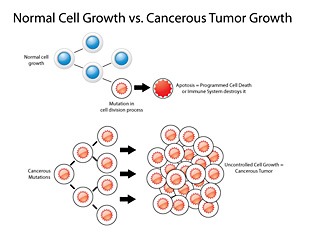
10.
Cancer creates abnormal cells by disrupting
a)
the cell cycle
b)
red blood cell formation
c)
DNA replication
d)
ATP synthesis
11.
An abnormal mass of cancer cells is called a 
a)
tumor
b)
cyst
c)
lesion
d)
polyp
12.
Cancer is best and fully described by ...
a)
Uncontrolled cell growth
b)
Cells which grow abnormally and no longer function correctly
c)
Cells which have lost the ability to reproduce
d)
Cells which create abnormal tissues
13.
Resisting Cell Death hallmark is best described when ...
a)
When the cell blocks apoptosis
b)
When the cell evades the signal
c)
When cells grow rapidly
d)
When cells evade suppressor proteins
14.

What is cell differentiation?

a)

The process where unspecialized cells become different in structure and function.

b)

When DNA controls the cell cycle.

c)

The ability of cells to make more cells.

d)

The ability of cells to maintain homeostasis.

15.
Which is true about Embryonic Stem Cells.
a)
They no longer do mitosis, their cell type is set and can not change
b)
They are limited to the type of cell they can become
c)
They can become any cell type in the body
d)
They are found in adults
16.
Embryonic stem cells are?
a)
mutlipotent
b)
pluripotent
c)
totipotent
d)
isopotent 
17.
The diagram shows the process of cell specialization from a single stem cell. Which of the following statements is true about the process of specialization.
a)
Specilized cells (blood, skin, nervous etc) cannot be produced from a single stem cell
b)
Specilized cells are produced immediately following fertilization
c)
Even though all the cells in an organism come from one single cell, they can specialize into different cell types
d)
Sincce all the cells in an organism come from one single cell, they must all have the same structure and function
18.
What does "pluripotent" mean?
a)
able to divide and make many different types of cells
b)
not able to divide
c)
can only divide and make one cell type 
d)
if it divides, it will make a cancerous tumor
19.
Which best explains why muscle cells are different from blood cells?
a)
Muscle cells are produced by the brain, but blood cells are produced by the heart. 
b)
Different genes are activated in muscle cells than in blood cells. 
c)
Muscles cells experience different environmental influences than blood cells. 
d)
A mutation occurs during the development of muscle cells but not in blood cells. 
20.
What is one goal of cellular differentiation/specialization?
a)
To create specialized cells to help organism maintain homeostasis.
b)
To many cells.
c)
To make stem cells
d)
to make single celled organisms
21.
Stem cells are
a)
cells that grow uncontrollably
b)
undifferentiated and can be any type of cell
c)
never go through cell division
d)
only found in embryos
22.

Which organelle is responsible making food (Glucose) using sunlight?

a)

Ribosomes

b)

Nucleus

c)

Chloroplast

d)

Mitochondria

23.

Select all that are raw materials for Photosynthesis.

a)

Water

b)

Carbon Dioxide

c)

Oxygen

d)

Sunlight (Light Energy)

e)

Glucose (Sugar/food)

24.

Select all that are products of Photosynthesis.

a)

Water

b)

Carbon Dioxide

c)

Oxygen

d)

Sunlight (Light Energy)

e)

Glucose (Sugar/food)

25.

What is the green pigment that "traps" sunlight?

a)

Chlorophyll

b)

Chloroplasts

c)

Photosynthesis

d)

ATP

26.
What major energy transformation occurs during photosynthesis?
a)
Thermal --> Chemical
b)
Kinetic --> Radiant
c)
Chemical --> Radiant
d)
Radiant --> Chemical
27.
Which organelle in the plant cell performs photosynthesis?
a)
Chloroplast
b)
Mitochondria
c)
Nucleus
d)
Cytoplasm
28.
Which of the following is the correct equation for PHOTOSYNTHESIS?
a)
CO+ light + H2O --> O+ Sugar
b)
CO+ sugar + H2O --> O+ light
c)
O2 + light + H2O --> CO+ Sugar
d)
CO+ O2 + H2O --> Light+ Sugar
29.
What is the ultimate ORIGINAL source of energy for living things
a)
Sugar
b)
Sun
c)
Moon
d)
Carbon Dioxide
30.
Which gas is removed from the atmosphere during photosynthesis?
a)
hydrogen
b)
oxygen
c)
nitrogen
d)
carbon dioxide
31.
In which organelle does photosynthesis occur?
a)
mitochondria
b)
cell membrane
c)
nucleus
d)
chloroplasts
32.
What is the chemical formula for glucose?
a)
C6H12O6
b)
C6H6O12
c)
C12H6O12
d)
C6O2H6
33.
What is the chemical formula for water?
a)
H2O
b)
HO2
c)
CHO2
d)
CO2H
34.
What is the chemical formula for carbon dioxide?
a)
H2O
b)
CO2
c)
CHO2
d)
CO2H
35.
Which is the correct formula for photosynthesis?
a)
CO2 + H2O --> (in sunlight) C6H12O6 + O2
b)
sunlight + CO2 + H2O --> C6H12O6 + O2
c)
C6H12O6 + O2 --> (in sunlight) CO2 + H2O
d)
CO2 + H2O --> C6H12O6 + O2 + sunlight
36.
What is the function of ATP in living things?
a)
provides energy for cells
b)
stores genetic information
c)
provides structure in the nucleus
37.
What is the correct equation for cellular respiration?
a)
6O2 + C6H12O6 -> 6CO2 + 6H2O + Energy
b)
6O2 + C6H12O6 + Energy -> 6CO2 + 6H2O
c)
6CO2 + 6H2O -> 6O2 + C6H12O6 + Energy
d)
6CO2 + 6H2O + Energy -> 6O2 + C6H12O6
38.

What are the reactants for Cell Respiration?

a)

CO2 + H20

b)

C6H12O6 + CO2

c)

C6H12O6 + O2

d)

CO2 + H20 + 38 ATP

39.

What are the products for Cell Respiration?

a)

CO2 + H20

b)

C6H12O6 + CO2

c)

C6H12O6 + O2

d)

CO2 + H20 + 38 ATP

40.
In what organelle does cell respiration take place?
a)
Mitochondria
b)
Chloroplast
c)
Golgi Apparatus
d)
Nucleus
41.
True or False: Plants do Cell Respiration and Photosynthesis?
a)
TRUE
b)
FASLE
42.

What is the energy that is produced in cell respiration?

a)

ADP

b)

Sugar

c)

ATP

43.

In which stage of the cell cycle does the cell grow in size?

a)

G1

b)

S

c)

G2

d)

Mitosis

44.

In which stage of the cell cycle does the DNA replicate?

a)

G1

b)

S

c)

G2

d)

Mitosis

45.

A process where one cell forms two identical daughter calls is called...

a)

cell cycle

b)

interphase

c)

meiosis

d)

cytokinesis

46.

The following describes_________________________ during mitosis. The chromatin condenses and spindle fibers form at each side of the cell. The chromosomes begin to form and nuclear membrane disappears.

a)

prophase

b)

anaphase

c)

metaphase

d)

telophase

47.

The following describes_________________________ during mitosis. The chromosomes line up along the middle of the cell and the spindle fibers attach to each chromosome at the centromere.

a)

prophase

b)

metaphase

c)

anaphase

d)

telophase

48.

How many chromosomes do human somatic cells (body cells) have?

a)

23

b)

48

c)

46

d)

92

49.

When you start with 1 cell, at the end of mitosis, how many identical cells will you have?

a)

1

b)

2

c)

3

d)

4

50.
Place these cells in order of mitosis.
a)
A, B, C, D, E
b)
B, E, D, A, C
c)
C, E, A, D, B
d)
B, D, A, E, C
51.
What is the longest stage of the cell cycle called?
a)
Cytokinesis
b)
M phase
c)
Interphase
d)
G1 Phase
52.
During which stage of the cell cycle does mitosis and cytokinesis occur?
a)
Interphase
b)
S phase
c)
M phase
d)
G1 phase
53.
Which phase of mitosis is shown in the picture?
a)
Prophase
b)
Anaphase
c)
Telophase
54.
Which phase of mitosis is shown in the picture?
a)
Interphase
b)
Metaphase
c)
Telophase
55.
Which phase of mitosis is shown in the picture?
a)
Interphase
b)
Metaphase
c)
Telophase
56.
Which phase of mitosis is shown in the picture?
a)
Prophase
b)
Metaphase
c)
Anaphase
57.
Which phase of mitosis is shown in the picture?
a)
Prophase
b)
Telophase
c)
Metaphase
58.
What is shown in the picture?
a)
Mitosis
b)
Interphase
c)
Cytokinesis
59.
Sister chromatids are joined together at the ___________.
a)
equator
b)
chromosome
c)
centromere
d)
ends
60.

What is the image above:

a)

Chromosome

b)

Chromotid

c)

Centromere

d)

Centriole

61.

A chromosome is packaged

a)

DNA

b)

Protein

c)

Carbohydrates

d)

Lipids

62.
Which of these lists presents the stages of the cell cycle in the correct order?
a)
interphase, mitosis, cytokinesis
b)
cytokinesis, mitosis, interphase
c)
mitosis, interphase, cytokinesis
d)
interphase, cytokinesis, mitosis
63.
Which of these phases of mitosis take place first?
a)
anaphase
b)
telophase
c)
prophase
d)
metaphase
64.
Identify the stage of mitosis.
a)
interphase
b)
prophase
c)
anaphase
d)
cytokinesis
65.
What does DNA stand for?
a)
DeNatured Acid
b)
DomiNant Acid
c)
DeoxyriboNucleic Acid
d)
DiriboNucleic Acid
66.
Replication is when __________.
a)
the cell makes a copy of its DNA in nucleus 
b)
the cell forms 2 identical cells
c)
the cell produces 2 sets of organelles
d)
the cell continues to complete the same function
67.
Where does replication occur within the cell?
a)
in the cytoplasm
b)
in the nucleus 
c)
in the ribosome
d)
in the chromatin
68.
If the percentage of DNA is made of 30% Thymine, what is the correct percentage of Guanine?
a)
30
b)
15
c)
20
d)
60
69.
Replicate the following strand of DNA: 
AATCATGGA
a)
AATCATGGA
b)
TTAGTACCT
c)
UUAGUACCU
d)
GGATAUCUA
70.
The enzyme that unzips the DNA to prepare for replication
a)
helicase
b)
replicase
c)
polymerase
d)
synthase