Wayground logo

Free Printable Worksheets

Font size

S
M
L
XL
Worksheets

Energy and Energy Transfer

Total questions: 35

Worksheet time: 1hrs 10mins

Name
Class
Date
1.
The flow of energy from an object at a higher temperature to an object at a lower temperature.
a)
heat
b)
temperature
c)
radiation
d)
conduction
2.
Energy that travels across distances in the form of electromagnetic waves. 
a)
Convection
b)
Radiation
c)
Conduction
d)
Induction
3.
Heat transfer always goes from-
a)
Cold to Hot
b)
Hot to Cold
c)
Heat doesn't transfer
d)
Freezing to Cold
4.
In what direction do hot liquids and gasses move?
a)
Side to Side
b)
Down
c)
Up
d)
Back and Forth
5.
What happens to particles as they heat up?
a)
They slow down
b)
Nothing
c)
They don't move
d)
They speed up
6.
This form of energy could be represented by the movement of electrons within copper wires.
a)
Electrical
b)
Light
c)
Sound
d)
Mechanical
7.
You could find a lot this type of energy at the top of a tall tree.
a)
Electrical
b)
Kinetic
c)
Potential
d)
Mechanical
8.
This form of energy does NOT come from the sun.
a)
Solar
b)
Thermal
c)
Light
d)
Sound
9.
"Stored energy" is another way of describing what energy type?
a)
Potential
b)
Electrical
c)
Kinetic
d)
Mechanical
10.
If your cup of hot chocolate is really hot that means it has a lot of this type of energy.
a)
Chemical
b)
Thermal
c)
Electrical
d)
Potential
11.
What form of energy is defined as, "the total potential and kinetic energy of an object".
a)
Potential
b)
Mechanical
c)
Kinetic
d)
Electrical
12.
What type of energy is best represented by a battery?
a)
Sound
b)
Thermal
c)
Mechanical
d)
Chemical
13.
What type of energy transfer is most likely responsible when a plant converts the suns energy into food?
a)
Chemical to Solar
b)
Solar to chemical
c)
Light to electrical
d)
Electrical to chemical
14.
What form of energy transfer is most likely responsible when your clothes dryer dries your clothes?
a)
Potential to Chemical to Nuclear
b)
Kinetic to Thermal to Light
c)
Chemical to Mechanical to Electrical
d)
Electrical to Mechanical to Thermal
15.
True or False.  Energy cannot be lost or destroyed, rather it is transformed from one energy type to another.
a)
True
b)
False
16.

Plants need the sun for _____________________ energy.

a)

Light / Radiant

b)

Sound

c)

Chemical

d)

Electrical

17.

Water being held by a dam, is an example of ______________energy.

a)

Water

b)

Dam

c)

Gravitational

d)

Sound

18.

The diagram shows a cart moving freely along a track. What happens to the energy of the cart as it moves from point A to point B on the diagram?

a)

Potential energy is transformed to kinetic energy.

b)

Kinetic energy is transformed to potential energy.

c)

Both potential energy and kinetic energy stay the same.

19.

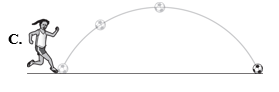
Which diagram models the position of a soccer ball when it has the greatest amount of gravitational potential energy?
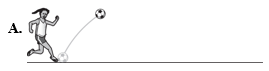
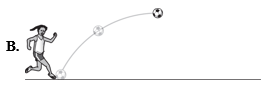
a)
b)
c)
20.

A toy robot can walk and talk and runs on batteries. Which type of energy is stored in the batteries?

a)

nuclear

b)

chemical

c)

electrical

d)

mechanical

21.

A nuclear power plant captures the energy created by the fission of the nuclei of uranium atoms and uses the generated energy to boil water. The boiled water creates steam that spins a series of turbines as it rises. As each turbine spins, it generates power that is sent into the power grid. Choose the correct sequence to fill in the blanks below. The uranium atoms contain __________ energy. The heat from their fission increases the __________ energy of the water. The spinning of the turbines is __________ energy that then generates __________ energy used in people’s homes.

a)

CDBA

b)

CBDA

c)

CADB

d)

CABD

22.

A hockey player uses her stick to hit a hockey puck. Which statement describes the overall energy transfer?

a)

Energy is transferred from the stick to the puck.

b)

Energy is transferred from the player to the puck.

c)

Energy is transferred from the puck to the player.

d)

Energy is transferred from the stick to the player.

23.

What energy transformation takes place when a hair dryer is used?

a)

Energy from the sun is transformed to chemical energy.

b)

Sound energy is transformed to thermal energy and electrical energy.

c)

Electrical energy is transformed to thermal energy and sound energy.Electrical energy is transformed to thermal energy, sound energy, and mechanical energy

d)

Electrical energy is transformed to thermal energy and sound energy.

24.

A scientist performed an experiment during which she measured the energy transferred in each step of her experiment. The total quantity of energy transferred in all of the steps was less than the amount she measured at the beginning. What is the most likely explanation for this result?

a)

Energy was destroyed during certain steps in the experiment.

b)

The steps in the experiment required more energy than was available.

c)

The experiments created energy that was then used up at a faster rate.

d)

Some energy was transformed into unwanted heat or sound that was not detected.

25.

A hot potato at 80 ºC is placed in a bowl of soup at 40 ºC. The surrounding room is at 20 ºC. Which correctly describes the directions of thermal energy transfer?

a)

potato to soup, and soup to room

b)

room to soup, and soup to potato

c)

room to soup, and room to potato

d)

soup to potato, and potato to room

26.
These kind of observations are made using instruments such as rulers, balances and thermometers.
a)
Qualitative
b)
Quantitative
c)
Scientific
27.
These kind of observation use your senses to observe results.
a)
Qualitative
b)
Quantitative
c)
Scientific
28.
Scientists frequently repeat the experiments of others scientists. Why is this important in science?
a)
Scientists often ask each other for help in performing experiments.
b)
Replication of experiments helps to confirm and verify results.
c)
Scientists frequently perform other scientists’ experiments in order to practice their technique.
d)
Repeating experiments is an effective way to make sure a laboratory is in optimal condition.
29.
Dr. Smith has been reading about another scientist’s research in a physics journal. He plans to do these experiments himself and see if he gets the same result.
a)
repetition
b)
replication
30.

Which month had the greatest number of books read?

a)

November

b)

December

c)

January

d)

February

31.
A battery converts what type of energy to another?
a)
sound to kinetic
b)
light to heat
c)
mechanical to electrical
d)
chemical to electrical
32.
According to which law of energy, energy can't be created or destroyed?
a)
First law of motion
b)
The law of tacos
c)
Laws of Energy
d)
law of conservation of energy
33.

Maggie measures the wind speed every day for 7 weeks. She constructs the following line graph of the average weekly wind speed. How many of the 7 weeks experience average wind speeds greater than 7.9 km/h?

a)

4 weeeks

b)

5 weeks

c)

6 weeks

d)

7 weeks

34.
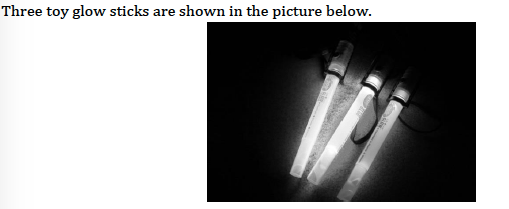
The glow sticks produce light for a short amount of time. The light from the glow stick is a conversion from what to what?
a)
thermal to light
b)
gravitational to potential
c)
radiant to electrical
d)
chemical to light
35.
What machine changes electrical energy into light and sound energy?
a)
battery
b)
lightbulb
c)
alarm clock
d)
apple