wayground logo

Free Printable Worksheets

NEW

Font size

S
M
L
XL
Worksheets

Describing Motion Ch. Review

Total questions: 75

Worksheet time: 2hrs 40mins

Name
Class
Date
1.

Which item is necessary to describe location?

a)

two dimensions

b)

a reference point

c)

a change in speed

2.

When an arrow represents velocity, the length of the arrow is

a)

time.

b)

speed.

c)

direction

3.

If an object speeds up, slows down, or changes direction, it experiences a change in

a)

mass

b)

velocity

c)

reference point

4.

Distance from a reference point

a)

displacement

b)

motion

c)

position

5.

Process of changing position

a)

displacement

b)

motion

c)

position

6.

difference between initial and final position of an object

a)

displacement

b)

motion

c)

position

7.

total distance traveled divided by the total time taken to travel that distance

a)

average speed

b)

constant speed

c)

instantaneous speed

8.

speed at a specific point in time

a)

average speed

b)

constant speed

c)

instantaneous speed

9.

rate of change of position in which the same distance is traveled each second

a)

constant speed

b)

average speed

c)

instantaneous speed

10.

Calculate the average speed of the train from minute 5 of the journey until minute 10.

a)

1.3 km/min

b)

1.2 km/min

c)

0.8 km/min

11.

What was the train was doing 4 minutes after it started this trip?

a)

speeding up

b)

slowing down

c)

standing still

12.

What does the dotted line on the

a)

It shows the trains average speed

b)

It shows the trains actual speed

c)

It shows the trains speed at a given

13.

The difference between distance and displacement.

a)

Displacement is the difference between initial and final position of an object, and speed is the measure of the distance an object travels per unit of time.

b)

Speed is the difference between initial and final position of an object, and displacement is the measure of the distance an object travels per unit of time.

c)

There is no difference.

14.

Changing a reference point does not change the actual position of an object.

a)

True

b)

False

15.

Speed is speed at a specific instant in time.

a)

True

b)

False

16.

The equation for average speed is v = d/t What does the symbol d mean?

a)

total time

b)

total distance

c)

average speed

17.
You can measure _____ by dividing distance over time.
a)
motion
b)
position
c)
speed
d)
velocity
18.
When runners are running around a track, they are constantly changing their _____.
a)
motion
b)
speed
c)
velocity
d)
force
19.
The measure of an object's speed in a certain direction is its ________.
a)
force
b)
position
c)
speed
d)
velocity
20.
When describing an object's position, other objects you use as comparisons become your _____ of _____.
a)
motion of position
b)
frame of reference
c)
speed of direction
d)
direction of velocity
21.
_____ is a force which slows and eventually stops motion.
a)
force
b)
friction
c)
gravity
d)
speed
22.

Which two things must you know to find the velocity of an object?

a)

mass and speed

b)

speed and direction

c)

reference point and mass

d)

direction and reference point

23.

The acceleration of an object measures its change in

a)

speed

b)

velocity

c)

location

d)

reference point

24.
North, south, east, west, right, left, up and down are all words used to describe _____.
a)
direction
b)
motion
c)
position
d)
speed
25.
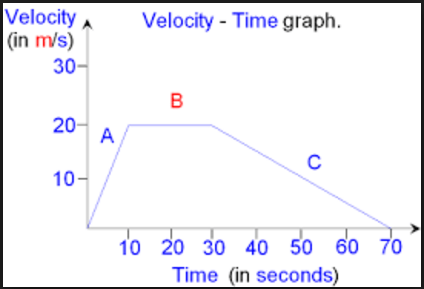
What is happening to the object from point A to point B? (Pay attention to what type of graph it is) 
a)
It stopped moving 
b)
It's accelerating 
c)
It is moving at a constant speed 
d)
It is decelerating 
26.
What is the total speed for the object after 60 seconds? 
a)
500 m/s
b)
60 m/s 
c)
8.33 m/s
d)
300 m/s 
27.
LT5: The rate at which velocity CHANGES is: 
a)
acceleration
b)
speed
c)
direction
d)
physics
28.
On a distance vs. time graph, the steeper the slope _____
a)
the slower the speed
b)
the faster the speed
c)
less acceleration
d)
greater acceleration
29.
This is a velocity-time graph.  What is the object doing in segment B?
a)
Positive acceleration
b)
Negative acceleration
c)
Constant Velocity
d)
Not moving
30.
If Clara runs 200 m in 20 seconds and Mario runs 300 m in  50 seconds, what can not we say about them is............
a)
Clara is faster than mario
b)
clara's average speed is higher than mario
c)
Mario ran for longer time than Clara to reach same distance
d)
Mario is faster than clara
31.
direction opposite the reference direction
a)
positive direction
b)
negative direction
c)
reference point
32.
The reference direction
a)
positive direction
b)
negative direction
c)
reference point
33.
Which of the following is a reference direction?
a)
faster
b)
the street
c)
to the north
d)
slower
34.
The velocity of an object is the same as its speed.
a)
True
b)
False
35.
Which of the following is not part of an object's velocity?
a)
mass
b)
speed
c)
direction
d)
They are all part of velocity.
36.
What is a common label for acceleration?
a)
mph
b)
m/s/s
c)
km/hr
d)
m/s
37.
Which of the following is an example of acceleration?
a)
speeding up
b)
slowing down
c)
turning a corner
d)
all of the above
38.
Calculate the speed for a car that went a distance of 125 miles in 2 hours time.
a)
250 mph
b)
250 m/s
c)
62.5 mph
d)
62.5 m/s
39.
Jessica jogs on a path that is 25 kilometers long to get to a park that is south of the jogging path. If it takes Jessica 2.5 hours then what is her speed?
a)
62.5 km/h
b)
62.5 mph
c)
10 km/h
d)
10 mph
40.
Jessica jogs on a path that is 25 kilometers long to get to a park that is south of the jogging path. If it takes Jessica 2.5 hours then what is her velocity?
a)
10 km/h south
b)
10 m/s south
c)
10 km/h
d)
10 mph
41.
A driver starts his parked car and within 5 seconds reaches a speed of 60 km/h, as he travels east. What is his acceleration?
a)
300 km/h
b)
300 km/h/s
c)
12 km/h
d)
12 km/h/s
42.
The steepness of a line on a graph is called the 
a)
rise
b)
run
c)
slant
d)
slope
43.
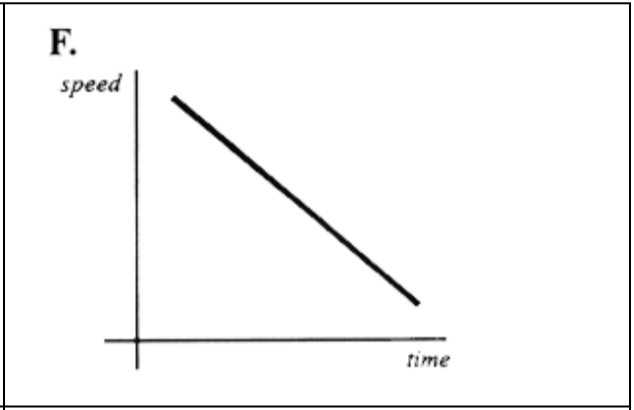
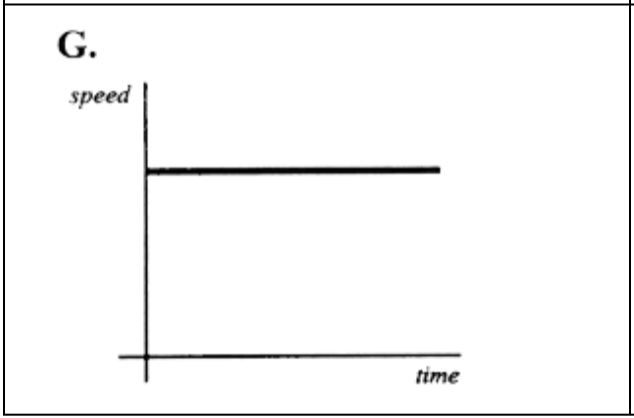
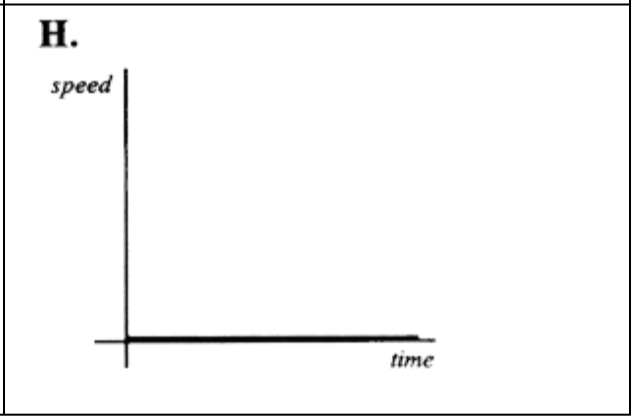
What does this graph represent?
a)
Constant Speed
b)
Acceleration
c)
Not moving
44.
LT2: "Woah! Did you see that fastball pitch? I clocked it at 97 mph!"
Is this person talking about instantaneous speed or average speed? 
a)
instantaneous
b)
average
45.

distance traveled divided by elapsed time

a)

average speed

b)

distance-time graph

c)

velocity

46.

If two objects are represented on a distance-time graph, which object is moving faster?

a)

the object represented by the longest straight lilne

b)

the object represented by the shortest straight line

c)

the object represented by the steepest straight line

47.
You walk 10 meters to math class in 20 seconds. Your average speed is
a)
2 m/s
b)
0.5 m/s
c)
200 m/s
d)
5 m/s
48.

These graphs both represent:

a)

decreasing speed

b)

constant speed

c)

acceleration

d)

object at rest

49.

A roller coasters accelerates from an initial speed of 6.0 m/s to a final speed of 70 m/s over 4 seconds. What's the acceleration?

a)

24 m/s2

b)

18 m/s2

c)

16 m/s2

d)

16 m/s

50.
A car accelerates from a standstill to 70 m/s in 10 seconds.  What is the acceleration?
a)
0.7m/s2
b)
7m/s2
c)
14m/s2
d)
none of the above
51.
What is velocity?
a)
the quickness of an object
b)
the location of an object
c)
acceleration
d)
speed in a specific direction
52.
What is speed?
a)
how far you go
b)
how much distance is covered over a period of time
c)
how fast you accelerate
d)
the change in the location of a object
53.
Change in speed over a given period of time is
a)
velocity
b)
motion
c)
speed
d)
acceleration
54.
Which runner had a head start?
a)
A
b)
B
c)
C
d)
None of them
55.
What does this graph represent?
a)
Constant speed
b)
Acceleration
c)
Not moving
56.
During which interval is the object speeding up?
a)
A to B
b)
B to C
c)
D to E
d)
E to F
57.

Which runner stopped for a rest?

a)

Albert

b)

Bob

c)

Charlie

d)

None of them stopped

58.
What is happening at D?
a)
Stationary
b)
Accelerating
c)
Fast steady speed; moving away from the starting position
d)
Slower steady speed; moving away from the starting position
59.
Which graph represents the greatest acceleration?
a)
A
b)
B
c)
C
d)
D
60.
Which section of the graph shows decreasing velocity?
a)
CD
b)
DE
c)
EF
d)
GH
61.
Which graph is would represent a decrease in speed?
a)
Graph A
b)
Graph B
c)
Graph C
d)
The object is not decreasing in speed in any of these graphs
62.
What is the object doing from 10-12.5 seconds?
a)
Slowing down 
b)
Returning to the starting position
c)
Speeding up
d)
Not moving
63.
Describe the speed of the object from
0-2 seconds using the distance vs. time graph.
a)
Constant speed
b)
Speeding up
c)
Slowing down
d)
Not moving
64.
Which graph represents zero acceleration (constant velocity)?
a)
A
b)
B
c)
C
d)
D
65.
How many times does this object STOP moving?
a)
None
b)
Once
c)
Twice
d)
Three times
66.
How far does the object move?
a)
40m
b)
80m
c)
100
d)
100m
67.
What is the objects average speed from 0-20 seconds?
a)
0.5m/s
b)
10m/s
c)
2m/s
d)
10m
68.
What is happening at C?
a)
Stationary
b)
Accelerating
c)
Fast steady speed; moving away from the starting position
d)
Slower steady speed; moving away from the starting position
69.

A negative acceleration means that your object is _____.

a)

doing nothing

b)

moving in circles

c)

speeding up

d)

slowing down

70.

What is happening during point A to B?

a)

not moving

b)

increasing speed at a constant rate

c)

moving at a constant speed

d)

moving at 10 m/s2 acceleration

71.

Match the graph to the description:

"The car is traveling at a constant speed."
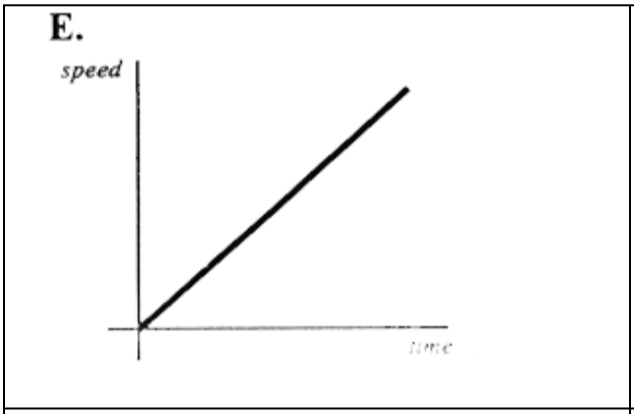
a)
b)
c)
d)
72.

Match the graph to the description:

"The car is accelerating."

a)
b)
c)
d)
73.

Match the graph to the description:

"The car is stationary."

a)
b)
c)
d)
74.

Mark slams on the brakes after traveling 25 m/s. It takes him 3 seconds to come to a complete stop. What is his acceleration?

a)

8.33 m/s2

b)

-8.33 m/s2

c)

75 m/s2

d)

-75 m/s2

75.
A drag racer accelerated from rest ( 0 m/s ) to 195 m/s in 6.5 s.  What was the acceleration?
a)
10 m/s
b)
30 m/s2
c)
-3 m/s2
d)
26 m/s