
 Worksheets
Physical Science Assessment Review
Total questions: 80
Worksheet time: 1hrs 22mins
Name
Class
Date
1.
If there is a gap in a circuit, it is known as an _________ circuit.
a)
Open
b)
Closed
2.
Negatively charged particles that flow through a wire and light a bulb are called:
a)
Circuits
b)
Currents
c)
Electrons
d)
Parallels
3.
Series circuit is
a)
a circuit with more than one path for current to travel
b)
has magnets to help current to travel
c)
a circuit that has only one path for the current to travel
d)
does not allow electric current to travel through it
4.

Would would best complete this circuit?
a)
A wire
b)
A switch
c)
A battery
d)
A light bulb
5.
A ______ opens and closes a circuit.
a)
power source
b)
conductor
c)
switch
d)
output device
6.

this circuit is...?
a)
open
b)
closed
c)
parallel
d)
all of the above
7.

this circuit is .....?
a)
open
b)
parallel
c)
closed
d)
chris barton
8.
What is a circuit that has only one path that electricity can follow?
a)
Series Circuit
b)
Parallel Circuit
9.
What is a circuit that has two or more paths that electricity can follow?
a)
Series Circuit
b)
Parallel Circuit
10.

Does this diagram represent a series or parallel circuit?
a)
series circuit
b)
parallel circuit
11.

__________ is an energy resource that WILL NOT run out in the next several hundred years.
a)
Renewable Energy Resource
b)
Nonrenewable Energy Resource
c)
Fossil Fuel
d)
Forever Fuel
12.

__________ is an energy resource that WILL run out in the next several hundred years.
a)
Renewable Energy Resource
b)
Nonrenewable Energy Resource
c)
Fossil Fuels
d)
Forever Fuels
13.

Coal is a __________ energy resource.
a)
Renewable
b)
Nonrenewable
14.

Solar Power is a __________ energy resource.
a)
Renewable
b)
Nonrenewable
15.

Oil is a __________ energy resource.
a)
Renewable
b)
Nonrenewable
16.

Natural Gas is a __________ energy resource.
a)
Renewable
b)
Nonrenewable
17.

Which stage does the #3 show in the diagram?
a)
condensation
b)
evaporation
c)
precipitation
d)
run off
18.

During which interval is the object not moving?
a)
B to C
b)
C to D
c)
D to E
d)
only at point A
19.

During which interval is the object traveling at a constant velocity?
a)
B to C
b)
D to E
c)
F to G
d)
it traveling at a constant velocity during all of the intervals shown.
20.

During which interval is the object speeding up?
a)
A to B
b)
B to C
c)
D to E
d)
E to F
21.

During which interval is the object slowing down?
a)
A to B
b)
D to E
c)
E to F
d)
G to H
22.

Which runner stopped for a rest?
a)
Albert
b)
Bob
c)
Charlie
23.
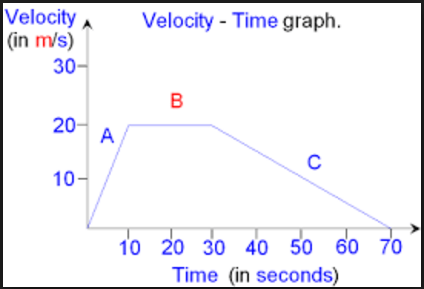
This is a velocity-time graph. What is the object doing in segment A?
a)
Positive acceleration
b)
Negative acceleration
c)
Constant Velocity
d)
Not moving
24.
A truck driving at 60 miles per hour travels 150 miles. How long is it driving for?
a)
9000 hours
b)
0.4 hours
c)
210 hours
d)
2.5 hours
25.

When a heavy football player and a light one run into each other, who exerts more force?
a)
The heavy one
b)
The light one
c)
They are equal
d)
there is no such thing as force
26.
What is Newton's First Law
a)
F=ma
b)
Every action has an equal and opposite reaction
c)
An object at rest stays at rest, an object in motion stays in motion.
d)
Friction
27.
Which of Newton's laws includes the formula: Force = mass x acceleration?
a)
Newton's 1st Law
b)
Newton's 2nd Law
c)
Newton's 3rd Law
28.

Which of Newton's Laws deals with Action/Reaction pairs?
a)
Newton's 1st Law
b)
Newton's 2nd Law
c)
Newton's 3rd Law
29.

The rocket pushes gases downward. The gases push the rock upward.
a)
Newton's 1st Law
b)
Newton's 2nd Law
c)
Newton's 3rd Law
30.

It requires MORE force to push a car than a lawn mower.
a)
Newton's 1st Law
b)
Newton's 2nd Law
c)
Newton's 3rd Law
31.
What is Inertia?
a)
An unbalanced for will stay as an unbalanced for unless acted upon by a movement of force
b)
A point of unbalanced forces will move while a object at rest will stay at rest until smashed into by an unstoppable force
c)
Inertia is when moose stay at place and dont move... ever
d)
An object at rest will stay at rest and a object in motion will stay in motion unless acted upon by an unbalanced force
32.
How many elements are in C6H12O6?
a)
1
b)
2
c)
3
d)
4
33.
How many atoms of carbon (C) are in C6H12O6?
a)
3
b)
6
c)
12
d)
24
34.
Element or compound?
H2O
H2O
a)
element
b)
compound
35.
Element or compound?
O2
O2
a)
Element
b)
Compound
36.
How many atoms are there TOTAL in:
H2SO4
H2SO4
a)
6
b)
5
c)
7
d)
3
37.
Which of the following is NOT an element?
a)
H2O
b)
H2
c)
O2
d)
Au
38.

The red numbers in the image below represent ________
a)
subscripts
b)
coefficients
c)
I don't know, and don't want to try
d)
None of the answers are correct
39.

The blue numbers in the image below represent ________
a)
I don't know, and don't want to try
b)
coefficients
c)
subscripts
d)
none of the answers are correct
40.
The substances at the beginning of a chemical equation are called the ____
a)
product
b)
yield
c)
chemical symbol
d)
reactants
41.
In the equation, 2Mg + O2 ---> 2MgO, which are the reactants?
a)
Mg and O
b)
MgO
c)
Mg and MgO
d)
O and MgO
42.
How many atoms of aluminum are on each side of the following equation: 4Al + 3O2 --> 2Al2 O3
a)
2
b)
6
c)
1
d)
4
43.
Is the following equation balanced or unbalanced?
Fe + S --> FeS
Fe + S --> FeS
a)
balanced
b)
unbalanced
44.
How many atoms are there TOTAL in:
H2SO4
H2SO4
a)
6
b)
5
c)
7
d)
3
45.
How many Sodium (Na) are in 6NaCl?
a)
1
b)
12
c)
6
46.
How many Aluminum are in Al2O3?
a)
3
b)
2
c)
5
47.
How many Hydrogen are in 4H2O?
a)
6
b)
8
c)
2
d)
4
48.
How many Magnesium are in 10MgCl2?
a)
10
b)
5
c)
20
49.
The pH scale is a range from:
a)
1-7
b)
0-14
c)
1-14
d)
1-20
50.
A(n) ______ is a substance with a pH less than 7
a)
Acid
b)
Alkaline
c)
Base
d)
Buffer
51.

Is this substance acidic, alkali, or neutral?
a)
Acidic
b)
alkali
c)
Neutral
52.

Is this substance acidic, alkali, or neutral?
a)
Acidic
b)
alkali
c)
Neutral
53.
A solution with a pH of 3.6 would be...
a)
Acid
b)
alkali
c)
Neutral
d)
Acid and alkali
54.
Which of the following is a property of an acid?
a)
pH > 7
b)
turns litmus paper blue
c)
tart or sour taste
d)
corrosive to organic materials
55.
Which is most acidic?
a)
Baking Soda
b)
Lemon Juice
c)
Black Coffee
d)
Milk
56.
On the universal pH scale, which color is neutral?
a)
Blue
b)
Red
c)
Green
d)
Maroon
57.
In the modern periodic table elements are arranged by:
a)
atomic mass
b)
atomic number
c)
valence electrons
d)
number of isotopes
58.
Each column in the periodic table is called a
a)
period
b)
group
c)
cluster
d)
unit
59.
Which group of the periodic table is composed of inert (not reactive) gases?
a)
alkali metals
b)
alkaline earth metals
c)
halogens
d)
noble gases
60.
Elements which are shiny, conduct electricity and heat are called
a)
metal
b)
nonmetal
c)
metalloid
d)
nonexistent
61.

The atoms along the staircase are called
a)
metals
b)
nonmetals
c)
metalloids
d)
noble gases
62.

What's a valence electron?
a)
electrons in the second energy level
b)
electrons in the outermost energy level
c)
the atomic number
d)
electrons in the first level
63.

How many electrons does a Copper atom have?
a)
63
b)
29
c)
92
d)
34
64.

How many neutrons are in a Gold atom?
a)
79
b)
196
c)
118
d)
275
65.

What does the 1.00794 stand for?
a)
Hydrogen
b)
atomic number
c)
atomic mass
d)
atomic explosion
66.
The electrons of an atom are found...
a)
in the outer "cloud" surrounding the atom.
b)
in the nucleus of the atom.
c)
in the cloud and in the nucleus.
67.
The subatomic particle with a negative charge is the
a)
electron
b)
proton
c)
neutron
d)
nucleus
68.
What is the mass number?
a)
the number of protons
b)
the number of protons and neutrons
c)
the number of neutrons
d)
the number of protons and electrons
69.

How many protons are in Beryllium?
a)
4
b)
9
c)
5
d)
2
70.

How many electrons does a Copper atom have?
a)
63
b)
29
c)
92
d)
34
71.

What element is represented in this Bohr Model?
a)
Carbon
b)
Hydrogen
c)
Aluminum
d)
Lithium
72.
What element is represented in this Bohr Model?
a)
Carbon
b)
Hydrogen
c)
Aluminum
d)
Lithium
73.

What's a valence electron?
a)
electrons in the second energy level
b)
electrons in the outermost energy level
c)
the atomic number
d)
electrons in the first level
74.
Which of the following has a full valence shell?
a)
Oxygen
b)
Neon
c)
Barium
d)
Carbon
75.
The majority of an atom's mass exists where?
a)
In the nucleus
b)
In the electron cloud
c)
In the space between the nucleus and the electrons
d)
In the neutrons
76.

How many protons are in this element?
a)
79
b)
196
c)
117
d)
Cannot be determined
77.

How many neutrons does the isotope of lithium have?
a)
8
b)
3
c)
4
d)
5
78.

The period for Bromine is ___________.
a)
3
b)
2
c)
4
79.

What are electrons?
a)
Negatively charged particles
b)
Neutrally charged particles
c)
Positively charged particles
d)
Uncharged particles
80.

How many electrons are in the outer shell of Sodium (Na)?
a)
3
b)
1
c)
2
d)
4
100 %

