wayground logo

Free Printable Worksheets

Font size

S
M
L
XL
Worksheets

Cells

Total questions: 46

Worksheet time: 59mins

Name
Class
Date
1.
A cell is...
a)
the basic unit of structure and function in living organism
b)
an organism
c)
a basic part of everything that we see
d)
found only in animals, not plants
2.

Which of the following converts food into energy for the cell?

a)

vacuole

b)

mitochondria

c)

cytoplasm

d)

cell membrane

3.
What do vacuoles do? 
a)
They actually do not have an important role
b)
They protect the cell
c)
They are the brain of the cell
d)
storage area for cells; water storage in plants 
4.
Which of the following is the smallest unit of life that can carry out all life functions?
a)
the mitochondria
b)
the vacuoles
c)
the nucleus
d)
the cell
5.
Which structures are found in every living cell?
a)
cell membrane and cytoplasm
b)
chloroplasts and mitochondria
c)
a cell wall and nucleus
d)
chloroplasts and cell wall
6.
What is the function of the cell nucleus found in both plant and animal cells?
a)
to produce energy
b)
to control cell activity
c)
to remove waste products
d)
to allow molecules to enter the cell
7.
Which cell structure is found in plant and animals cells and controls what can come into or leave a cell?
a)
cell membrane
b)
cytoplasm
c)
nucleus
d)
vacuole
8.
In what part of the plant cell does the process of photosynthesis take place?
a)
nucleus
b)
mitochondria
c)
chloroplasts
d)
vacuoles
9.

What is the function of the nucleus in a cell?

a)

To determine what enters and exits the cell

b)

to maintain rigidity and shape

c)

to direct the cells activities and hold genetic information

d)

to produce energy for the cell

10.

Where does the process of photosynthesis take place?

a)

cell wall

b)

cell membrane

c)

mitochondria

d)

chloroplast

11.

Plants use carbon dioxide, sunlight and water to produce food for themselves. In which organelle does this occur?

a)

mitochondria

b)

cytoplasm

c)

cell wall

d)

chloroplasts

12.

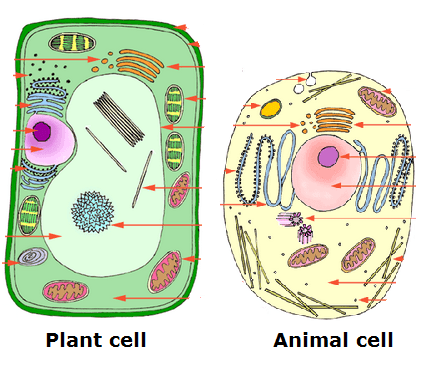
You could determine an animal cell from a plant cell by looking at the organelles. Which two organelles are lacking in an animal cell?

a)

cell membrane, cytoplasm

b)

mitochondria, nucleus

c)

vacuoles, cell membrane

d)

cell wall, chloroplasts

13.

What distinguishes a plant cell from an animal cell? (How do you tell them apart) Hint: There's 3 ways (Check all 3)

a)

Central Vacuole

b)

Mitochondria

c)

Cell Wall

d)

Ribosomes

e)

Chloroplasts

14.

The 3 parts of the Cell Theory are...?

a)

All living things are composed of cells

Cells are the basic units of structure and function in living things

All cells are produced from other cells

b)

All living things are composed of cells

Cells are the basic units of dance and vibes in living things

All cells are destroyed from other aliens

c)

All living things are composed of Jell-O

Cells are the basic units of structure and function in living things

All cells are produced from factories in Canada

d)

All living things are composed of cells

Cells do karate and practice eating whole pies in their free time

All cells are produced from other cells

15.
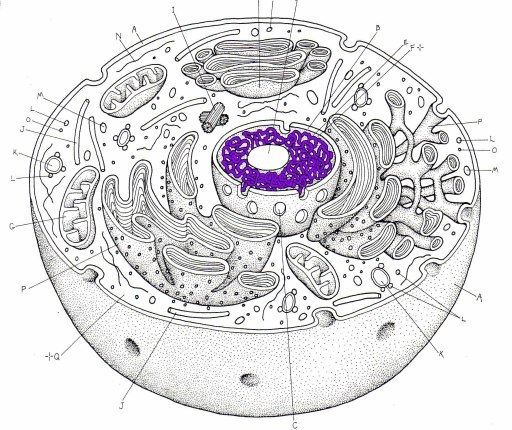
What is number 1?
This organelle is the control center of the cell.
a)
Ribosome
b)
Organelle
c)
Cytoplasm
d)
Nucleus
16.

The function of the nucleus is to:

a)

make energy for the cell

b)

hold the cell's DNA

c)

protect the cell

d)

make proteins for the cell

17.

What is the function of the cell wall in plant cells?

a)

determine what enters and exits the cell

b)

provide shape and rigidity

c)

this is where photosynthesis occurs

d)

produces energy for the cell

18.
The main function of chloroplasts is:
a)
To control what enters and leaves the cell.
b)
To break down food to release energy for the cell.
c)
To control all activities of the cell.
d)
To produce food for the cell using the sun's energy.
19.
Plants and animals are made up of millions of tiny what?
a)
atoms
b)
cells
c)
particles
d)
dots
20.
Animal cells have_______________.
a)
cell walls
b)
chloroplasts
c)
cytoplasm
d)
large vacuoles
21.
Michael looked at a cell through a microscope.  He identified a nucleus, chloroplast, and cytoplasm.  What kind of cell did Michael observe?
a)
animal
b)
plant
c)
vertebrate
d)
bacteria
22.
Which piece of equipment is the best to use to observe the structure of a cell?
a)
magnifying glass
b)
binoculars
c)
telescope
d)
microscope
23.
What organelle is NOT found in animal cells?
a)
chloroplast
b)
cell membrane
c)
nucleus
d)
mitochondria
24.
Which of the following is found in plant cells but not in animal cells?
a)
nucleus
b)
cell membrane
c)
vacuoles
d)
chloroplasts
25.
Directs all cell activities and the DNA is located there. "The brain"
a)
Lysosomes
b)
Nucleus
c)
Cell Wall
d)
Cytoplasm
26.
A rigid layer that lies outside the cell's  membrane is...
a)
Cytoplasm
b)
Cell membrane
c)
Cell Wall
d)
Flagella
27.
Which organelle provides storage of food, water, and nutrients?
a)
Cell membrane
b)
mitochondria
c)
Vacuole
d)
Vacuume
28.
What is a group of organs working together is called?
a)
Tissue system
b)
organ system
c)
An organism
d)
cell system
29.
Which level of organization is in order from smallest to largest?
a)
Cells, organs, tissues,organ systems
b)
Tissues, cells, organ systems, organs
c)
Organ system, organs, tissues, cells
d)
cells, tissues,organs, organ systems
30.
Which term refers to groups of different tissues that have combined to form a single structure?
a)
Cells
b)
Organs
c)
organ system
d)
Organisms
31.
Plant cells ......
a)
are called Prokaryotic cells.
b)
have a cell wall and chloroplast.
c)
are usually circular in shape
d)
All choices are correct.
32.
I produce the energy a cell needs.  I am a mighty power house.  Who am I?
a)
Mitochondria
b)
Nucleus
c)
Lysosome
d)
Cell Membrane
33.
What what are groups of similar cells that do the same sort of work called?
a)
Organs
b)
Cells
c)
Tissues
d)
Organ System
34.
I control movement in and out of a cell. Who am I?
a)
Cell Wall
b)
Cyto
c)
Cell Membrane 
d)
Nucleus
35.
Bacteria is what kind of cell?
a)
Eukaryotic
b)
Prokaryotic
36.
What kind of cell is this?
a)
Eukaryotic
b)
Prokaryotic
37.
What is unicellular? 
a)
one cell 
b)
many cells 
c)
no nuclues 
d)
DNA 
38.
What is multicellular? 
a)
one cell 
b)
no cells 
c)
many cells 
d)
no nucleus 
39.
What type of cell has a nucleus? 
a)
eukaryotic
b)
prokaryotic 
40.
What type of cell does not have a nucleus?
a)
eukaryotic 
b)
prokaryotic 
41.
Plants and animal cells are examples of ___ cells 
a)
prokaryotic cells 
b)
eukaryotic cells 
42.

A structure made up of different types of tissue and performs a specific job.

a)

cells

b)

tissue

c)

organ

d)

organ system

43.
A group of similar cells that perform the same function.
a)
tissue
b)
organelle
c)
mass
d)
tendon
44.
A group of organs that work together to perform a major function is an organ
a)
system
b)
column
c)
bank
d)
stack
45.
Which of the following is the correct order of organization in living things from most basic (simple) to most complex?
a)
a.  Organism, cell, tissue, organ, organ system
b)
a.  Organ system, organ, tissue, cell, organism
c)
a.  Cell, tissue, organ, organ system, organism
d)
a.  Cell, organ, tissue, organ, organism, organ system
46.
Anything that can perform life processes by itself is a/an
a)
cell
b)
organ
c)
organism
d)
organ system