wayground logo

Free Printable Worksheets

Font size

S
M
L
XL
Worksheets

Waves Test

Total questions: 50

Worksheet time: 54mins

Name
Class
Date
1.

What is the ability to cause change?

a)

energy

b)

matter

c)

volume

2.
Mechanical waves are created when a source of energy causes a medium to...
a)
Move
b)
Expand
c)
Vibrate
d)
Compress
3.
Waves that move the particles of the medium parallel to the direction in which the waves are traveling are called
a)
Surface Waves
b)
Combination Waves
c)
Longitudinal Waves
d)
Transverse Waves
4.
The maximum distance that the particles of a medium move from the rest position is the
a)
Wavelength of the Wave
b)
Frequency of the Wave
c)
Amplitude of the Wave
d)
Speed of the Wave
5.
The distance between two corresponding parts of a wave is the wave’s
a)
Wavelength
b)
Frequency
c)
Amplitude
d)
Speed
6.
The interaction between two waves that meet is called
a)
refraction
b)
reflection
c)
diffreaction
d)
interference
7.
The speed of a wave is its wavelength multiplied by its
a)
Vibration
b)
Frequency
c)
Amplitude
d)
Reflection
8.
Why do you see lightning from a distant storm before you hear thunder?
a)
Your eyes react faster than your ears
b)
Light travels faster than sound
c)
The thunder is produced after the lightening
9.
Mechanical waves are classified according to
a)
how they move
b)
their source
c)
their shape 
d)
their size
10.
As the frequency of a wave traveling at constant speed increases, its ____________________ decreases.
a)
wavelength
b)
amplitude
c)
speed
d)
reflection
11.
The more ____________________ a mechanical wave has, the greater its amplitude.
a)
reflection
b)
energy
c)
speed
d)
frequency
12.
Surface waves combine the properties of transverse and longitudinal waves so that the particles in the wave move with a(n) up-and-down motion.
a)
True
b)
False
(Circular)
13.

Nodes are points on a standing wave where the amplitude of the wave is maximum.

a)

True

b)

False(Zero)

14.
Waves that require a medium through which to travel are called
electromagnetic waves.
a)
True
b)
False(Mechanical)
15.
How can you measure the wavelength of a transverse wave?
a)
crest to crest
b)
amplitude (height of the wave)
c)
frequency of the wave in a given time
d)
Speed
16.
What is the frequency of a wave equal to?
a)
1/Wavelength
b)
1/Period
c)
1/Velocity
d)
1/Amplitude 
17.
If a wave travels 4 meters and has 20 cycles while doing so, what is its wavelength?
a)
5 m
b)
10 m
c)
0.2 m
d)
4 m
18.
The distance that a wave covers during one cycle is called its __________.
a)
Wavelength
b)
Period
c)
Amplitude
d)
Velocity
19.
If a wave has a wavelength of 50 m and a frequency of 25 Hz, what is its velocity?
a)
2 m/s
b)
150 m/s
c)
250 m/s
d)
1250 m/s
20.
If a wave is traveling at 260 m/s and has a wavelength of 0.8 m/s, what is its frequency?
a)
208 Hz
b)
325 Hz
c)
430 Hz
d)
160 Hz
21.
Which of the following types of waves needs a medium to travel through?
a)
Electromagnetic
b)
Radiowave
c)
Microwave
d)
Sound wave
22.
A wave covers a distance of 68 m during one of its cycles and has a frequency of 700 Hz.  What is its speed?
a)
10.3 m/s
b)
47600 m/s
c)
3600 m/s
d)
830.5 m/s
23.
If a wave has a frequency of 50 Hz and a wavelength of 600 m, what is its period?
a)
12 s
b)
0.02 s
c)
30000 s
d)
50 s
24.
If a wave is traveling at 45 m/s and has a frequency 5 Hz, what is its wavelength?
a)
225 m
b)
9 m
c)
0.11 m
d)
4.8 m
25.
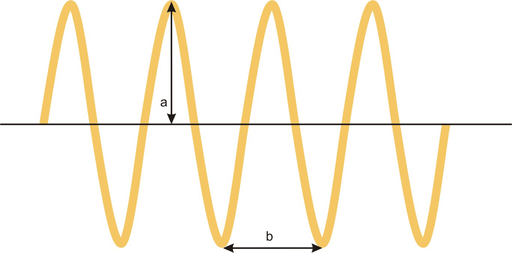
What part is represented by the blue lines?
a)
Crest
b)
Resting Point
c)
Wavelength
d)
Amplitude
26.
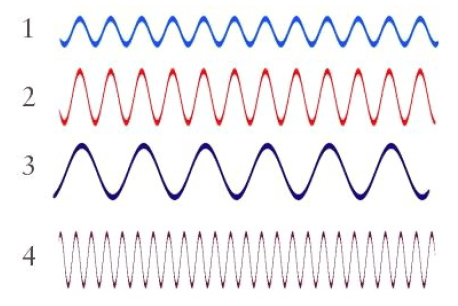
Which wave in the diagram has the greatest frequency?
a)
1
b)
2
c)
3
d)
4
27.
What kind of wave is pictured?
a)
Transverse
b)
Longitudinal
c)
surface
d)
none of the above
28.
 A wave has frequency of 50 Hz and a wavelength of 10 m. What is the speed of the wave?
a)
500 m/s
b)
50 m/s
c)
5 m/s
d)
0.5 m/s
29.
Which is the correct equation for calculating the speed of a wave?
a)
T = 1/f
b)
Speed= Wavelength x Period
c)
Speed = Wavelength/Frequency
d)
Speed= Wavelength x Frequency
30.
When the frequency of a wave increases, what happens to the wavelength?
a)
The wavelength is not directly affected by the frequency of a wave.
b)
The wavelength increases.
c)
The wavelength decreases.
d)
More specific information is needed to form a conclusion about the wavelength.
31.
What is the speed of a 20 Hz with a 4m wavelength?
a)
0.2 m/s
b)
5 m/s
c)
80 m/s
d)
320 m/s
32.
What is the frequency of a wave traveling at 300 m/s with a 4 m wavelength?
a)
0.013 Hz
b)
75 Hz
c)
300 Hz
d)
1200 Hz
33.

A wave has frequency of 50 Hz and a wavelength of 10 m. What is the speed of the wave?

a)

500 m/s

b)

50 m/s

c)

5 m/s

d)

0.5 m/s

34.

Wavelength x Frequency = (choose two answers)

a)

Wave Speed

b)

Velocity

c)

Amplitude

d)

Crest height

35.
The number of wavelengths that pass a point each second
a)
frequency
b)
wavelength
c)
pitch
d)
amplitude
36.
How many waves are in this wave chain?
a)
6
b)
3
c)
4
d)
5
37.
Velocity= 12 m/s
Wavelength= __________
Frequency= 600 hertz
a)
7200 m
b)
0.02 m
c)
612 m
38.
Velocity= 12 m/s
Wavelength= __________
Frequency= 600 hertz
a)
7200 m
b)
0.02 m
c)
612 m
39.
What kind of wave is pictured?
a)
Transverse Wave
b)
Longitudinal Wave
c)
compressional wave
d)
none of the above
40.
Which has the largest amplitude?
a)
B
b)
C
c)
D
d)
All same
41.
Which letter represents wavelength?
a)
A
b)
B
c)
C
d)
D
42.

Frequency is measured in

a)

Seconds

b)

Metres

c)

metres per second

d)

Hertz

43.

Which is correct

a)

T = 1 x f

b)

T = f

c)

T = 1/ f

d)

T = f / 1

44.
What is the formula to determine wavelength
a)
f / v
b)
v / f
c)
v times f
d)
v minus f
45.
What is the velocity of a wave that has a frequency of 20 Hz and the wavelength of .5 meters?
a)
100 m/s
b)
20.5 m/s
c)
10 m/s
d)
.025 m/s
46.
What is the formula to calculate speed?
a)
S = t/d
b)
S = d/t
c)
S = d x t
d)
S = t x d
47.
The lowest pitch the average human can hear is about 20.0 Hz. If sound with this frequency travels through air about 300 m/s, What is its wavelength?
a)
15
b)
6000 m
c)
15 m
d)
6000 
48.
A fly flaps its wings back and forth 200 times each second. Calculate the period of a wing flap.
a)
200
b)
0.5
c)
0.05
d)
0.005
49.
A kangaroo completes 2 hops in 4 seconds.  What is the period of the hops?
a)
0.5
b)
2
c)
6
d)
8
50.

How is a longitudinal wave different from a transverse wave?

a)

Transverse Waves move vertically, and Longitudinal waves compress and refract horizontally.

b)

Longitudinal Waves move vertically, and Transverse waves compress and refract horizontally.

c)

Longitudinal Waves change to Transverse Waves as they speed up.

d)

Transverse Waves travel through only air and Longitudinal Waves travel only through water.