wayground logo

Free Printable Worksheets

Font size

S
M
L
XL
Worksheets

Muscular contraction

Total questions: 29

Worksheet time: 44mins

Name
Class
Date
1.

What is the purpose of a neuromuscular junction?

a)

To destroy the muscle cell in order to end muscle contraction

b)

It is a crossroad for action potential (signals) to cross from neuron to muscle.

c)

To slow down action potentials so that the muscle doesn't receive as many signals.

2.

Muscle cramping is characterized by:

a)

The inability to contract your muscles for long periods of time.

b)

Pulses of action potentials that don't stop.

c)

The inability to relax your muscles for long periods of time.

d)

Absence of calcium being released into the muscles.

3.
When our muscles shorten such as a bicep curl.  This is called?
a)
Concentric 
b)
Eccentric
c)
Curl
d)
Isometric 
4.
When you release down from a pull-up is that Eccentric or Concentric?
a)
Eccentric
b)
Concentric
5.

The neurotransmitter that signals muscle contraction is called...

a)

Acetylcholine

b)

Myosin

c)

Actin

d)

Calcium

6.
Region where a motor neuron comes in close contact with a muscle cell.
a)
neurotransmitter
b)
muscular dystrophy
c)
muscle tension
d)
neuromuscular junction
7.
Skeletal Muscle contraction is initiated when the ________ sends a message to the muscle cell.  
a)
Muscle cell
b)
Neuron
c)
Gland
d)
None of the above
8.
A single neuron and all the muscle fibers it stimulates make up a(n) _______.
a)
motor unit
b)
motor neuron
c)
axon
d)
neuromuscular junction
9.

The space between the motor neuron and a muscle fiber at a neuromuscular junction

a)

synaptic knob

b)

motor end plate

c)

synaptic cleft

d)

motor neural termination

10.

Muscles in the eye contain motor units with a motor neuron connected to only five muscle fibers. What type of control does a person have over these muscles?

a)

Very little control

b)

No control

c)

Extremely accurate control

d)

Moderate or average control

11.

What type of nerve causes a muscle to contract?

a)

motor neuron

b)

parasympathetic neuron

c)

interneuron

d)

sensory neuron

12.

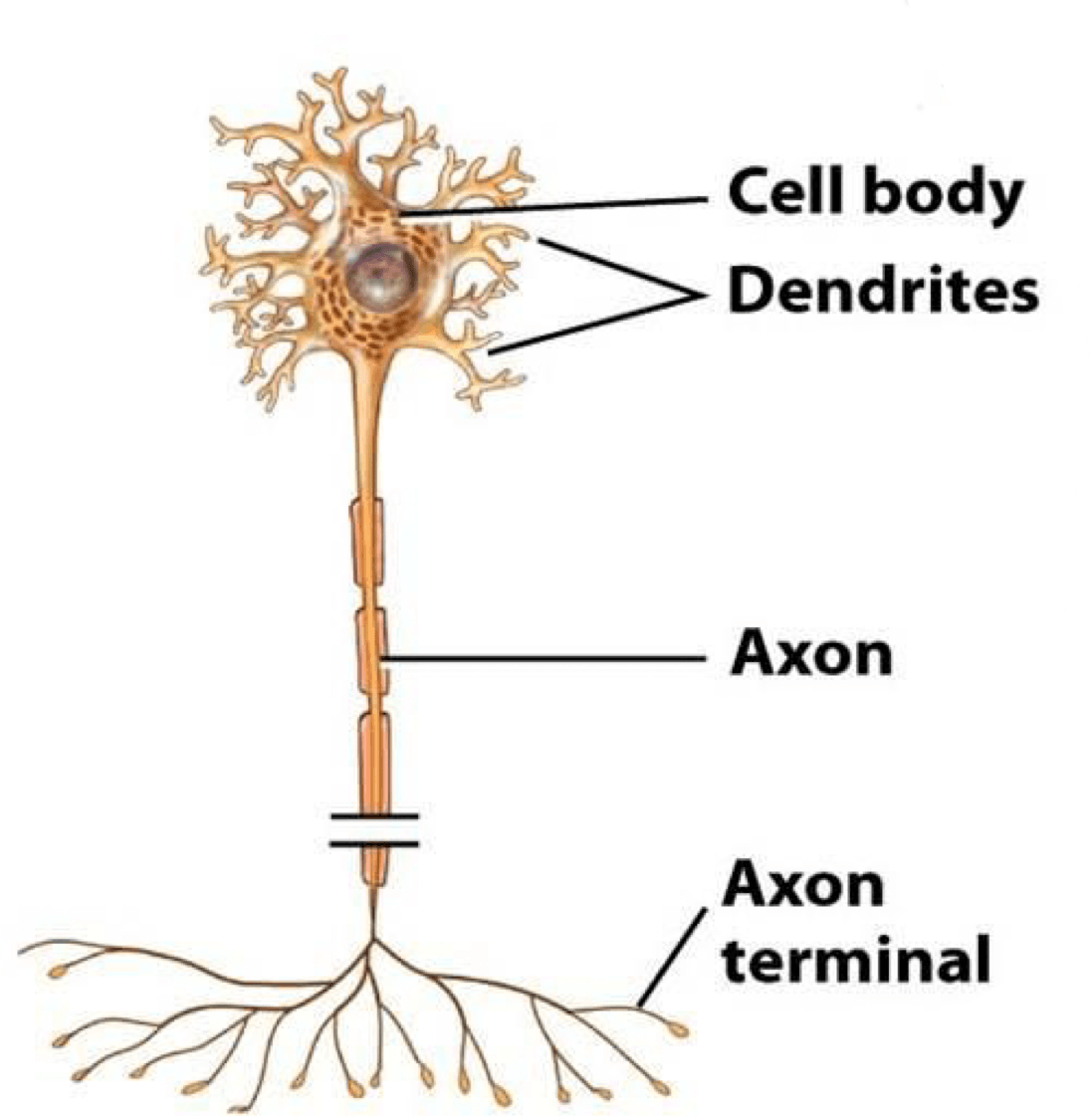
What is the name of the part of the neuron that is pointed out in the image?

a)

Myelin sheaths

b)

Cell Body (Soma)

c)

Axon

d)

Dendrites

13.

What is the name of the part of the neuron that is pointed out in the image?

a)

Myelin Sheats

b)

Axon

c)

Dendrites

d)

Cell Body (Soma)

14.

What is the name of the part of the neuron that is pointed out in the image?

a)

Myelin Sheats

b)

Cell Body (Soma)

c)

Dendrites

d)

Axon

15.

The protective fatty tissue that speeds up the transmission of messages is:

a)

Myelin Sheaths

b)

Axon

c)

Dendrites

d)

Soma

16.

The extension that transmit electrical impulses from the som to other parts is:

a)

Myelin Sheaths

b)

Soma

c)

Dendrites

d)

Axon

17.

The extensions that obtain the messages from other cells are:

a)

Myelin Sheats

b)

Axon

c)

Dendrites

d)

Soma

18.

What type of neuron is represented on the image?

a)

Motor Neuron

b)

Interneuron

c)

Sensory Neuron

19.
Which is the correct sequence in the transmission of a neural impulse?
a)
axon, dendrite, cell body, synapse
b)
dendrite, axon, cell body, synapse
c)
synapse, axon, dendrite, cell body
d)
dendrite, cell body, axon, synapse
20.
An axon conducts nerve impulses _________ the cell body.
a)
away from
b)
toward
c)
both toward and away
d)
around, bypassing
21.
Which of the following are parts of neurons?
a)
brain, spinal cord, and vertebral column
b)
dendrite, axon, and cell body
c)
sensory and motor dendrites
d)
dendrite, medulla and myelin sheath
22.
What part of the neuron is myelinated?
a)
Cell Body
b)
Axon
c)
Synapse
d)
Dendrite
23.
The spaces between the covered parts of an axon are called:  
a)
synaptic clefts
b)
nodes of Ranvier
c)
Ventricles
d)
Vesicles
24.
A nerve cell can also be termed
a)
Neuron
b)
Cell Body
c)
Dendrite
d)
Axon
25.
What is the nerve impulse in the axon called?
a)
action potential
b)
resting potential
c)
membrane potential
d)
synapse
26.
Label the Neuron-What does the letter "E" represent?
a)
Schwann Cell
b)
Node of Ranvier
c)
Axon Terminal
d)
Myelin Sheath
27.
What two things are found in the central nervous system?
a)
brain/spinal cord
b)
spinal cord/motor neurons
c)
motor/sensory neurons
d)
only brain
28.

Neurons that carry messages from the brain to the muscles are...

a)

Sensory neurons

b)

Motor neurons

c)

Interneurons

d)

Connecting neurons

29.

What do Nodes of Ranvier do?

a)

Intakes information from other neurons

b)

Produces fatty tissue for the Myelin Sheath

c)

Sends information to the next cell

d)

Controls the speed of electrical signal through the axon