wayground logo

Free Printable Worksheets

Font size

S
M
L
XL
Worksheets

Invertebrates Quiz

Total questions: 58

Worksheet time: 29mins

Name
Class
Date
1.
What do invertebrates not have?
a)
backbones
b)
exoskeleton
c)
blood
d)
reproduce
2.
One characteristic of animals is that their bodies are ________.
a)
insects
b)
multicellular
c)
bugs
d)
unicellular
3.
Animals are _________, which means they cannot make their own food.
a)
heterotrophs
b)
autotrophs
4.
What is an example of a echinoderm?
a)
insects
b)
dogs
c)
sea urchin
d)
sponge
5.
What are the two major groups of animals?
a)
invertebrates and vertebrates
b)
genus and species
c)
autotrophs and heterotrophs
d)
internal and external
6.
True or false. An echinoderm has a tube like body with segments.
a)
False
b)
True
7.
What is a autotroph?
a)
organism that cannot make their own food
b)
organism that can make their own food
8.
Sponges have ______ which are holes that that water pass through to help them feed and eliminate waste.
a)
arms
b)
backbones
c)
skeleton
d)
pores
9.
This is an example of a _____.
a)
Sea star
b)
sea urchin
c)
sea cucumber
d)
brittle star
10.
What is the name of the organism in the picture?
a)
earthworm
b)
leech
11.
An ________ has arms that extend from the middle of their bodies.
a)
mollusk
b)
sponge
c)
arthropod
d)
echinoderm
12.

Which group of invertebrates must molt its exoskeleton as it grows?

a)

Cnidarians

b)

Mollusks

c)

Arthropods

d)

Echinoderms

13.

Which invertebrate group below is describes as being the simplest of all the invertebrates with pores that are lined with specialized cells to obtain their resources?

a)

Segmented worms

b)

mollusks

c)

echinoderms

d)

sponges

14.

You have observed an animal that lives in the water that has an hard outer covering, a segmented body and jointed legs. In which group of invertebrates would you classify this animal?

a)

Echinoderms

b)

Arthropods

c)

Mollusks

d)

Segmented Worms

15.

What best explains or defines Molting?

a)

shedding of the exoskeleton for growth

b)

the metamorphosis of a butterfly

c)

an organism making its own food

d)

poison or the ability to sting

16.

What best explains or defines an exoskeleton?

a)

a system of support outside an animal’s body

b)

an animal that has a backbone

c)

an animal that does not have a backbone

d)

a skeleton that is within an animal’s body

17.

Which structure for movement is a characteristic of some Mollusk?

a)

stinging tentacles

b)

pores for obtaining food

c)

jointed legs

d)

a thick muscular foot

18.

Which picture shows an example of an animal with an exoskeleton?

a)
b)
c)
d)
19.

Which animal below moves with the aid of tube feet and has “spiny skin"?

a)
b)
c)
d)
20.

Which animal below uses specialized cells to sting its prey

a)
b)
c)
d)
21.

Which group of invertebrates is a non-predatory filter feeder?

a)

Sponge

b)

Insects

c)

Echinoderms

d)

Segmented worms

22.

Which type of invertebrate has a simple nervous system, a digestive tube that runs the length of their body and blood flowing in vessels?

a)

Mollusks

b)

Segmented Worms

c)

Sponges

d)

Echinoderms

23.

Earthworms need oxygen from the air to breathe. Which of the following allows earthworms to take in oxygen?

a)

Gills

b)

Specialized Cells

c)

Skin

d)

Nostrils

24.

Which group of invertebrates is known for its radial symmetry?

a)

Cnidarians

b)

Arthropods

c)

Sponges

d)

Mollusks

25.

A new species of animal is discovered. It moves using a strong muscular foot, it lives in salt water, and

it has a shell surrounding its soft body. In which group of invertebrates should scientists place this new animal?

a)

Mollusks

b)

Segmented Worms

c)

Echinoderms

d)

Sponges

26.

You have observed an animal with an exoskeleton, 6 jointed legs and wings. It is probably a member of the largest group of invertebrates, a(n)___________________.

a)

Echinoderms

b)

Mollusks

c)

Arthropods

d)

Cnidarians

27.

Which invertebrate animal has the ability to camouflage itself and eject ink to protect its soft body

a)

Octopus

b)

Jellyfish

c)

Clam

d)

Earthworm

28.
What does the term echinoderm mean?
a)
tube feet
b)
star shaped
c)
spiny skin
d)
stomach foot
29.
Echinoderms have an internal skeleton and a system of fluid-filled tubes called a(n)...
a)
water vascular system
b)
nervous system
c)
notochord
d)
ampulla
30.
Which side of the sea star is the top side?
a)
aboral surface
b)
oral surface
31.
What echinoderm is this?
a)
sea lily 
b)
sea urchin 
c)
sea cucumber 
d)
sand dollar 
32.
all have radial symmetry
a)
univalve
b)
bivalve
c)
head-footed
d)
echinoderms
33.
Which part of the Mollusk body is specialized for burrowing, feeding, and movement?
a)
trochophores
b)
visceral mass
c)
mantle
d)
foot
34.
What type of symmetry do MOST mollusks have?
a)
Bilateral
b)
Radial
c)
Circular
d)
Asymmetrical
35.
Which class of Mollusks include clams, oysters, and mussels?
a)
Gastropods
b)
Bivalves
c)
Cephalopods
36.
Which class of Mollusks include squid, cuttlefish and octopus?
a)
Gastropods
b)
Bivalves
c)
Caphalopods
37.
Which class of Mollusks includes snails, slugs, or nudibranches?
a)
Cephalapods
b)
Bivalves
c)
Gastropods
38.
Which class of Mollusks include clams, oysters, and mussels?
a)
Gastropods
b)
Bivalves
c)
Cephalopods
d)
Arthropods
39.
Which of the following is a correct description of the polyp body form?
a)
It is sessile and the tentacles and mouth point downward.
b)
It is sessile and the mouth and tentacles point upward.
c)
It is mobile and the tentacles and mouth point downward.
d)
It is mobile and the tentacles and mouth point upward.
40.
Phylum Porifera is known as 
a)
"stinging cells"
b)
"Tentacles"
c)
"Cleaners"
d)
"Sponges"
41.
To which group of mollusks does this animal belong?
a)
Class Gastropoda
b)
Class Bivalvia
c)
Class Cephalopoda
d)
Class Polyplacophora
42.
What type of symmetry do sponges (Porifera) have?
a)
asymmetry
b)
radial
c)
bilateral 
d)
medial
43.
Phylum Cnidaria is known as 
a)
"stinging cells"
b)
"Tentacles"
c)
"Cleaners"
d)
"Sponges"
44.
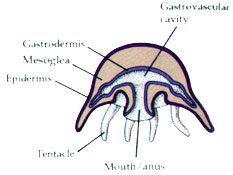
Which body form is represented by this diagram?
a)
Mesoglea
b)
Medusa
c)
Polyp
d)
Nematocyst
45.
Which of the following is an example of a crustacean?
a)
squid
b)
crab
c)
earth worm
d)
bumble bee
46.
Which is not a main class within the phylum of mollusca?
a)
crustacean 
b)
cephalopod
c)
gastropod
d)
bivalve
47.
cells that make up pores all over the sponges body and allow water to enter the sponge.
a)
amoebocyte
b)
porocyte
c)
pinacocyte
d)
ostiocyte
48.
cells have sticky, funnel-shaped collar to collect food particles and a flagellum that creates a water current
a)
amoebocyte
b)
ostiocyte
c)
pinacocyte
d)
choanocyte
49.
large opening at the top of a sponge where water exits.
a)
ostia
b)
osculum
c)
orifice
d)
opening
50.
skeleton structures made of silica or calcium carbonate 
a)
spicules
b)
spongin
c)
sessile
d)
something
51.
Asexual sponge reproduction where a piece of the adult sponge breaks off and settles in a new area growing to adulthood.
a)
broadcast spawning
b)
branching
c)
budding
d)
forcast spawning
52.
When a jellyfish attacks its prey, it uses stinging cells called...
a)
Colloblasts 
b)
Stingers
c)
Cnidocytes
d)
Blastoscytes 
53.
What surrounds the mouth of cnidarians?
a)
arms
b)
combs
c)
tentacles
d)
spines
54.
What form is this organism?
a)
Polyp
b)
Medusa
c)
Comb jelly
d)
Coral
55.
What body form do members of Class Anthozoa have?
a)
medusa
b)
polyp
c)
medusa and polyp
d)
neither medusa nor polyp
56.
Which of the following is NOT a class of cnidarians?
a)
Mesoglea
b)
Anthozoa
c)
Scyphozoa
d)
Cubozoa
57.
Why do arthropods have to shed their exoskeletons?
a)
it wears out
b)
they don't shed
c)
it limits the size they can grow
d)
to go from water to land environments
58.
Cephalopods move quickly by
a)
using jet propulsion
b)
creeping on their muscular foot
c)
digging into the sand
d)
waving their tentacles to swim