wayground logo

Free Printable Worksheets

Font size

S
M
L
XL
Worksheets

Human Bio ch 1-4 review: COL, chemistry, cells, tissues

Total questions: 63

Worksheet time: 34mins

Name
Class
Date
1.
When you step out into the cold, your body shivers in order to keep its temperature at 98.6oF.
a)
All living things use energy
b)
All living things contain cells
c)
All living things maintain homeostasis
d)
All living things grow and develop
2.
Green plants produce their own food through the process of photosynthesis.
a)
All living things use energy
b)
All living things contain cells
c)
All living things maintain homeostasis
d)
All living things grow and develop
3.
A camel has eyelashes that work to keep the dust and sand out of its eyes.
a)
All living things adapt to their environment
b)
All living things grow and develop
c)
All living things have cells
d)
All living things display organization
4.
A caterpillar hibernates in a cocoon and emerges as a butterfly.
a)
All living things adapt to their environment
b)
All living things use energy
c)
All living things respond to their environment
d)
All living things grow and develop
5.
A tulip opens in the morning at sunrise and closes in the evening at sunset.
a)
All living things have cells
b)
All living things use energy
c)
All living things respond to their environment
d)
All living things grow and develop
6.
An amoeba is a unicellular organism. 
a)
All living things reproduce
b)
All living things contain a cell or cells
c)
All living things respond to their environment
d)
All living things grow and develop
7.
A sea worm drops its tail and the tail becomes a new worm.
a)
All living things contain cells
b)
All living things grow and develop
c)
All living things display organization
d)
All living things reproduce
8.

What is Herd Immunity?

a)

When a group of animals become immune to an illness

b)

The number of people someone with an infection can possibly spread the illness to

c)

Becoming immune to a vaccine and having it not work

d)

When a large amount of people protect those who haven't gotten vaccinated

9.
The part of foreign materials that cause a response from the immune system are called _____________________.
a)
Antigens
b)
Active Immunity
c)
Antibodies
d)
Antibiotics
10.

Vaccination provides immunity to specific diseases. Why are vaccines referred to as a form of artificial active immunity?

a)

They are attenuated forms of the pathogen

b)

They lead to the production of memory cells

c)

They involve deliberate exposure to antigenic material to stimulate an immune response

d)

The vaccines are produced through artificial means

11.
People are making antibiotic resistance worse by:
a)
taking antibiotics only when they need them
b)
putting antibiotics into our food and environment
c)
not sharing antibiotics with others
12.
Antibiotic resistant bacteria are a problem because:
a)
we can't help people with those infections
b)
bacteria smell pretty bad
c)
something about viruses
d)
they are not a problem, I love being sick
13.
A group of people trained to climb a mountain.  As they practices in high altitudes, a researcher measured changes in their lung strength.  Why is it important that her study has a control group?
a)
to ensure that everyone in the group was strong enough to climb a mountain
b)
to test equipment for measuring lung strength
c)
to share her research with as many people as possible
d)
to compare typical lung strength with the effects of training
14.

Which feature does not distinguish humans from other animals?

a)

opposable thumb

b)

bipedalism

c)

ability to evolve

d)

capacity for complex language

15.

In graphs, which is plotted on the x-axis?

a)

controlled variable

b)

independent variable

c)

dependent variable

d)

placebo

16.

If a molecule of starch is repeatedly hydrolyzed, which would be the final product?

a)

glucose

b)

fructose

c)

ribose

d)

sucrose

17.

Which molecule is hydrophobic?

a)

glucose

b)

sodium chloride

c)

cholesterol

d)

DNA

18.

When sugar is dissolved in water, sugar is the ___ and water is the ___.

a)

acid....base

b)

base...acid

c)

solute...solvent

d)

solvent...solute

e)

inorganic molecule.....organic molecule

19.

a monosaccharide is to a polysaccharide as an amino acid is to a ______.

a)

nucleic acid

b)

carbohydrate

c)

nucleotide

d)

amino acid

e)

triglyceride

20.

DNA ultimately contains the instructions for the assembly of

a)

proteins

b)

polysaccharides

c)

nucleotides

d)

steroids

e)

triglycerides

21.
What is the function of ATP in living things?
a)
provides energy for cells
b)
stores genetic information
c)
provides structure in the nucleus
22.
Muscles use a lot of cellular energy because they are highly functional. Which organelle would be in abundant to provide that energy?
a)
Nucleus
b)
Endoplasmic 
c)
Vacuole
d)
Mitochondria
23.
What distinguishes a eukaryotic cell from a prokaryotic cell is the presence of 
a)
A cell wall
b)
A nucleus
c)
DNA
d)
Ribosomes
24.

In eukaryotic cells, chromosomes carrying genetic information are found in the

a)

Ribosomes

b)

Lysosomes

c)

Nucleus

d)

cytoplasm (free-floating)

25.

This type of tissue has cells embedded in an extracellular matrix.

a)

epithelial

b)

connective

c)

muscle

d)

nervous

26.

This type of epithelial tissue found lining organs of the digestive system such as the small intestines.

a)

simple columnar

b)

simple cuboidal

c)

pesudostratified columnar

d)

simple squamous

27.

What type of tissue is commonly called fat?

a)

Adipose

b)

Bone

c)

Reticular

d)

Dense

28.

Many layers of FLATTENED cells is what type of epithelial cell?

a)

stratified columnar

b)

stratified squamous

c)

pesudostratified columnar

d)

simple squamous

29.

What is the arrangement of the phospholipids as a substance passes through the plasma membrane?

a)

head, tail, head, tail

b)

head, tail, tail, head

c)

tail, head, tail

d)

tail, head, head, tail

30.

Which of the following is NOT classified as a connective tissue?

a)

bone

b)

cartilage

c)

skeletal

d)

adipose

31.

Which type of tissue is situated in the lining of the urinary bladder and urethra where stretching occurs?

a)

simple cuboidal

b)

stratified squamous

c)

simple squamous

d)

transitional epithelium

32.

Which of these characteristics best describes cardiac muscle tissue?

a)

movement is involuntary and cells possess striations

b)

attached to skeleton

c)

movement is voluntary and cells possess striations

d)

single nucleus; shaped liked spindles

33.

The type of muscle found in the walls of hollow organs, such as the stomach, and in the walls of blood vessels is ________.

a)

cardiac

b)

skeletal

c)

smooth

d)

smooth & skeletal

34.
Organs and tissues that perform the same function is called _____________?
a)
cells
b)
tissues 
c)
organ system
d)
organs
35.
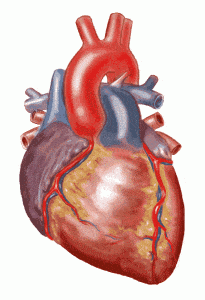
A group of tissues that perform a similar function is called_____. (Examples include the heart, lungs or stomach)
a)
cells
b)
tissues
c)
organs
d)
organ system
36.
 A group of cells that have similar functions? Examples are nervous, epithelial, muscle and connective
a)
cells
b)
tissues
c)
organs
d)
atoms
37.
When many organ systems work together it can form...
a)
organ
b)
cells
c)
organ system
d)
organism 
38.
What is the correct order of organization
a)
tissues-cells-organs-organ systems-organism
b)
cell-tissue-organs-organ systems-organism
c)
organism-cells-tissues-organ systems-organism
d)
tissues-cells-organs-organ sytems-organism
39.
What word means "the relatively constant state maintained by the body"?
a)
homosapien
b)
homogenization
c)
homoniem
d)
homeostasis
40.
This is a example of ........
a)
cell
b)
organ system
c)
organ
d)
tissue
41.
Which of the following is not an organ system?
a)
nervous system
b)
respiratory system
c)
cellular system
d)
skeletal system
42.
Cells need to bring in molecules to carry out cellular processes. Often, this requires moving the molecules across the cell membrane against the concentration gradient. How do these molecules get into the cell?
a)
passive transport by diffusion
b)
active transport using ATP 
c)
passive transport by osmosis
d)
 osmosis
43.
 Look at the diagram of a cross-section of a cell membrane below. The cell membrane controls movement of materials into and out of the cell. The following particles are moving from high concentration to low concentration and are using a carrier protein. How would you describe this type of movement across the membrane? 
a)
simple osmosis
b)
active transport
c)
simple diffusion
d)
facilitated diffusion
44.
Look at the cross section of a cell membrane of a eukaryotic cell. H+ ions are being pumped from a low concentration to a high concentration. How do you describe this type of transport across the cell membrane?
a)
active transport
b)
passive transport
c)
facilitated diffusion
d)
co-transport
45.
The diagram below represents a cell and some molecules in its environment. Which molecule would require the use of energy in order to be brought into the cell?
a)
1
b)
2
c)
3
d)
4
46.
Which activity can occur without the use of energy?
a)
contraction of muscle tissue
b)
protein synthesis in a cell
c)
active transport of minerals
d)
movement of water across a membrane
47.
During diffusion molecules tend to move 
a)
   up the concentration gradient
b)
 from an area of lower concentration to an area of higher concentration
c)
 in a direction that doesn’t depend on concentration
d)
 down the concentration gradient
48.

What is the function of the nervous system?

a)

Whenever we get in front of crowds, it causes our bodies to shake.

b)

It coordinates the body's response to changes in its environment.

c)

It is responsible for the blood flow throughout your body.

d)

It helps us take in oxygen and expel carbon dioxide.

49.

Which two systems are responsible for bringing in oxygen and delivering the oxygen throughout the body?

a)

nervous

b)

respiratory

c)

digestive

d)

cardiovascular (circulatory)

50.

These are the muscles attached to your bones.

a)

Skeletal

b)

Smooth

c)

Rough

51.

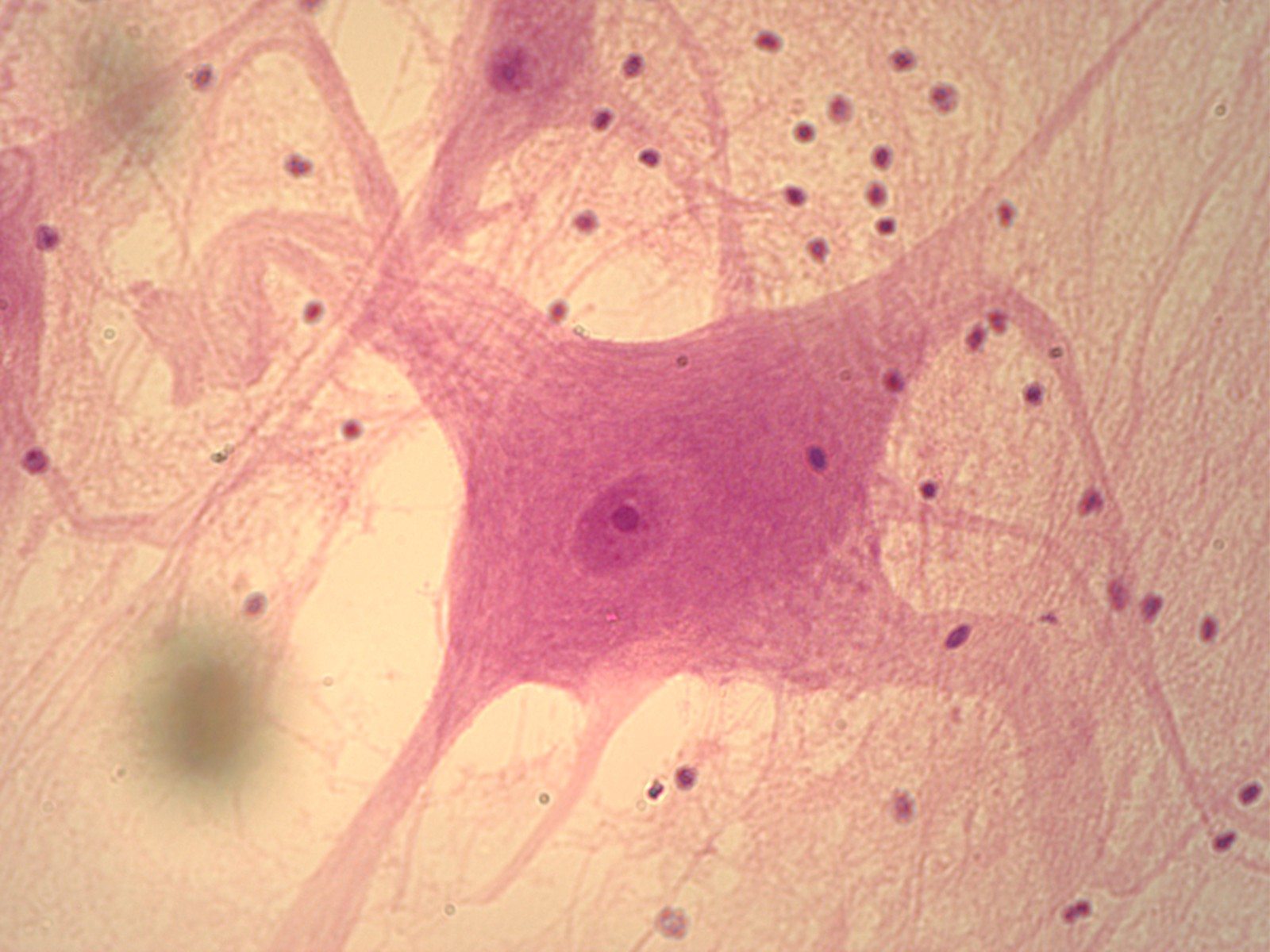
This type of tissue shown in the picture transmits information throughout the body to and from the brain.

a)

Nervous Tissue

b)

Connective Tissue

c)

Muscular Tissue

52.

What is the function of epithelial cells?

a)

Protects the body and organs

b)

Provide movement by pulling on bones

c)

Act as the messaging pathway between different areas of the body

53.

The stomach consists of what type of muscle that allows the stomach to contract and move food?

a)

Smooth muscle

b)

Skeletal muscle

c)

Cardiac muscle

54.
Which tissue is this?
a)
Simple Squamous
b)
Stratified Squamous
c)
Simple cuboidal
d)
Pseudostratified columnar
55.
Which tissue is this?
a)
Simple squamous
b)
simple columnar
c)
transitional
d)
simple cuboidal
56.
Which type of epithelial tissue would allow oxygen to quickly pass through it?
a)
Simple Squamous
b)
Simple Cuboidal
c)
Simple Columnar
d)
Transitional
57.
a)

smooth muscle

b)

bone

c)

nerve

d)

blood

58.
What tissue type is this?
a)
Adipose tissue
b)
Cardiac muscle
c)
Nervous tissue
d)
Skeletal muscle
59.
What tissue type is this?
a)
Skeletal muscle
b)
Nervous tissue
c)
Adipose tissue
d)
'Specialised' connective tissue
60.

What tissue is this?

a)

Muscle

b)

Epithelial

c)

Nervous

d)

Connective

61.
The muscle tissue shown is called ______.
a)
Skeletal
b)
Cardiac
c)
Smooth
62.

What tissue is this?

a)

Epithelial

b)

Connective

c)

Muscular

d)

Nervous

63.
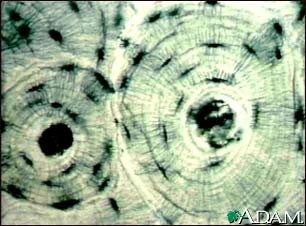
Name this tissue
a)
Bone
b)
Cartilage
c)
Blood
d)
Adipose