wayground logo

Free Printable Worksheets

NEW

Font size

S
M
L
XL
Worksheets

Unit 1 Psych 20: Major Theoretical Perspectives

Total questions: 65

Worksheet time: 55mins

Name
Class
Date
1.
This personality type tries  to meet the desires of the id in a way that is socially acceptable in the world. It deals with the reality.
a)
Selfie
b)
Id
c)
Superego
d)
Ego
2.
The "Id" is defined as which part of your human personality?
a)
Based on morals and judgments about  right and wrong 
b)
Dealing with reality
c)
Needing to look good
d)
Meeting basic needs
3.
Sally was thirsty. However, she knew that her server would be back soon to refill her water glass, so she waited until then to get a drink, even though she really just wanted to drink from Mr. Smith’s glass. What is this an example of?
a)
Ego
b)
Id
c)
Latin
d)
Superego
4.
In line at the salad bar, Amy was so hungry that she shoved a handful of croutons in her mouth as she waited for the line to move. This is an example of what?
a)
Freud
b)
Id
c)
Superego
d)
Ego
5.
Sarah knew that she could steal the supplies from work and no one would know about it. However, she knew that stealing was wrong, so she decided not to take anything even though she would probably never get caught.
What is this an example of?
a)
Superego
b)
Ego
c)
Dishonesty
d)
Id
6.
Who developed a  psychoanalytic personality theory which involved the id, ego and superego?
a)
B.F. Skinner
b)
Erik Erikson
c)
Sigmund Freud
d)
William Golding
7.

Much of Freud's psychoanalytic theory on personality is criticized for lacking empirical support. What is one exception?

a)

The psychosexual stages of development

b)

The concept of defense mechanisms

c)

The three levels of consciousness

d)

The three personality structures

8.
Lucas really hates his girlfriend's ex-boyfriend, but when he sees him at the basketball court he pretends they are bros. 
a)
reaction formation
b)
denial
c)
displacement
d)
projection
9.
Read the following description and select the defense mechanism it describes:

When you use this defense mechanism, you may kick your dog because you are angry at your parents. 
a)
Projection
b)
Repression
c)
Displacement
d)
Rationalization
10.
Read the following description and select the defense mechanism it describes:

When you use this defense mechanism, you might not admit to yourself that you are failing a class even though your last three tests were “F’s”.  
a)
Projection
b)
Denial
c)
Displacement
d)
Rationalization
11.

What was Freuds approach to psychology

a)

Psychoanalysis

b)

Humanistic

c)

Cognitive

d)

Behavioural

12.
Which theorist believed that personality develops, through a series of stages. Experiences in childhood profoundly affect adult life.
a)
Freud
b)
Piaget
c)
Vygotsky
d)
Bronfenbrenner
13.
Which theorist outlined the layers of development through the Ecological Systems Theory (Microsystem, Mesosystem, Exosystem, Macrosystem)?
a)
Freud
b)
Piaget
c)
Vygotsky
d)
Bronfenbrenner
14.
Which theorist was the first to study children scientifically?
a)
Freud
b)
Piaget
c)
Vygotsky
d)
Bronfenbrenner
15.
Which theorist used a rat in a box to study their theory?
a)
Bronfenbrenner
b)
Bandura
c)
Erickson
d)
Skinner
16.
Which theorist argued that when a child’s actions have positive results, they will be repeated. Negative results will make actions stop.
a)
Bronfenbrenner
b)
Bandura
c)
Erickson
d)
Skinner
17.
Which theorist believed that personality develops, through a series of stages. Experiences in childhood profoundly affect adult life.
a)
Freud
b)
Bandura
c)
Vygotsky
d)
Skinner
18.
Blood type, hair color, and skin color are all examples of what type on influence on our development?
a)
Nature
b)
Nurture
19.
Your friends, where you live, and your school are all examples of what type on influence on our development?
a)
Nature
b)
Nurture
20.

According to Bronfenbrenner, every person develops within a?

a)

Micro-system

b)

Macro-system

c)

Exo-system

d)

Gaming System

21.

A consequence that strengthens the behavior it follows is known as a?

a)

enforcer

b)

reinforcer

c)

annihilator

d)

positive pressure

22.

Jane cleans her desk.

Jane's teacher praises her.

Jane will continue to clean her desk.

a)

Positive Reinforcement

b)

Negative Reinforcement

c)

Punishment

23.

Ricardo complains of headaches when it is time to do homework.


Ricardo is allowed to go to bed without doing his homework.


Ricardo will have headaches whenever there is homework to do.

a)

Positive reinforcement

b)

Negative reinforcement

c)

Punishment

24.

Rob works quietly at his seat.

The teacher praises and rewards Rob.

Rob will continue to work quietly at his seat

a)

Positive Reinforcement

b)

Negative Reinforcement

c)

Punishment

25.

Ella sits on the teachers desk at school.

Ella is kept inside for recess each time she sits on the teachers desk.

Ella will not sit on the teachers desk.

a)

Positive Reinforcement

b)

Negative Reinforcement

c)

Negative Punishment

26.

Which theorist thought that people could be trained to perform a certain task or response by providing some sort of trigger?

a)

Ivan Pavlov

b)

John B. Watson

c)

B. F. Skinner

d)

Jean Piaget

27.

In classical conditioning, what is a stimulus that automatically elicits a particular unconditoned response?

a)

Conditioned stimulus (CS)

b)

Unconditioned response (UR)

c)

Unconditioned stimulus (US)

d)

Conditioned response (CR)

28.

What is a form of learning in which a neutral stimulus comes to elicit a response after being associated with a stimulus that already elicits that response?

a)

Normal learning

b)

Classical conditioning

c)

Operant conditioning

d)

Positive reinforcement

29.

Which theorist was a behaviorist who believed that children were "blank slates" and acquired all skills and personality via learning?

a)

B. F. Skinner

b)

Ivan Pavlov

c)

John B. Watson

d)

John Locke

30.

What was Watson most famous for?

a)

Classical conditioning

b)

His invention of the teaching machine

c)

His work with children with autism

d)

His experiment with Little Albert, a rat, and a loud noise

31.

What is a type of learning in which behavior is strengthened if followed by a reinforcer or diminished if followed by a punisher?

a)

Classical conditioning

b)

Positive reinforcement

c)

Operant conditioning

d)

Programmed instruction

32.

What increases behaviors by presenting positive stimuli, such as food? This is any stimulus that, when presented after a response, strengthens the response.

a)

Positive reinforcement

b)

Negative reinforcement

c)

Positive punishment

d)

Negative punishment

33.

What increases behaviors by stopping or reducing negative stimuli, such as shock? This is any stimulus that, when removed after a response, strengthens the response.

a)

Positive reinforcement

b)

Negative reinforcement

c)

Positive punishment

d)

Negative punishment

34.

What involves the presentation of an unfavorable event or outcome in order to weaken the response it follows?

a)

Positive reinforcement

b)

Negative reinforcement

c)

Positive punishment

d)

Negative punishment

35.

What occurs when a favorable event or outcome is removed after a behavior occurs in order to weaken the response it follows?

a)

Positive reinforcement

b)

Negative reinforcement

c)

Positive punishment

d)

Negative punishment

36.

After Cassie flirted with someone else at the party, her boyfriend stopped talking to her. Cassie didn't flirt at the next party. This is an example of...

a)

Positive punishment

b)

Positive reinforcement

c)

Negative reinforcement

d)

Negative punishment

37.

The student jumps up and down, hand raised, yelling "me, me, me!" and the teacher calls on her. The child jumps and yells even more in the future. This is an example of...

a)

Positive punishment

b)

Negative punishment

c)

Positive reinforcement

d)

Negative reinforcement

38.

Natalie can get up from the dinner table after she eats two bites of her broccoli. This is an example of...

a)

Positive punishment

b)

Positive reinforcement

c)

Negative punishment

d)

Negative reinforcement

39.
Cindy understands her world primarily by grasping and sucking easily available objects. Cindy is clearly in Piaget's ________ stage
a)
preoperational
b)
concrete operational
c)
sensorimotor
d)
formal operational
40.
According to Piaget, during the formal operational stage people begin to:
a)
reason abstractly
b)
adhere to social norms
c)
distinguish between good and bad behaviors
d)
become aware of the positive and negative consequences of their own behaviors
41.
According to Piaget, children come to understand that the volume of a substance remains constant despite changes in its shape during the ________ stage.
a)
sensorimotor
b)
preoperational
c)
concrete operational
d)
formal operational
42.
An infant who has developed object permanence...
a)
is attached to specific objects, such as a blanket.
b)
will see all objects as being the same.
c)
knows that an object, such as a rattle, exists even if it is not in view.
d)
cries when a wanted object is taken away.
43.
Four-year-old Jennifer mistakenly believes that her mother would like to receive a toy doll as a Christmas present. This best illustrates Piaget's concept of:
a)
accommodation
b)
attachment
c)
object permanence
d)
egocentricism
44.
Peek-a-boo works on children in what stage?
a)
Sensorimotor
b)
Preoperational
c)
Concrete Operational
d)
Formal Operational
45.
The ability to use deductive logic, think abstractly and systematically solve problems emerges during the:
a)
Concrete Operational Stage
b)
Sensorimotor Stage
c)
Formal Operational Stage 
d)
Preoperational State 
46.
The first stage of development is the _____ stage.
a)
adaptation
b)
assimilation
c)
accommodation
d)
sensorimotor
47.

In Piaget's theory, the stage in which infants are only aware of what is immediately in front of them (from birth to about 2 years of age).

a)

Formal Operational Stage

b)

Preoperational Stage

c)

Sensorimotor Stage

d)

Concrete Operational Stage

48.

Piaget's fourth and final stage of cognitive development. The person can think logically, hypothetically, and in the abstract

a)

Preconventional Moral Reasoning

b)

Postconventional Moral Reasoning

c)

Conventional Moral Reasoning

d)

Formal Operational Stage

49.
How many stages did Piaget state people go through as they developed?
a)
5
b)
1
c)
4
d)
2
50.
According to your age and Piaget's theory, what stage are you at?
a)
Concrete Operational
b)
Formal Operational
c)
Preoperational
d)
Sensorimotor
51.

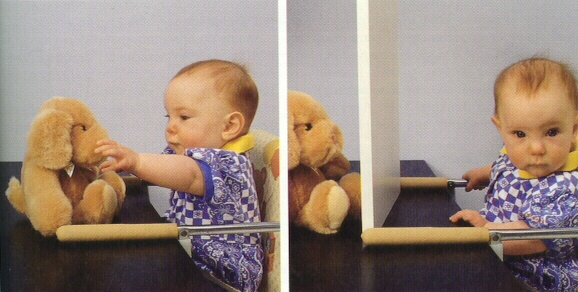
Sally attempts to retrieve her teddy bear after her father hides it under a blanket. This suggests that Sally has developed a sense of

a)

egocentrism.

b)

object permanence.

c)

conservation.

d)

accommodation.

52.

Robby understands her world primarily by grasping and sucking easily available objects. Robby is clearly in Piaget's ________ stage.

a)

preoperational

b)

concrete operational

c)

sensorimotor

d)

formal operational

53.

Sally attempts to retrieve her teddy bear after her father hides it under a blanket. This suggests that Sally has developed a sense of

a)

egocentrism.

b)

object permanence.

c)

conservation.

d)

accommodation.

54.
The unconscious mind influences everything we do.
a)
Biological perspective
b)
Behavioral perspective
c)
Cognitive perspective
d)
Psychodynamic perspective
55.

State of fulfillment in which a person is achieving at his or her highest level of capability

a)

Self-Actualization

b)

Self-transcendence

c)

Unconditional Positive Regard

d)

Actualizing Tendency

56.

Meaning, purpose, and communion beyond the self

a)

Self-Actualization

b)

Self-transcendence

c)

Unconditional Positive Regard

d)

Actualizing Tendency

57.

According to Humanism, people are trying to

a)

Become the best person they could be

b)

Work through their hidden wishes, desires, etc...

c)

Avoid being punished by the Superego

d)

Satisfy the immediate demands of the Id

58.

Negative self-concept = Unhappy with who they are, see the world as unsafe

a)

True

b)

False

59.

The Real Self = Person that you would like to be

a)

True

b)

False

60.

The Ideal Self = Person you actually are

a)

True

b)

False

61.
 emphasizes the influences of ethnicity, gender, culture, and socio-economic status on behavior and mental processes 
a)
evolutionary perspective
b)
biological perspective
c)
sociocultural perspective
d)
all of the above
62.
 emphasizes the role that thoughts play in determining behavior  
a)
evolutionary perspective
b)
cognitive perspective
c)
biological perspective
d)
all of the above
63.
 the scientific study of behavior and mental processes
a)
psychology
b)
biology
c)
morality
d)
behavior
64.
The evolutionary perspective is rooted in the ideas of Sigmund Freud.
a)
True
b)
False
65.

any action that people can observe or measure

a)

behavior

b)

psychology

c)

sociology

d)

cognition