wayground logo

Free Printable Worksheets

Font size

S
M
L
XL
Worksheets

Parts of a Cell and Organelle Functions Test Review

Total questions: 63

Worksheet time: 1hrs 3mins

Name
Class
Date
1.
a)
produces ribosomes
b)
contains genetic information
c)
stores food, water, wastes and other materials
2.
a)
controls what enters and exits the cell
b)
contains chlorophyll
c)
thick and rigid
3.
a)

contain DNA

b)

used in photosynthesis

c)

give plants their taste

4.
a)
site of protein synthesis by ribosomes
b)
where ribosomes are made
c)
gel-like fluid
5.
a)
where ribosomes are made
b)
receives proteins from ER and distributes them
c)
assembles amino acids into proteins
6.
a)
produces energy a cell needs
b)
where ribosomes are made
c)
packages amino acids and moves them out of the cell
7.
a)
control center of the cell
b)
captures energy from sunlight
c)
found in plant and animal cells
8.
Directs all cell activities through the DNA located there.
a)
Lysosomes
b)
Nucleus
c)
ribosomes
d)
Mitochondria
9.
"Storage tanks" Can hold food, water or waste for the cell
a)
Ribosomes
b)
Vacuole
c)
Chloroplast
d)
Nucleolus
10.
I am a protein packaging and shipping machine! Who am I?
a)
vacuole
b)
ribosome
c)
endoplasmic reticulum
d)
golgi apparatus
11.
You might think of me as the trash collector, but recycler is maybe more accurate. What am I?
a)
cytoplasm
b)
lysosome
c)
vacuole
d)
ribosome
12.
Where are proteins made?
a)
Golgi body
b)
Mitoichondrion
c)
Chromosomes
d)
Ribosomes
13.
This organelle takes food and turns it into ENERGY for plant and animal cells.
a)
Chloroplast
b)
Mitochondria
c)
Lysosome
d)
Ribosome
14.
A rigid layer that protects a plant cell.
a)
Cytoskeleton
b)
Cilia
c)
Cell Wall
d)
Flagella
15.
What is the gel-like substance inside of cells called?

a)
photoplasm
b)
photosynthesis
c)
cytoskeleton
d)
cytoplasm
16.
What organelle is considered to be the “gatekeeper” for plant and animal cells?  It only allows certain things to come in and out of the cell.

a)
Cell Wall
b)
Cytoplasm
c)
Nucleous
d)
Cell Membrane
17.
no membrane bound organelles, no nucleus
a)
prokaryote
b)
eukaryote
18.
has a nucleus and membrane bound organelles
a)
prokaryote
b)
eukaryote
19.
lets stuff in and out of the cell
a)
cell membrane
b)
cell wall
c)
chloroplast
d)
central vacuole
20.
where photosynthesis occurs
a)
chloroplast
b)
central vacuole
c)
 cell wall
d)
centrioles
21.
long, tail-like. used for movement
a)
flagella
b)
cilia
22.
short, hair-like. used for movement
a)
flagella
b)
cilia
23.
Each cell has a specific job. Whatever job a cell does is called its ______________.
a)
Structure
b)
Function
c)
Career
d)
Jobanelle
24.
What type of cell is shown below?
a)
Prokaryotic
b)
Eukaryotic
c)
Awesomekaryotic
d)
Lamekaryotic
25.
What three things do ALL cells have?
a)
Cytoskeleton, Cell membrane, vacuole
b)
DNA, ribosome, nucleus
c)
Cell wall, cytoskeleton, golgi apparatus
d)
Cell membrane, cytoplasm, DNA
26.
What type of cells have a cell wall and chloroplasts?
a)
Plant cells
b)
Animal cells
c)
Plant and animal cells
d)
Neither plant NOR animal cells
27.
Provides structure and support to the cell
a)
Chloroplast
b)
Cytoskeleton
c)
Cell membrane
d)
Golgi apparatus
28.
Sends messages from the nucleus to different parts of the cell
a)
Ribosome
b)
Golgi apparatus
c)
Endoplasmic reticulum
d)
Vacuole
29.
Uses energy from the sun to make sugars/food for the cell
a)
Mitochondria
b)
Chloroplast
c)
Vacuole
d)
Lysosome
30.
“Powerhouse” of the cell, breaks food down into energy for the cell
a)
Vacuole
b)
Chloroplast
c)
Nucleus
d)
Mitochondria
31.

Which of the following would you find in a eukaryotic cell but not a prokaryotic cell?

a)

Nucleus

b)

Ribosome

c)

Cell Membrane

d)

DNA

32.
What type of cell is pictured?
a)
Prokaryotic
b)
Eukaryotic
c)
Plant
d)
Animal
33.

Ribosomes are found in both prokaryotic and eukaryotic cells. What is the main function of ribosomes?

a)

to make proteins

b)

to make sugar

c)

to make oil

d)

to make cells

34.

All cells have cell membranes. What is the function of the cell membrane?

a)

To allow certain things to enter and exit the cell.

b)

To allow all things to enter the cell.

c)

It does not allow anything to enter and exit.

d)

It is made out of wood.

35.
What is the name of the structure shown in the diagram where cellular respiration takes place?
a)
Chloroplast
b)
Mitochondrion
c)
Nucleus
d)
Vacuole
36.
The site of photosynthesis
a)
ribosome
b)
mitochondria
c)
chloroplast
d)
nucleus
37.
Cells with a nucleus and membrane-bound organelles are called ____________________.
a)
prokaryotes
b)
eukaryotes
c)
bacteria
d)
protists
38.

Which of the following is not part of the cell theory?

a)

cells must contain DNA

b)

all living things are made from cells

c)

new cells come from existing cells

d)

cells are the basic unit of life

39.

Animal and plant cells are both considered _______.

a)

Eukaryotic

b)

Prokaryotic

40.

Bacterial cells are considered _____________.

a)

Eukaryotic

b)

Prokaryotic

41.
Where is the DNA found in a prokaryotic cell? 
a)
floating around in the cytoplasm 
b)
in the nucleus 
42.

Which cell has a cell wall?

a)

Animal Cell

b)

Plant Cell

c)

Both

43.

Which cell has chloroplast?

a)

Plant cell

b)

Animal cell

c)

Both

d)

Neither one of them have chloroplast

44.
Which of the following lists these levels in the correct order of organization from the simplest to the most complex?
a)
cells, tissues, organs, organ systems, organisms
b)
organisms, organ systems, organs, tissues, cells
c)
tissues, cells, organs, organisms, organ systems
d)

organs, organ systems, organisms, cells, tissues
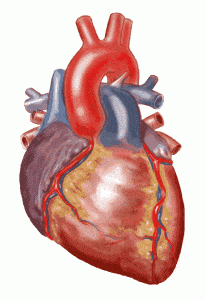
45.
This is a example of ........
a)
cell
b)
organ system
c)
organ
d)
tissue
46.
 A group of cells that have similar functions? Examples are nervous, epithelial, muscle and connective
a)
cells
b)
tissues
c)
organs
d)
atoms
47.
A group of tissues that perform a similar function is called_____. (Examples include the heart, lungs or stomach)
a)
cells
b)
tissues
c)
organs
d)
organ system
48.
The ___________ is the basic unit of life
a)
organ
b)
cell
c)
atom
d)
tissue
49.

Jared observes a cell in biology lab with the light microscope. The cell has the following structures: nucleus, cell wall, and chloroplast. Identify the type of cell that Jared is observing.

a)

animal

b)

plant

c)

fungus

d)

bacteria

50.

Identify this type of cell.

a)

animal

b)

plant

c)

protist

d)

bacteria

51.

Carrie observes an electron micrograph of a cell during biology lab. The cell has a flagellum, ribosomes, cell wall, and no apparent nucleus. Which of the following is likely true of the cell that Carrie is observing?

a)

The cell also contains mitochondria.

b)

The presence of the organelles proves that the cell is eukaryotic.

c)

The cell is a plant because of the cell wall.

d)

The cell is prokaryotic.

52.
Plants and animal cells both have a nucleus.
a)
True
b)
False
53.
made up of chromosomes and determines the genetic traits.
a)
cytoplasm
b)
mitochondria
c)
organelles
d)
DNA
54.
Provides extra support for the plant cell and gives in shape
a)
chlorophyll
b)
chloroplast
c)
cell wall
d)
vacuole
55.
What is the smallest unit of life that can carry out all life functions?
a)
the nucleus
b)
the vacuole
c)
the mitochondria
d)
the cell
56.
Makes proteins for the cell, can be found attached to the endoplasmic reticulum or free in the cytoplasm
a)
Cell Wall
b)
Golgi Body
c)
Ribosome
d)
Cytoplasm
57.
What tool do you use to view the cells?
a)
metric ruler
b)
centrifuge
c)
microscope
d)
pipette
58.

Organs that work together are part of a(n) ________________________.

a)

cells

b)

tissue

c)

organ system

59.

The dark structure in the middle of each cell is a

a)

nucleus

b)

lysosome

c)

mitochondria

60.

Muscle tissue is made of ...

a)

muscle cells

b)

skin tissue

c)

stem cells

61.
This is a example of........ 
a)
organ system
b)
cells
c)
organ
d)
tissue
62.
What is the difference between a cell and a tissue?
a)
cell is basic unit of life; tissue is group of cells that work as one
b)
cell is group of tissues; tissue is basic unit of life
c)
cell is basic unit of life; tissue is groups of different cells
d)
cell is group of organs; tissue is group of different cells
63.

What structure is labeled H?

a)

mitochondria

b)

central vacuole

c)

cell wall

d)

chloroplast