wayground logo

Free Printable Worksheets

NEW

Font size

S
M
L
XL
Worksheets

Porifera, Cnidaria, Platyhelminthes

Total questions: 34

Worksheet time: 1hrs 7mins

Name
Class
Date
1.
The hard "skeleton" structures in a sponge are called...
a)
Spongin
b)
Spicules
c)
Amebocytes
d)
Pinococytes
2.
What kind of symmetry does a Cnidarian have?  
a)
No Symmetry 
b)
Bilateral Symmetry 
c)
Radial Symmetry 
d)
Square
3.
What phylum has two different forms that exist which are called the medusa and the polyp?
a)
Phylum Porifera
b)
Phylum Cnidaria
c)
Phylum Platyhelminthes
d)
Kingdom Animalia
4.
Which of the following is a correct description of the Cnidarian digestive tract?
a)
A complete digestive tract consisting of two openings.
b)
A complete digestive tract consisting of one opening
c)
An incomplete digestive tract consisting of two openings.
d)
contains only a mouth and an internal cavity.
5.
Which part of the sponge body is a large opening at the top of the central cavity through which water leaves the sponge?
a)
Ostia
b)
Meenchyme
c)
Spongecoel
d)
Osculum
6.
What phylum of invertebrates does the following picture belong?
a)
Platyhelminthes
b)
Cnidaria
c)
Porifera
d)
Mollusca
7.
What phylum of invertebrates does the following picture belong?
a)
Cnidaria
b)
Porifera
c)
Platyhelminthes
d)
Animalia
8.

Tentacles contain cnidocytes that hold/secrete coiled thread with an attached barb called a ...

a)

nematocyst

b)

spicule

c)

ectoderm

d)

spirocyst

9.

The image represents a nematocysts which Cnidarians use to subdue their prey. What is the name of the specialized cell that secretes the nematocyst?

a)

cnidocyte

b)

barb capsule

c)

gastroblast

d)

nematocyst

10.
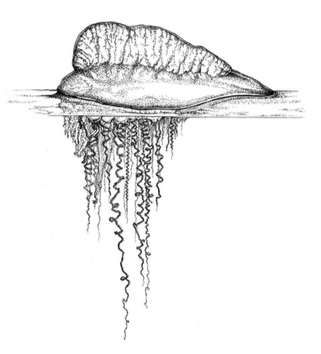
What phylum does this animal belong in the image?
a)
Platyhelminthes
b)
Cnidaria
c)
Porifera
d)
Plantae
11.
Jellyfish can reproduce
a)
sexually only
b)
asexually only 
c)
both sexually and asexually
d)
neither sexually or asexually
12.
A flexible, fibrous material that can make up the skeleton of a sponge?
a)
spicule
b)
spongin
c)
grass sponge
d)
spongocoel
13.

Many cnidarians feature 2 body forms, the asexual ____________, and the sexual _____________.

a)

blastula, planula

b)

medusa, poly

c)

planula, blastula

d)

polyp, medusa

14.
Most sponges are hermaphrodites.  What does this mean?
a)
sponges can produce their own food
b)
sponges can produce both eggs and sperm
c)
sponges cannot reproduce
d)
sponges can swim around
15.

What type of symmetry does a sponge have?

a)

bilateral symmetry

b)

radial symmetry

c)

asymmetry

d)

medial symmetry

16.
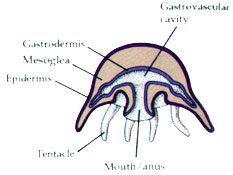
Which body form is represented by this diagram?
a)
Mesoglea
b)
Medusa
c)
Moses
d)
Nematocyst
17.
What form is this organism? (Image 1)
a)
Polyp
b)
Medusa
18.

Flatworms show...

a)

no symmetry

b)

radial symmetry

c)

bilateral symmetry

19.

What is cephalization?

a)

formation of a digestive system

b)

formation of a head with a brain

c)

formation of a dorsal side

d)

formation of bilateral symmetry

e)

formation of an excretory system

20.

What do planarians not have?

a)

respiratory system

b)

digestive system

c)

reproductive system

d)

nervous system

21.
Flatworms have no true body cavity. This means they are ____________________. 
a)
Symmetrical
b)
Sessile
c)
Coelomates
d)
Acoelomates
22.
A brightly colored flatworm, swimming with a wavelike motion, likely belongs to which class?
a)
Cestoda
b)
Trematoda 
c)
Turbellaria 
d)
Monogenea 
23.
The small segments behind a scolex that reproduce quickly, making a tapeworm longer and longer are called...
a)
Cilia
b)
Hooks
c)
Proglottids
d)
Snaps
24.

What class of Flatworm is this?

a)

Turbellaria

b)

Cestoda

c)

Trematoda

25.

What class of Flatworm is this?

a)

Turbellaria

b)

Cestoda

c)

Trematoda

26.

What class of Flatworm is this?

a)

Turbellaria

b)

Cestoda

c)

Trematoda

27.

What class of Cnidaria is this?

a)

Anthozoa

b)

Scyphozoa

c)

Cubozoa

d)

Hydrozoa

28.

What class of Cnidaria is this?

a)

Anthozoa

b)

Scyphozoa

c)

Cubozoa

d)

Hydrozoa

29.

What class of Cnidaria is this?

a)

Anthozoa

b)

Scyphozoa

c)

Cubozoa

d)

Hydrozoa

30.

What class of Cnidaria is this?

a)

Anthozoa

b)

Scyphozoa

c)

Cubozoa

d)

Hydrozoa

31.

What class of Cnidaria is this?

a)

Anthozoa

b)

Scyphozoa

c)

Cubozoa

d)

Hydrozoa

32.

What sponge canal system is this?

a)

Asconoid

b)

Syconoid

c)

Leuconoid

33.

What sponge canal system is this?

a)

Asconoid

b)

Syconoid

c)

Leuconoid

34.

What sponge canal system is this?

a)

Asconoid

b)

Syconoid

c)

Leuconoid