
 Worksheets
IB Biology T5 Pretest
Total questions: 35
Worksheet time: 21mins

Lichens are returning to the forests of the industrial areas of the UK due to strict pollution control. What is the expected outcome in the population of peppered moths (Biston betularia)?
Increased numbers of light coloured peppered moths
Increased industrial melanism in peppered moths
Increased predation of peppered moths
Increased speciation of peppered moths


Natural selection results in change in a population's _____________ traits over time.
inherited
acquired
Over generations of time apart on different islands with different food sources, the separated populations of Galapagos finches accumulated genetic differences until each group had different beaks. This is an example of _____.
natural selection
genetic drift
adaptation
speciation
Individuals undergo evolution.
True
False
A phenotype that improves an organism’s chance of survival in their environment is considered a(n) ____________.
natural selection
adaption
speciation
Which of the following is NOT an example of natural selection?
People selectively breeding hamsters for size.
Insect populations developing resistance to certain pesticides.
Bacteria becoming resistant to antibiotics.
Male birds of certain species inheriting colorful feathers that are more attractive to females.

The forelimbs of mammals have similar anatomy because these groups descended from a recent common ancestor. Their bone structure is an example of a(n) ______________ structure.
vestigial
analogous
homologous

Which if the following is NOT a domain of life?
Archaea
Bacteria
Eukaryota
Protist

Since DNA sequences in humans and chimpanzees are very similar,
Humans must have evolved from chimpanzees.
Humans and chimpanzees must have a recent common ancestor.
Human and Chimpanzees must be able to interbreed
Humans and chimpanzees are the same species.

At what point did roots develop?
A
B
C
D

What is evolution?
A measure of the relative survival success of an individual.
A physical, acquired change that is passed on to offspring.
A cumulative change in populations' genetic characteristics
A random change in alleles from generation to generation.

A group of species that share a common ancestor is called?
Phylum
Taxonomy
Homologous Trait
Clade

To what phylum does this organism belong?
Platyhelminthes
Porifera
Cordata
Mollusca

Classify this:
Mollusca
Platyhelminthes
Cnidaria
Annelid

Classify this:
Conifer
Angiosperm
Bryophyte
Filincinophyte

What is true about the following two species?
They are the same species
They both belong to the same species but different genus
They are both different species and different genus
They both belong to the same genus

Which if the following promote variation in species?
I only
II only
II and III only
I, II and II

Which species are most closely related?
A and B
C and D
C and E
E and D

A farmer breeding only his best animal is an example of?
Speciation
Artificial Selection
Natural Selection
Genetic Engineering

What is accepted by scientists as evidence of evolution?
I only
I and II only
I and III only
I, II and III

Humans use their pelvis and femur to walk. In whales, pelvis and femur are.....
Vestigial Structures
Analogous Structures
Mutations
Acquired Traits

Analogous structures are similar because.....
Common Ancestry
Identical Appearance
Similar Use
Artificial Selection

Why has antibiotic resistance evolved in bacteria?
All bacteria reproduce quickly
Bacteria exposed to antibiotics developed a resistance
Resistant bacteria reproduce faster
Resistance bacteria survive after exposed to antibiotics

What domain do all chordata belong to?
Bacteria
Eukaryote
Animalia
Archaea
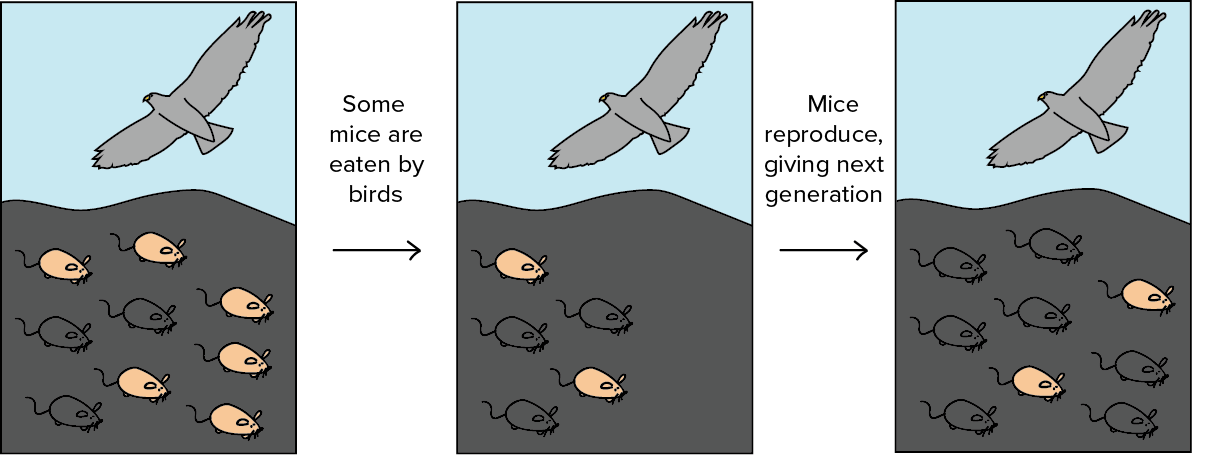
Where do adaptations come from?
The individual organism decides to adapt
Mutations that give an organism an advantage in its environment
Genetic recombination during meiosis
Both mutations and genetic recombination are sources of adaptation
Over generations of time apart on different islands with different food sources, the separated populations of Galapagos finches accumulated genetic differences until each group had different beaks. This is an example of _____.
natural selection
genetic drift
adaptation
speciation
Individuals undergo evolution.
True
False
A phenotype that improves an organism’s chance of survival in their environment is considered a(n) ____________.
natural selection
adaption
speciation
Which of the following is NOT an example of natural selection?
People selectively breeding hamsters for size.
Insect populations developing resistance to certain pesticides.
Bacteria becoming resistant to antibiotics.
Male birds of certain species inheriting colorful feathers that are more attractive to females.
The forelimbs of mammals have similar anatomy because these groups descended from a recent common ancestor. Their bone structure is an example of a(n) ______________ structure.
vestigial
analogous
homologous

