
 Worksheets
Unit 3 Test American Imperialism and WWI
Total questions: 50
Worksheet time: 4hrs 10mins

This poster was intended to
Overcome opposition to participation in the impending 2nd World War
Promote the acquisition of new territories abroad.
Advocate the ratification of the Treaty of Versailles.
Contain the spread of Soviet-dominated communism.

This poster most directly reflected the
Voluntary Exchange
American Imperialism
Manifest Destiny
Rationing
Use the following quote to answer the following question...
This is the Covenant of the League of Nations that you hear objected to, the only possible guarantee against war. I would consider myself recreant to every mother and father, every wife and sweetheart in this country, if I consented to the ending of this war without a guarantee that there would be no other. . . . For, I tell you, my fellow citizens, I can predict with absolute certainty that within another generation there will be another world war if the nations of the world do not concert the method by which to prevent it.
The excerpt best reflects and effort by Woodrow Wilson to
promote the acquisition of new territories abroad.
contain the spread of Soviet-dominated communism.
encourage the United States to avoid political entanglements in Europe.
make the world safe for democracy.
Use the following quote to answer question...
This is the Covenant of the League of Nations that you hear objected to, the only possible guarantee against war. I would consider myself recreant to every mother and father, every wife and sweetheart in this country, if I consented to the ending of this war without a guarantee that there would be no other. . . . For, I tell you, my fellow citizens, I can predict with absolute certainty that within another generation there will be another world war if the nations of the world do not concert the method by which to prevent it.
Source: Woodrow Wilson's
1919 speech
The trends described by Woodrow Wilson most directly illustrate which of the following major historical developments in the world?
The growth of mercantile empires that stretch across the Atlantic Ocean.
The issuing of the Emancipation Proclamation.
The United States participation in the impending Second World War.
The promotion of an isolationist ideology in the United States.
Which two wars were part of the American Imperialism? (MUST PICK TWO)
Spanish-American War
Vietnam War
World War I
Civil War
Philippine-American War
Use the following quote to answer question.
The people of the United States are drawn from many nations, and chiefly from the nations now at war. It is natural and inevitable that there should be utmost variety of sympathy and desire among them with regard to the issues and circumstances of the conflict. Some will wish one nation, others another, to succeed in the momentous struggle… The United States must be neutral in fact as well as in name during these days that are to try men’s souls.
President Woodrow Wilson, 1914
President Wilson’s analysis most directly illustrates the debates about which of the following issues in the United States?
The movement from U.S. Neutrality to engagement in World War I.
The Nullification Crisis caused by Southern resistance to federal law.
The U.S. military commitment to countries battling communist insurgencies.
Congresses support for the ratification of Wilson’s Fourteen Point Plan.
Which development caused the United States to change the foreign policy supported by President Wilson in the quotation?
Russia and China withdrew its military forces from the conflict.
German submarines attacked U.S. merchant ships and the Zimmerman Telegram.
The Central Powers began to use poison gas on the battlefield.
Hitler’s use of mass production to kill off the Jewish population
Use the following list to answer the question:
* “Hawaiian Planters Urge American Annexation”
*“U.S. and Germany Negotiate for Control of the Samoan Islands”
*“U.S. Gains Control of Wake Island and Guam”
Which conclusion can best be drawn from these headlines?
The Anti-Imperialist League strongly influenced Congress.
Respect for native cultures motivated United States foreign policy.
United States territorial expansion increased in the Pacific Ocean.
Construction of a railroad to Alaska was a major policy goal.

The map most directly reflects the following:
migration of African Americans to the North and West during World War I
migration of Dust bowlers to the North and West during the Great Depression
migration of Southern farmers during the Civil War
migration of big business during the 1920’s
“Why, by interweaving our destiny with that of any part of Europe, entangled our peace and prosperity in the toils of European ambitions, rivalship, interest, humor, or caprice?”
Which action by the Unites States best reflects the philosophy expressed in this quotation?
Enactment of the Lend-Lease Act
Rejection of the League of Nations by Congress
Approval of the Treaty of Versailles Passage
Passage of legislation restricting immigration
Which two foreign policies were designed to keep European countries from influencing the Western Hemisphere? (MUST PICK TWO)
George Washington's Farewell Address
The Roosevelt Corollary
The Neutrality Act
Containment Policy
The Monroe Doctrine
For what purpose did the United States want to build the Panama Canal?
It would make it easier for manufactures in New York to reach Western markets.
It would allow eastern U.S. cities to trade more easily with Europe.
It would allow U.S. ships to travel back and forth between the Atlantic and Pacific more easily.
It would make it easier for U.S. troops to reach Cuba to fight the Spanish.
What role did Eugene V. Debs play during World War I?
He was imprisoned because of the Espionage Act
He was imprisoned because of the Sedition Act
He was imprisoned because he was a Japanese immigrant
He was imprisoned because he made terroristic threats against the U.S. government

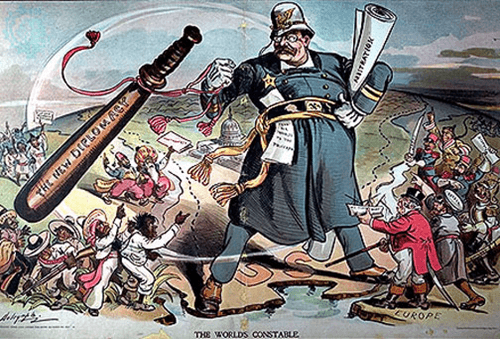
Based on the image above...
Which of the following groups would have been likely to support the opinion of the artist?
Members of Congress after World War I
Northern Industrialist
Supporters of President Wilson’s League of Nations.
Anti-imperialist

Based on the image,
The ideas expressed in the political cartoon most strongly influenced which United States foreign policy decision in the twentieth century?
The establishment of the United Nations in 1945.
The formation of the NATO alliance between the United States and Western Europe in 1910.
The refusal to join the League of Nation in 1919.
The oil embargo against Japan in 1941.
A U.S. citizen alive during World War I who strongly believed in freedom of speech, freedom of expression, and other civil rights, would have been MOST upset about
the U.S. Supreme Court’s decisions in Miranda v. Arizona.
the Senate’s refusal to ratify the Treaty of Versailles
the Espionage Act and the Sedition Act
Roosevelt’s court-packing scheme.
What was the Great Migration during the First World War?
The increased number of European migrants coming to America, hoping to escape the war.
The mass exodus of Midwestern farmers looking for factory jobs in war industries.
The mass exodus of African Americans from the South looking for factory jobs in war industries.
The massive transition of women to do work once solely carried out by men.
The U.S. involvement in Latin America, as reflected by the Roosevelt Corollary and the Monroe Doctrine led to
Matthew Perry opening up trade relations with Japan.
the United States construction of the Panama Canal.
Polk citing the doctrine as justification for Manifest Destiny.
The United States’ arbitration in the Venezuelan boundary dispute with Britain.

Which action by the United States government best reflects the philosophy expressed in this poster?
The Intolerable Acts
The Espionage and Sedition Acts
American Expansionism and Imperialism
The Communist Red Scare
A major purpose of President Woodrow Wilson’s Fourteen Points was to
ask Congress to enter World War I
make the world safe for democracy post World War I
provide an aid program for rebuilding war-torn nations.
retaliate for sinking the Lusitania.
Why did the creation of the Panama Canal lead to the Roosevelt Corollary?
The United States wanted to control Chinese immigration in Latin America
The United States wanted to stop the spread of Communism in Latin America
The United States wanted to protect its economic and political interests in Latin America
The United States wanted control of the Amazon River
In a United States history textbook, the terms The Spanish-American War, Roosevelt Corollary, and the building of the Panama Canal would most likely be found in a chapter entitled
Reconstruction (1865–1877)
Industrialization (1870–1900)
American Imperialism (1898–1905)
Progressive (1900–1917)
Which argument was used to support American Imperialism in the late 1800’s?
The United States needed to obtain raw materials not found here and new markets.
The spread of Marxist/Communist ideas had to be stopped because they threatened world peace.
The United States should be the first world power to build a colonial empire.
The doctrine of Manifest Destiny had become obsolete.
What were the two reasons the United States entered World War I?
The sinking of a passenger ship, the Lusitania, by a German submarine.
The assassination of Archduke Franz Ferdinand.
The United States wanted to prevent future attacks on their own land.
The Zimmerman Note, which asked Mexico to join the Central Powers if the United States declared war on Germany.
Immediately after war erupted in Europe in 1914, President Wilson
declared war on Germany.
urged Americans “to remain neutral in thought as well as in action.”
issued a protest against Russian involvement.
became a major speech maker in the preparedness movement.
The United States entered WWI when
Allied armies appeared near collapse.
Italy withdrew from the war.
Germany resumed unrestricted submarine warfare and sank 4 American freighters.
Mexico published the Zimmerman Telegram.
The Triple Entente before 1914 included which of the following countries?
France, Spain, Great Britain
Austria, Germany, the Ottoman Empire
Great Britain, France, Russia
Turkey, Russia, Germany
How did the Treaty of Versailles severely punish Germany?
It forced Germany to accept blame for the war and to pay reparations.
It supported economic help given to Germany by the U.S.
It divided Germany into four separate, occupied zones.
It took away German territory in Spain and Russia.
What was the name of the American policy which demanded the western powers respect the territorial integrity of China and ensure equal access to trade with China?
Boxer Rebellion
Open Door Policy
America First Policy
Opium War
As a result of the Spanish American War, the United States gained possession of
Philppines
Panama
Cuba
Guam
Puerto Rico
Which two ways of fighting were used primarily in WWI?
Atomic Weapons
Trench Warfare
Guerrilla Warfare
Chemical Warfare
What was the name of the peace keeping organization formed after WWI?
United Nations
League of Nations
Warsaw Pact
Munich Conference

The creation of ever expanding armies threatened peace in early 20th century. This is called...
Militarism
Isolationism
Alliances
Nationalism
What event made the US declare war on Spain?
the death of José Martí.
Dewey’s attack on the Philippines.
the destruction of the USS Maine.
the de Lôme letter.
World War I was triggered by the assassination of what man?
Vladimir Lenin
Czar Nicholas II
Otto Von Bismark
Franz Ferdinand
What engineering marvel created a direct link between the Atlantic and Pacific Oceans?
Salt Lake
Panama Canal
Erie Canal
Bering Strait
Who created the Fourteen Points?
Clemenceau
Woodrow Wilson
Teddy Roosevelt
Obama

