

wayground logo

Free Printable Worksheets

NEW

Font size

S
M
L
XL
Worksheets

Waves, Current, Plate Tectonics, Hurricanes Review 2019

Total questions: 68

Worksheet time: 58mins
Name
Class
Date
1.
Pangaea was an ancient supercontinent made up of...
a)
America, Greenland, and Europe.
b)
Antarctica, India, and America.
c)
all of Earth’s continents.
d)
South Africa, India, Australia, and South America.
2.
The San Andréa fault in California is one example of a...  
a)
Divergent boundary
b)
Convergent boundary
c)
Transform boundary
d)
All of the above
3.

In sea-floor spreading, molten material rises from the mantle and erupts

a)

along the edges of all the continents.

b)

along mid-ocean ridges.

c)

in deep-ocean trenches.

d)

at the north and south poles.

4.

A place where two plates slip past each other, moving in opposite directions, is known as a _______

a)

transform boundary

b)

divergent boundary.

c)

convergent boundary.

d)

rift valley.

5.

The place where two plates come together is known as a _______

a)

transform boundary.

b)

divergent boundary.

c)

convergent boundary.

d)

rift valley.

6.

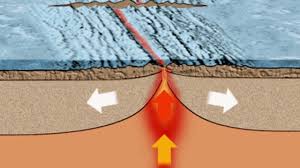
Below is a picture of sea-floor spreading. How are the ocean crusts moving?

a)

Converging

b)

Diverging

c)

Sliding

d)

No movement

7.
What is Pangaea?
a)
the name of a German scientist
b)
the name of the super-continent that existed millions of years ago
c)
another name for continental drift
d)
the name of an ancient fossil
8.

What type of event will occur at this boundary?

a)

Earthquake

b)

Volcano Eruption

c)

Tornado

d)

Mountain Building

9.

A divergent boundary occurs when plates ....

a)

Pull apart

b)

Come together

c)

Slide past each other

d)

subducting

10.

Mountains are created when....

a)

Two continental plates collide

b)

Two oceanic plates pull apart

c)

An Oceanic plate subducts under a Continental Plate

d)

Two continental plates pull apart

11.
There are three types of plate boundaries. Which choice is NOT a type of plate boundary?
a)
convergent
b)
thrust
c)
divergent
d)
transform
12.
Which ocean is expanding due to a mid-ocean ridge?
a)
Indian
b)
Dead Sea
c)
Atlantic
d)
Artic
13.
What causes waves?
a)
ice and wind
b)
winds and currents
c)
currents and tides
d)
wind and tide changes
14.
Describe surface currents.
a)
Currents that occur on the surface of the water.
b)
Currents caused by prevailing winds.
c)
Currents caused by water molecules moving in a circular pattern.
d)
Both A & B
15.
What is a tsunami?
a)
a wave direction
b)
a type of current
c)
a sand particle
d)
a giant sea wave
16.
What is the distance from the trough of the wave to the crest?
a)
peak
b)
wave length
c)
wave height
d)
trough
17.
Density currents are caused by...
a)
density differences caused by temperature & salinity. 
b)
changes in wind directions.
c)
prevailing winds.
18.

Theory that Earth's crust is divided into plates & the plates move around on the mantle

a)

Seafloor spreading

b)

Plate tectonics

c)

Continental drift

d)

Earthquakes

19.

The point on Earth's surface directly above the focus of an earthquake

a)

Juan de fuca plate

b)

Focus

c)

Seismic wave

d)

Epicenter

20.

Which type of ocean movement is a large-scale pattern that can circulate across all the oceans?

a)

Current

b)

Wave

c)

Tide

21.

Which type of ocean movement is a repeated up and down motion, generally caused by wind?

a)

Current

b)

Wave

c)

Tide

22.

Which type of ocean movement can be described as the rise and fall of sea level, mostly due to the gravitational influence of the moon?

a)

Current

b)

Wave

c)

Tide

23.

Which type of ocean movement can be divided into 2 groups: surface and deep?

a)

Current

b)

Wave

c)

Tide

24.

Which type of ocean movement varies depending on the current moon phase?

a)

Current

b)

Wave

c)

Tide

25.

TRUE or FALSE: The Gulf Stream carries cool water toward the North Atlantic, causing the weather in Great Britain to be colder.

a)

TRUE

b)

FALSE

26.

______ causes surface currents.

a)

The Coriolis Effect

b)

gravity

c)

density differences

d)

wind

27.

As plants and animals in the ocean die, the nutrients produced from their decay _____.

a)

are recycled by the Global Conveyor Belt

b)

sink to the bottom

c)

are destroyed by sunlight

d)

become coral reefs

28.

Nutrients are brought to the surface for phytoplankton to use at _______.

a)

gyres

b)

eddies

c)

upwellings

d)

the equator

29.

_______ causes the Coriolis Effect

a)

Earth's rotation

b)

gravity

c)

wind

d)

density

30.

The __________ is a surface current that flows along the eastern US and brings warm water to Europe.

a)

California Current

b)

Gulf Current

c)

North American Gyre

d)

Arctic Current

31.
Currents that are far beneath the surface
a)
deep ocean currents
b)
surface currents
c)
current
d)
global winds
32.
Currents that occur at or near the surface of the ocean are called 
a)
Deep Currents
b)
Convection Currents
c)
Surface Currents
d)
Wave Currents
33.
Surface currents are mainly caused by
a)
The Coriolis Effect
b)
Cold and Warm Water
c)
Convection
d)
Wind
34.
Upwelling provides _________ for many sea organisms.
a)
Water
b)
Nutrients
c)
Air
d)
Heat
35.
Currents release heat energy and this can affect an area's
a)
Oxygen
b)
Climate
c)
Upwelling
d)
Sunlight
36.
What do ocean currents move around the world?
a)
Gases
b)
Nutrients
c)
Heat Energy
d)
All of these
37.
an earthquake is ....
a)
movements of the ground that are caused by a sudden release of energy when rocks along a fault move. 
b)
a fault 
c)
seismic waves
d)
when the air moves and creates a wind storm
38.
what is this ????
a)
transform
b)
divergent
c)
convergent
d)
divergent
39.
what is this???
a)
subduction
b)
convergent
c)
diversion
d)
transform
40.
The area around the pacific plate where boundaries form is called...
a)
death ring
b)
fire zone
c)
ring of fire
d)
zone of fire
41.
What does the theory of continental drift state?
a)
The continents were once joined in a super-continent and have moved over time
b)
Continents are stationary and do not move
c)
The Earth is broken into lithospheric plates that move due to convection currents
d)
none of the above
42.
Who is the person credited with developing the theory of continental drift?
a)
Harry Hess
b)
Galileo
c)
Alfred Wegener
d)
Newton
43.
Name the boundary
a)
convergent boundary
b)
divergent boundary
c)
transform boundary
d)
sergent boundary
44.
Name the boundary
a)
convergent boundary
b)
divergent boundary
c)
transform boundary
d)
sergent boundary
45.
Name the boundary
a)
convergent boundary
b)
divergent boundary
c)
transform boundary
d)
sergent boundary
46.
As you travel from the crust to the inner core, how would temperature, pressure and density of the material change?
a)
The would all increase
b)
The would all decrease.
c)
They would stay the same.  
d)
Temperature would decrease, but pressure and density would increase. 
47.
Mountains form from ...
a)
plates sliding past one another
b)
collision of plates
c)
plates moving away from each other
48.
Which piece of evidence did Wegener use to prove continental drift?
a)
The shape of the continents
b)
Similar fossils found on separate continents
c)
Tree fossils found in odd places
d)
All of the above
49.
What is this a picture of?
a)
plate tectonics
b)
continental drift
c)
pangea
d)
glacier scaring
50.
What two specific continents fit together most noticeably?
a)
Africa and North America
b)
South America and Europe
c)
South America and Africa
d)
Antartica and Africa
51.
Can volcanic eruptions effect climate?
a)
yes 
b)
no
52.
An erupting volcano can cause...
a)
rain
b)
other disasters like tsunamis, earthquakes, etc.
c)
dragon attacks
d)
an early Christmas
53.
There are volcanoes underwater.
a)
True 
b)
False
54.
Volcanoes can normally be found at what type of boundary?
a)
Divergent
b)
Convergent
c)
Transform
55.
This plate is involved in all of the Ring of Fire Volcanoes.
a)
The Nazca Plate
b)
The North American Plate
c)
The Pacific Plate
d)
The Indian Plate
56.
What percent of the Earth's volcanoes reside in the Ring of Fire?
a)
75%
b)
100%
c)
90%
d)
0%
57.
The loudest sound ever recorded was...
a)
Mt. Vesuvius erupting
b)
Mt. Krakatoa erupting
c)
Mt. Kilauea
d)
A mouse whispering in the forest.
58.
Most tsunamis occur here.
a)
Atlantic Ocean
b)
Indian Ocean
c)
Arctic Ocean
d)
Pacific Ocean
59.
This is another cause of tsunamis.
a)
Landslides
b)
Cannonballs
c)
Geysers
d)
Hurricanes
60.
Volcanic eruptions can also cause tsunamis.
a)
True
b)
False
61.
The huge pieces of the earth's crust are called ____________________________. 
a)
crust
b)
plates
c)
directions
d)
seismos
62.
The San Andreas fault is located in Conneticut
a)
true
b)
false
63.
Volcanoes that have recently erupted are known as:
a)
Extinct Volcano
b)
Dormant Volcano
c)
Active Volcano
d)
What's a volcano?
64.
volcano that has erupted in the last 2000 years but not recently is known as....
a)
Dormant
b)
Active
c)
Extinct
d)
Angry
65.

What was the largest volcanic eruption in history?

a)

Mt St Helens VEI 4

b)

Mt Mc Kinley

c)

Mt Tambora VEI 7

d)

Krakatoa VEI 6

66.

Which super volcano is going to erupt some day here in the US?

a)

Yellowstone

b)

Mt Saint Helens

c)

Krakatoa

d)

Long Island

67.

What is ELE?

a)

Environmental Law Enforcement

b)

Extinction Level Event

c)

pop singer

d)

first robotic sub

68.

What does VEI stand for?

a)

Vehicle Emissions Information

b)

Volcanic Eruption Intensity

c)

first robot to Mars
