
 Worksheets
Plate Motion
Total questions: 33
Worksheet time: 22mins


evidence of life from the past, such as fossilized bones, footprints, or leaf prints
trench
model
fossil
geyser
something we observe to be similar over and over again
pattern
mantle
eruption
rifiting
mantle: the layer of soft, solid rock underneath Earth's plates
True
False
divergent: moving apart in different directions
True
False
moving toward the same place
convergent
plate boundary
earthquake
cross section
surface
a sudden shaking of Earth's surface
convergent
plate boundary
earthquake
cross section
mid-ocean ridge
a diagram that shows what the inside of something looks like
convergent
plate boundary
earthquake
cross section
mid-ocean ridge
the place where two plates meet
convergent
plate boundary
earthquake
cross section
surface


Which statement best describes Earth's outer layer underneath the surface in the image?
Underneath the soil, Earth's outer layer is made of water.
Underneath both the soil and the ocean, Earth's outer layer is made of sand and water.
Underneath the soil, Earth's outer layer is made of hard, solid rock. Underneath the ocean, Earth's outer layer is made of sand.
Underneath both the soil and the ocean, Earth's outer layer is made of hard, solid rock.
What is responsible for the movement of tectonic plates?
Oceans
Gravity
Mantle
Wind
Earth's outer layer is broken up into...
Bowls
Continents
Rocks
Plates

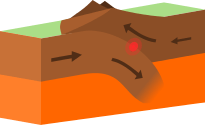
What type of plate boundary is this?
Divergent
Convergent
Transform
Earthquakes are caused by
activity on Earth's surface
extreme weather
Earth's rotation
plate motion
Which statement is TRUE?
Earthquakes cause plates to move
Plate motion causes earthquakes
Plate motion happens very quickly.
Continents float on top of Earth's oceans.
Which image best shows what the land is like where Mesosaurus fossils are found.


Which is the best option for viewing the inside of something?
Earthquake map
Seismograph
Cross section
Hydrophone
What is one way geologists determine where a plate boundary is located in real life?
By looking at a cross section of the Earth
By looking for a gap between plates
By looking at the distribution of earthquakes

The team is drilling underground at sites 1 and 2. Where will the team find hard, solid rock?
They will find hard, solid rock below site 1. At site 2, they will find water and sand.
They will find hard, solid rock below site 2. At site 1, they will find plants and soil.
They will find hard, solid rock below both sites.
They will find hard solid rock at neither of these sites; they will find water below both of them.
Earth's plates are a __________ solid material. Earth's mantle is a ________ solid material.
Soft; hard
Hard; soft
Soft; soft
Hard; hard

