wayground logo

Free Printable Worksheets

Font size

S
M
L
XL
Worksheets

Chapter 3 Practice Test

Total questions: 105

Worksheet time: 2hrs 37mins

Name
Class
Date
1.

What is the base unit for mass?

a)

meters

b)

liters

c)

grams

2.

What is the base unit for volume?

a)

meters

b)

liters

c)

grams

3.

What is the base unit for distance?

a)

meters

b)

liters

c)

grams

4.

Which of these is equal to 2000mm?

a)

0.2 m

b)

2 m

c)

20 m

5.

30 mg is that same as:

a)

3 kg

b)

0.03 g

c)

30 dg

6.

Which of these is the largest mass?

a)

5 kg

b)

800 g

c)

15,000mg

7.

Which of these measurements would be the closest to the thickness of a dime?

a)

1 kilometer

b)

1 millimeter

c)

1 meter

8.

Which of these would be closest to the mass of a paperclip?

a)

kilogram

b)

dekagram

c)

gram

9.

Which of these would be the most appropriate measurement for a large bottle of soda?

a)

2 meters

b)

2 kilograms

c)

2 liters

10.

What is the SI unit for temperature?

a)

celsius

b)

fahrenheit

c)

Kelvin

d)

Absolute temperature

11.

What is the SI unit for mass?

a)

Kg

b)

g

c)

mg

d)

cg

12.

What is the SI unit for volume?

a)

L

b)

m3

c)

cm3

d)

mL

13.

Water boils at 100oC and _____ K.

a)

-173

b)

273

c)

0

d)

373

14.

A cm3 is equivalent to which unit?

a)

L

b)

mL

c)

g/mL

d)

dL3

15.

How many cg would 500 μg be equivalent to?

a)

0.05

b)

5 X 10⁸

c)

5 X 10⁶

d)

5

16.

200 cm3 would be equivalent to ____mm3.

a)

2 X 10⁴

b)

2 X 10⁵

c)

2 X 10⁻⁴

d)

8 X 10⁶

17.

45.5 ML would be equivalent to _______ dL

a)

4.55 X 10⁷

b)

4.55 X 10⁻⁷

c)

4.55 X 10⁸

d)

4.55 X 10⁵

18.

Which of these is the same volume as 20L?

a)

2kL

b)

200cL

c)

20,000mL

19.
What two types of measurements make up DENSITY
a)
Mass and Volume
b)
Temperature and Mass
c)
Grams and Centimeters
d)
Volume and Weight
20.
What units can be used to express density?
a)
g/mL
b)
grams
c)
millimeters
d)
milliliters
21.
If an object has a density of .6 g/mL and you put it into water, will it sink or float?  
a)
sink
b)
float
22.
Which liquid has the highest density? 
a)
corn syrup
b)
lamp oil
c)
rubbing alcohol
d)
honey
23.
Frank has an eraser. It has a mass of 4g, and a volume of 2cm3. What is its density?
a)
8 g/cm3
b)
2 g/cm3
c)
1/2 g/cm3
d)
24 g/cm3
24.
An object should float in a liquid if it is 
a)
Denser than the liquid 
b)
Less dense than the liquid
c)
Lighter than metal
d)
 Shaped like a ball 
25.
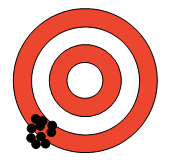
This bullseye demonstrates...
a)
High Accuracy & High Precision
b)
High Accuracy & Low Precision
c)
Low Accuracy & High Precision
d)
Low Accuracy & Low Precision
26.
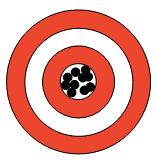
?
a)
High Accuracy & High Precision
b)
High Accuracy & Low Precision
c)
Low Accuracy & High Precision
d)
Low Accuracy & Low Precision
27.
Archimedes used density to discover if the crown of gold was real because
a)
Substances have their own unique densities
b)
Substances can change densities depending on their size
c)
Substances can change densities depending on their mass
d)
Substances can change densities depending on their volume
28.

The prefix deka represents 10 raised to what power?

a)

10

b)

1

c)

3

d)

-1

29.

The prefix micro represents 10 raised to what power?

a)

-3

b)

6

c)

-6

d)

3

30.

The prefix nano represents 10 raised to what power?

a)

-9

b)

-7

c)

9

d)

-6

31.

The prefix kilo represents 10 raised to what power?

a)

-3

b)

4

c)

6

d)

3

32.

The prefix centi represents 10 raised to what power?

a)

100

b)

3

c)

-2

d)

2

33.

Convert: 1 m = ? km

a)

100

b)

0.01

c)

10

d)

0.001

34.

Convert: 100 L = ? daL

a)

1000

b)

10

c)

.01

d)

1

35.

Convert: 25 g = ? pg

a)

2.5 X 10⁷

b)

2.5 X 10⁻¹²

c)

2.5 X 10⁻⁸

d)

2.5 X 10¹³

36.

Convert: 6.2 nm = ? mm

a)

6.2 X 10⁻⁶

b)

6.2 X 10⁶

c)

6.2 X 10⁻⁴

d)

6.2 X 10⁴

37.

Convert: 50 L = ? μL

a)

5 X 10⁵

b)

5 X 10⁻⁷

c)

5 X 10⁷

d)

5 X 10⁻⁶

38.

Convert: 10 mm3 = ? cm3

a)

0.001

b)

1

c)

0.01

d)

100

39.

Convert: 0.1 hg = ? cg

a)

1 X 10²

b)

1 X 10⁻⁵

c)

1 X 10⁻⁴

d)

1 X 10³

40.

How many significant figures in 4001.006 g?

a)

1

b)

3

c)

5

d)

7

41.

How many significant figures in10.000046 g

a)

8

b)

7

c)

5

d)

3

42.

How many significant figures in 0.0000456 g?

a)

8

b)

9

c)

5

d)

3

43.

How many significant figures in 3 cars?

a)

1

b)

3

c)

unlimited

d)

0

44.

How many significant figures in 20,000 g

a)

1

b)

5

c)

unlimited

d)

0

45.

How many significant figures in 20,000. g

a)

1

b)

5

c)

unlimited

d)

6

46.

How many significant figures in 1001.000 g

a)

4

b)

6

c)

7

d)

8

47.

How many significant figures in 20,000.00 g

a)

1

b)

5

c)

7

d)

indefinite

48.

How many significant figures in 100 g

a)

1

b)

2

c)

3

d)

unlimited

49.

How many significant figures in 0.000300680?

a)

3

b)

6

c)

9

d)

10

50.

How many significant figures in 101.00

a)

3

b)

4

c)

5

d)

unlimited

51.

Calculate and answer in sig figs:

37.26 m + 2.7 m . + 0.0015 m

a)

40 mL

b)

39.96 mL

c)

40.0 mL

d)

40. mL

52.

Calculate and answer in sig figs:

256.3 mL . + 2000 mL + 137 mL + 10.12 mL

a)

2400 mL

b)

2000 mL

c)

2403.4 mL

d)

2403 mL

53.

Calculate and answer in sig figs:

300. kPa X 274.57 mL / 547 kPa

a)

151 mL

b)

150 mL

c)

150.6 mL

d)

200 kPa/mL

54.

Calculate and answer in sig figs:

346 mL X 200 K / 546.4 K

a)

100 mL/K

b)

127 mL

c)

100 mL

d)

127 mL K2

55.

Express the following in proper scientific notation:

0.0000036

a)

3.6 X 10⁻⁵

b)

3.6 X 10⁻⁶

c)

3.6 X 10⁶

d)

36 X 105

56.

Express the following in proper scientific notation:

1,450,000

a)

145 X 104

b)

1.45 X 10⁻⁶

c)

145 X 10-5

d)

1.45 X 10⁶

57.

Express the following in proper scientific notation:

2340

a)

2.340 X 10⁻³

b)

2.34 X 10³

c)

234 X 104

d)

234 X 101

58.

Express the following in proper scientific notation:

111.34

a)

1.1134 X 10²

b)

1.1 X 10³

c)

1.1134 X 10⁻²

d)

1.113 X 10⁻³

59.

Ink can be separated by a method of -----------------------------------------------

a)

distillation

b)

filtration

c)

chromatography

d)

sedimentation

60.
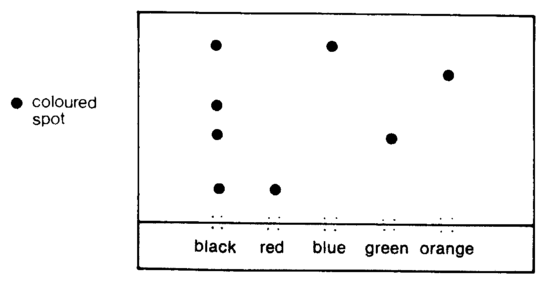
On the chromatogram given -------------- is mixture.
a)
red
b)
orange
c)
green
d)
black
61.
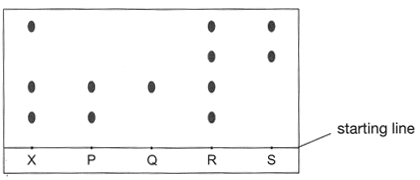
The diagram below shows a chromatogram obtained when a sample X was analysed together with four other known dyes P, Q, R and S. Dye Q was known to cause cancer. Which of the following dye(s) is/are safe for use?
a)
P only
b)
S only
c)
P and S
d)
P and X
62.
_________________ utilizes a stationary and a mobile phase to separate mixtures based on their affinity for each phase.
a)
filtration
b)
chromatography
c)
distillation
d)
osmosis
63.
The mobile phase in paper chromatography is typically a
a)
plasma
b)
solid
c)
gas
d)
liquid
64.

The substance in the mixture that has the greatest affinity (adsorption) for the stationary phase will travel

a)

fastest

b)

slowest

c)

adsorption is irrelevant

65.
The retention factor is used
a)
to zero the chromatography scale
b)
to identify unknown compounds in a sample
c)
to retain solvent
d)
as a starting tool for chromatography
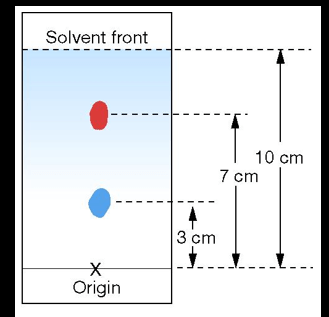
66.
The Rvalue  for the red component is 
a)
0.3
b)
0.7
c)
10
d)
7
67.

A substance is soluble if it can be dissolved.


In paper chromatography, the most soluble solute _____________________ .

a)

does not move from the start point

b)

stays closest to the start point

c)

travels furthest away from the start point

d)

can be found in the middle of the chromatogram

68.

In the image, which dye is the most soluble?

a)

Red

b)

Blue

c)

Purple

69.

In the image, which dye has the largest retention factor (Rf)?

a)

Red

b)

Blue

c)

Purple

70.

What is the Rf value of the blue dye?

a)

0.6

b)

0.2

c)

0.4

d)

0.8

e)

1.0

71.

The deer population is estimated to be 16,600 in northern Illinois, but an actual count was 21,500. What is the percent error?

a)

22%

b)

22.79%

c)

22.8%

d)

22.790%

72.

What is the length of the blue line?

a)

.3 cm

b)

.33 cm

c)

.03 cm

d)

3.219 cm

73.
What is the volume of the battery?
a)
17 cm3
b)
5 cm3
c)
22 cm3
d)
24 ml
74.

A set of data are all close to each other, and they are close to the actual value. This set of data can be described as having...

a)

good accuracy

b)

good precision

c)

both good precision and accuracy

d)

neither good precision nor good accuracy

75.

A set of data are not close to each other, but the average of the data is very close to the actual value. This set of data can be described as having...

a)

good accuracy

b)

good precision

c)

both good precision and accuracy

d)

neither good precision nor good accuracy

76.

Jack has a rock. The rock has a mass of 18g and a volume of 3cm3. What is the density of the rock?

a)

6 mL

b)

6 g/cm3

c)

54 g/cm3

d)

1/6 g/cm3

77.
How do you find the volume of a rectangle?
a)
Multiply length and width
b)
Multiply length, height and width
c)
Add length, height and width
d)
Add length and width
78.
Which of the following  is the most accurate and precise for measuring the volume of a liquid?
a)
Beaker
b)
Erlenmeyer flask
c)
Graduated Cylinder
d)
Round bottomed flask
79.
Which of these could be a correct measurement for the mass shown?  Click on this image for a better look.
a)
188.5 g
b)
188.50 g
c)
188.500 g
d)
189
80.
Which of these could be a correct measurement for the volume shown?  Click on this image for a better look.
a)
40 mL
b)
43 mL
c)
43.0 mL
d)
43.00 mL
81.
Which could be a correct measurement?  
a)
9 cm
b)
8.5 cm
c)
8.50 cm
d)
8.1 cm
82.
Which of these could be a correct measurement for the volume at the right? shown?  Click on this image for a better look.
a)
15 mL
b)
14.8 mL
c)
14.5 mL
d)
14.75 mL
83.
Which could be the length of this pencil?
a)
4 cm
b)
4.0 cm
c)
4.00 cm
d)
5 cm
84.
What is the density of the submerged object?
a)
2.41315 g/mL
b)
2.413 g/mL
c)
2.4 g/mL
d)
2.5 g/mL
85.

Use the graph shown, to estimate the density of gold

a)

26.7 g/mL

b)

40. g/mL

c)

0.025 g/mL

d)

2.7 g/mL

86.

When graphing density, the slope tells you the ______

a)

density

b)

mass

c)

mass ratio

d)

volume

87.

If the mass of a metal cube is 41.04 g and the density is 1.52 g/mL, what is the length of one side of the cube?

a)

27.0 cm3

b)

5.20 cm

c)

3.00 cm

d)

9.00 cm

88.
Identify the equipment shown here:
a)
graduated cylinder
b)
Erlenmeyer flask
c)
beaker
d)
volumetric flask
89.
Identify the equipment shown here:
a)
ring stand
b)
iron ring
c)
utility clamp
d)
test tube holder
test tube holder
90.
Identify the equipment shown here:
a)
concave glass
b)
convex glass
c)
watch glass
d)
glass plate
91.
Identify the equipment shown here:
a)
scale
b)
weighing device
c)
mass spectrometer
d)
triple beam balance
92.
Identify the equipment shown here:
a)
beakers
b)
flasks
c)
decanters
d)
graduated cylinders
93.
Identify the equipment shown here:
a)
volumetric flasks
b)
graduated cylinders
c)
Erlenmeyer flasks
d)
Florence flasks
94.
Identify the equipment shown here:
a)
test tube clamp
b)
iron ring
c)
utility clamp
d)
test tube holder
95.
Identify the equipment shown here:
a)
spatula
b)
scoopula
c)
weighing boat
d)
forceps
96.
Identify the equipment shown here:
a)
beaker
b)
Erlenmeyer flask
c)
Florence flask
d)
volumetric flask
97.
Identify the equipment shown here:
a)
probes
b)
tweezers
c)
spatulas
d)
forceps
98.
Identify the equipment shown here:
a)
crucible
b)
evaporating dish
c)
mortar and pestle
d)
bowl
99.
Identify the equipment shown here:
a)
acetylene torch
b)
flame thrower
c)
alcohol burner
d)
Bunsen burner
100.
Identify the equipment shown here:
a)
wire gauze
b)
flame spreader
c)
sieve
d)
mesh
101.
Identify the equipment shown here:
a)
test tube holder
b)
utility clamp
c)
iron ring
d)
buret clamp
102.
Identify the equipment shown here:
a)
test tube holder
b)
iron rod
c)
iron ring
d)
ring stand
103.
Identify the equipment shown here:
a)
crucible tongs
b)
beaker tongs
c)
test tube holder
d)
utility clamp
104.
Identify the equipment shown here:
a)
crucible holder
b)
wire gauze
c)
clay triangle
d)
test tube holder
105.
Identify the equipment shown here:
a)
beaker
b)
Erlenmeyer flask
c)
Florence flask
d)
volumetric flask