Wayground logo

Free Printable Worksheets

Font size

S
M
L
XL
Worksheets

Quarter 1 Review

Total questions: 66

Worksheet time: 1hrs 9mins

Name
Class
Date
1.
A possible explanation to a problem that has not yet been tested. 
a)
data
b)
theory
c)
hypothesis
d)
fact
2.
This variable in an experiment is the one being deliberately changed by the scientist. 
a)
dependent variable
b)
independent variable
c)
data
d)
control group
3.
An experiment is performed on plants to see how different liquids affect plant growth. Each plant in the experiment is given a different liquid; water, apple juice, or milk. Each plant has the same amount of soil, sunlight, and listens to the same music. In this investigation, the independent variable is ...
a)
The type of plant
b)
The amount of sunlight
c)
The type of music
d)
The type of liquid
4.
A student wants to test the effects of type of exercise on heart rate.  What is the dependent variable?
a)
heart rate
b)
type of exercise
c)
amount of exercise
d)
time of day exercise occurs
5.
An experiment is performed on plants to see how different liquids affect plant growth. Each plant in the experiment is given a different liquid; water, apple juice, or milk. Each plant has the same amount of soil, sunlight, and listens to the same music. In this investigation, what are the controlled variables?
a)
Type of plant, amount of music, and sunlight
b)
Water, apple juice, milk
c)
Plant growth
6.
Sarah wanted to find out if the size of a car tire made it a smoother ride over bumps. What is the dependent variable?
a)
Size of tire
b)
How smooth the ride was over bumps
c)
Type of car
7.

Which SI unit is used to measure length?

a)

mol

b)

m

c)

kg

d)

m2

8.

Which SI unit is used to measure mass?

a)

s

b)

m

c)

kg

d)

Pa

9.
The mass of a push pen would be measured in __?__.
a)
kilograms  (kg)
b)
liters (L)
c)
grams  (g)
d)
milligrams  (mg)
10.

Which of these explain how a natural phenomenon works or happens?

a)

theory

b)

law

11.

Which of these describes a natural phenomenon or relationship that always occurs under specific conditions

a)

theory

b)

law

12.
Scientific theories can be tested.
a)
True
b)
False
13.
In a controlled experiment, how many variables can be worked with at a time? 
a)
one
b)
none
c)
two or more
d)
how ever many makes sense.
14.

Concentration is

a)

the amount of solute in the solvent

b)

the amount of solvent in the solute

c)

density

d)

particle size

15.

Which solution is more concentrated?

Solution 1:

500 mL of water

100 g of salt


Solution 2:

500 mL of water

90 g of salt

a)

Solution 1

b)

Solution 2

c)

They have the same concentration

d)

I have no idea

16.

Which solution is more concentrated?


Solution 1:

20 mL of water

5 g of salt


Solution 2:

20 mL of water

10 g of salt

a)

Not enough information to tell

b)

Solution 1

c)

Solution 2

d)

They are equally concentrated

17.
The chemical combination of two or more different kinds of atoms in fixed amounts is called a(n)
a)
orbit
b)
compound
c)
mixture
d)
element
18.
A compound is...
a)
a substance made up of one type of atom in its molecular form.
b)
a substance formed by the reaction of two or more elements.
c)
a mixture formed by the mixing of two or more elements.
d)
a substance made up of one type of atom in its atomic form.
19.
Carbon dioxide is formed when two oxygen atoms chemically combine with a carbon atom. Which term best describes carbon dioxide?
a)
atom
b)
mixture
c)
element
d)
compound
20.
what is the definition of physical change?
a)
any change that results in the formation of new chemical substances. 
b)
rusting
c)
changes affecting the form of a chemical substance, but not its chemical composition.
d)
any property that is measurable, whose value describes a state of a physical system
21.
what is the definition of chemical change?
a)
any change that results in the formation of new chemical substances. 
b)
changing clothes
c)
matter cannot be created or destroyed, only change form
d)
changes affecting the form of a chemical substance, but not its chemical composition.
22.
Is burning wood a chemical or physical change?
a)
chemical
b)
physical
23.
Is hammering wood together to build a house a chemical or physical change?
a)
chemical
b)
physical
24.
Which of the following is NOT an example of chemical change?
a)
sour milk
b)
burning wood
c)
breaking a pencil
d)
rust
25.
Baking a cake by mixing flour, sugar, chocolate powder, eggs, and milk, and then heating them in the oven.
a)
Chemical Change
b)
Physical Change
26.
True or False:  The density of a specific type of material never changes.  
a)
True
b)
False
27.
What two types of measurements make up DENSITY? 
a)
Mass and Volume
b)
Temperature and Mass
c)
Grams and Centimeters
d)
Volume and Weight
28.

A temperature increase causes the particles ......

a)

to slow down

b)

move faster

c)

collide higher

d)

in the right order

29.

When we investigate the rate of reaction we are looking at the...

a)

amount of product formed

b)

speed of reaction

c)

concentration of reacting particles

d)

combining reactants with products

30.
Which factors increase the rate of a reaction.
a)
increasing temperature
b)
increasing concentration
c)
increasing surface area
d)
all of these
31.
Which of the following increase the reaction rate?
a)
less surface area
b)
lower temperature
c)
an inhibitor
d)
increased concentration
32.

When surface area is decreased the rate of reaction...

a)

Decreases, because there are LESS possible sites for correct collisions

b)

Increases, because there are LESS possible sites for correct collisions

c)

Decreases, because there are MORE possible sites for correct collisions

d)

Increases, because there are MORE possible sites for correct collisions

33.
A size dependent property is one that CHANGES when the size of an object changes.
What would be an example of size DEPENDENT?
a)
length, width, height, mass
b)
color, state of matter
34.
A size independent property is one that does not change when the size of an object changes.
What would be an example of size INDEPENDENT?
a)
length, width, height, mass
b)
color, state of matter
35.
Type of mixture that has the SAME COMPOSITION in every part.
a)
Homogenous
b)
Heterogeneous
36.
Type of mixture that DOESN'T HAVE the same composition in every part.
a)
Homogeneous
b)
Heterogeneous
37.
Chocolate milk is an example of a
a)
homogeneous mixture
b)
heterogeneous mixture
38.
M&M's is an examples of a
a)
homogeneous mixture
b)
heterogeneous mixture
39.
Salad is an example of a
a)
homogeneous mixture
b)
heterogeneous mixture
40.
Coloured water is an example of a
a)
homogeneous mixture
b)
heterogeneous mixture
41.
Adding or subtracting neutrons (charge = 0, mass = 1) makes the element change into an...
a)
ion
b)
mixture
c)
isotope
d)
neutral atom
42.
What is the charge on a lithium atom that looses 1 electron?
a)
+1
b)
0
c)
-1
d)
-2
43.
The atomic mass is equal to _.
a)
the number of protons only
b)
the number of neutrons only
c)
the total number of protons and neutrons
d)
the number of protons, neutrons, and electrons.
44.
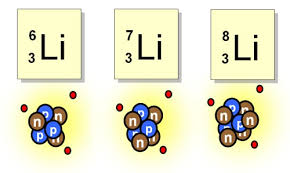
Which atom has  4 neutrons?
a)
Li-6
b)
Li-7
c)
Li-8
d)
they have the same # of neutrons
45.
If an atom gains an electron it is a(n)
a)
Positive ion
b)
Negative ion
c)
Isotope
d)
Neutral Atom
46.
If an atom loses an electron it is a(n)
a)
Positive ion
b)
Negative ion
c)
Isotope
d)
Neutral Atom
47.
Carbon-14 is an example of a(n)
a)
Positive ion
b)
Negative ion
c)
Isotope
d)
Neutral Atom
48.
The positive particles of an atom are 
a)
electrons 
b)
positrons 
c)
neutrons 
d)
protons 
49.
the central region of an atom where its neutrons and protons are is its 
a)
nucleus 
b)
electron cloud
c)
core 
d)
center 
50.
an atom with atomic number 6 would have how many protons 
a)
6
b)
12
c)
3
d)
cannot be determined 
51.
Particles in an atom that are neutral and have no charge are 
a)
negatrons 
b)
electrons 
c)
neutrons 
d)
protons 
52.
A particle that moves around the nucleus is a(n)...
a)
Proton
b)
Neutron
c)
Electron
d)
Quark
53.
The process of nuclear change in an atom of radioactive material is called... 
a)
nuclear decay
b)
nuclear mass
c)
isotopes
d)
radon
54.
During beta decay, a nucleus .... 
a)
gives up two protons and two neutrons.
b)
  maintains the same number of protons and neutrons.
c)
  loses a proton and gains a neutron.
d)
gains a proton and loses a neutron. 
55.
When a nucleus undergoes nuclear decay by gamma rays, the atomic number of the element....
a)
remains the same
b)
  decreases by one.
c)
increases by one.
d)
increases by two.
56.
The three types of nuclear radiation in increasing order of penetrating power are ____.  
a)
  alpha, beta, gamma 
b)
X ray, beta, gamma
c)
alpha, gamma, beta 
d)
X ray, gamma, beta 
57.

What type of decay is shown here

23892U ---> 23490Th + 42He.

a)

alpha

b)

beta

c)

gamma

58.

Identify the type of nuclear decay shown here

21483Bi → 0-1e + 21484Po

a)

alpha

b)

beta

c)

gamma

59.
What contribution did John Dalton make to atomic theory? 
a)
He discovered that every atom was positively charged. 
b)
He discovered that every element consisted of one type of atom that couldn't be divided. 
c)
He discovered that atoms had nuclei. 
d)
He discovered that atoms could be divided into smaller parts. 
60.

What scientist is best known for his "Plum Pudding" or Chocolate chip cookie model of the atom?

a)

J.J. Thomson

b)

Ernest Rutherford

c)

John Dalton

d)

Democritus

61.
How did Thomson build upon Dalton's model? 
a)
His model was the same.
b)
He put electrons in orbitals.
c)
He discovered the nucleus.
d)
He discovere subatomic particles (electron).
62.
The scientist responsible for "discovering" the nucleus is:
a)
Bohr
b)
Rutherford
c)
Schroedinger
d)
Einstein
63.
How did Rutherford discover the proton?
a)
Cathode tube ray experiment
b)
Gold Foil Experiment
c)
Planetary Model
d)
Plum Pudding Model
64.

Which subatomic particles have almost the same mass?

a)

electrons and neutrons

b)

protons and neutrons

c)

protons and electrons

65.
In an atom, electrons move in definite orbits around the nucleus.
a)
Thomson
b)
Rutherford
c)
Bohr
d)
Democritus
66.
Created the Planetary Model of the atom
a)
Bohr
b)
Dalton
c)
Rutherford
d)
Chadwick