wayground logo

Free Printable Worksheets

Font size

S
M
L
XL
Worksheets

6th grade 1st 9 weeks review

Total questions: 72

Worksheet time: 1hrs 26mins

Name
Class
Date
1.
Which of the following is a compound?
a)
Co
b)
He
c)
CO
d)
H
2.
Which best describes a compound? 
a)
found on the periodic table 
b)
made from two or more elements
c)
a pure substance 
d)
only 100 in the world 
3.
Compounds are represented by a...
a)
Capital Letter
b)
Chemical symbol 
c)
Chemical formula 
d)
Chlorine 
4.

The chemical symbol O represents?

a)

The compound - Osmium

b)

The compound - Oxygen

c)

The element - Oxygen

d)

The element - Osmium

5.
Is salt NaCl a compound or a element?
a)
Element
b)
Compound
6.
Water is an example of:
a)
Element
b)
Compound
c)
Solution
7.
How many different elements are represented in the compound?
Fe3O4
a)
2
b)
3
c)
1
d)
4
8.
How many different elements are represented in the compound?
C13H9N
a)
2
b)
3
c)
1
d)
4
9.
What is the chemical symbol for the element Gold
a)
G
b)
go
c)
AU
d)
Au
10.
A pure substance that cannot be separated into simpler substances by chemical or physical means.  
a)
Element
b)
Compound
c)
Mixture
d)
Chemical
11.

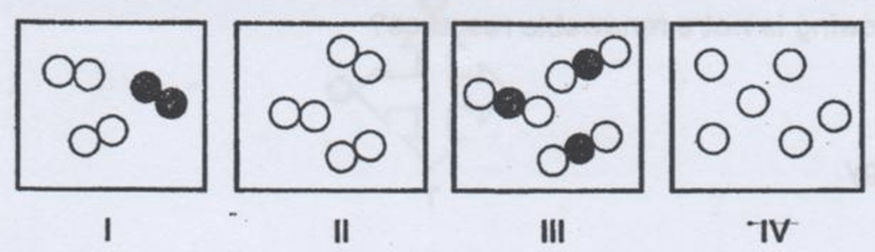
In the diagrams, each different colored circle is a different element. Which diagram represents a compound?

a)

I

b)

II

c)

III

d)

IV

12.

In the diagrams, each different colored circle is a different element. Which diagram represents two different elements?

a)

I

b)

II

c)

III

d)

IV

13.

Dissolving salt is a

a)

Chemical change

b)

Physical change

14.

The glow stick lighting up is a __________

a)

Chemical change

b)

Physical change

15.

Color change, formation of a precipitate, formation of a gas, odor change and temperature change are all signs of a ...

a)

Physical Change

b)

Chemical Change

16.

When you combine vinegar and baking soda, a gas is produced. The gas produced is considered evidence that a chemical reaction occurred.

a)

True

b)

False

17.

This is an evidence that a chemical reaction has occurred.

a)

dissolving

b)

melting

c)

formation of a gas

d)

bending

18.
In a ___________change, a substance changes into a different substance.
a)
Physical
b)
Chemical
19.

In a ___________change, a substance now looks different but isn't new.

a)

Physical

b)

Chemical

20.

Which of these is NOT a sign that a chemical change has occurred?

a)

Being broken down into small pieces

b)

An increase in temperature

c)

Bubbles forming when combining 2 liquids

d)

Light being produced

21.
a copper penny turning greenish after a few years.
a)
Chemical Change
b)
Physical Change
22.
An gel ice pack getting cold after you put it in the freezer for an hour.
a)
Chemical Change
b)
Physical Change
23.
Which of the following IS a physical change?
a)
Getting a haircut
b)
Rusty metal
c)
sour milk
d)
A compound
24.

Which of the following 2 are chemical reactions?

a)

sugar dissolving in water

b)

water turning into steam

c)

burning wood

d)

mixing baking soda and vinegar

e)

tearing paper

25.
Which is the name of the kind of solid substance formed in this figure?  
a)
aqueous 
b)
precipitate
c)
acid
d)
synthesis 
26.
The word “luster” refers to which property of matter?
a)
The ability to conduct electrical or thermal energy
b)
Capable of being drawn out into thin wires
c)
The way a surface appears when it reflects light
d)
Suitable for being shaped by beating or rolling
27.

The word “Malleability” refers to which property of matter?

a)

The ability to allow electrical or thermal energy to pass through

b)

Capable of being pulled out into thin wires

c)

The way a surface appears when it reflects light

d)

Able to be shaped by beating or rolling without breaking

28.

The word “Conductivity” refers to which property of matter?

a)

The ability to allow electrical or thermal energy to pass through

b)

Capable of being pulled out into thin wires

c)

The way a surface appears when it reflects light

d)

Able to be shaped by beating or rolling without breaking

29.

Good conductors of heat are

a)

Metals

b)

Nonmetals

c)

Metalloids

d)

Insulators

30.
Iron is a good conductor, malleable and magnetic. What type of element is Iron? 
a)
Metal
b)
Nonmetal
c)
Metalloid
d)
Pretty
31.
Which of the following is a property of a non-metal?
a)
Conducts electricity and heats well
b)
Can be hammered into thin sheets
c)
Is brittle and breaks easily
d)
Has a shiny, metallic luster
32.
All of the following are properties used to classify elements as metals, non-metals, and metalloids EXCEPT —
a)
texture
b)
conductivity
c)
luster
d)
malleability
33.
Silicon is a semiconductor and has properties of both metals and nonmetals. What type of element is Silicon? 
a)
Metal
b)
Nonmetal
c)
Metalloid
d)
Pretty
34.
The table shows the properties of four elements. Which element in the table is classified as a metal?
a)
Manganese
b)
Sulfur
c)
Silicon
d)
Neon
35.
Which element is a metalloid?
a)
Titanium
b)
Selenium
c)
Potassium
d)
Polonium
36.

A student tested the conductivity of four elements by putting them though an electrical circuit. Based on the results, which element is classified as a metal?

a)

Hydrogen

b)

Arsenic

c)

Krypton

d)

Copper

37.
What are the three major categories of the periodic table?
a)
Alpha, Beta & Gamma
b)
Metals, Non-Metals and Metalloids
c)
Metals, Semi-metals and Metalloids
d)
Non-Metals, Semi-Metals and Metalloids
38.

Where are the non-metal elements found in the periodic table?

a)

In the staircase

b)

In the top rows

c)

On the left side of the staircase

d)

On the right side of the staircase

39.

Where are the metal elements found in the periodic table?

a)

In the staircase

b)

In the top rows

c)

On the left side of the staircase

d)

On the right side of the staircase

40.

Where are the metalloid elements found in the periodic table?

a)

On the left side of the staircase

b)

In the staircase

c)

In the top rows

d)

On the right side of the staircase

41.
What two types of measurements make up DENSITY
a)
Mass and Volume
b)
Temperature and Mass
c)
Grams and Centimeters
d)
Volume and Weight
42.

If an object has a density of 0.6 g/mL and you put it into water, will it sink or float? (The density of water is 1.0g/mL)

a)

sink

b)

float

43.
What units can be used to express density?
a)
g/mL
b)
grams
c)
millimeters
d)
milliliters
44.
What is the formula for density?
a)
density = mass x volume
b)
density = mass / volume
c)
density = mass + volume
d)
density = mass - volume
45.
Jack has a rock. The rock has a mass of 14g and a volume of 2cm3. What is the density of the rock?
a)
7 mL
b)
7 g/cm3
c)
28 g/cm3
d)
1/7 g/cm3
46.
Frank has an eraser. It has a mass of 4g, and a volume of 2cm3. What is its density?
a)
8 g/cm3
b)
2 g/cm3
c)
1/2 g/cm3
d)
24 g/cm3
47.
Frank has a paper clip. It has a mass of 9g and a volume of 3cm3. What is its density?
a)
3 g/cm3
b)
1/3 g/cm3
c)
27 g/cm3
d)
39 g/cm3
48.
What is the density of a liquid that has a mass of 27g and a volume of 30mL?
a)
0.9 g/mL
b)
3 g/mL
c)
57 g/mL
d)
810 g/mL
49.
Which lab tool might you use to measure the volume of a liquid?
a)
electric scale
b)
bunsen burner
c)
test tube
d)
graduated cylinder
50.

What is the formula for Volume?

a)

Volume = mass / density

b)

Volume = mass x density

c)

Volume = density / mass

d)

Volume = density - mass

51.

If the initial volume of a graduated cylinder with water is 15mL and it rises to 46mL after adding in a toy car, what is the volume of the toy car?

a)

61mL

b)

31mL

c)

3.07mL

d)

0.33mL

52.
What is the volume of Object X?
a)
10.0 cm3
b)
15.0 cm3
c)
20.0 cm3
d)
25.0 cm3
53.
What is the volume of 150 grams of lead if it has a density of 11.3 g/cm3?
a)
13.3 g
b)
13.3 cm3
c)
.075 g
d)
1695 cm3
54.
What is the mass on this triple beam?
a)
506g
b)
576g
c)
570g
55.

What is the formula for Mass?

a)

Mass = Density / volume

b)

Mass = Volume / Density

c)

Mass = Density - Volume

d)

Mass = Density x Volume

56.
The density of this material is 2 g/cm3.
There are 24 cm3  Find the total mass.
a)
12 grams
b)
48 grams
c)
12 g/cm3
d)
48 g/cm3
57.
a)

303.4 g

b)

370.4 g

c)

373.0 g

d)

373.4 g

58.

What is the mass of an object that has a density of 2.5 g/cm3 and a volume of 10.0 cm3?

a)

0.25g

b)

25 g

c)

4g

d)

12.5g

59.
A piece of metal has a mass of 35.4 grams and a volume of 6cm3. According to the table what metal is it?
a)
Aluminum
b)
Scandium
c)
Radium
d)
Xenon
60.
Sue found a ring and wanted to know what type of metal it was. She found the mass to be 26.7 grams and the volume to be 3 cm3. What metal is the ring?
a)
Nickel
b)
Silver
c)
Lead
d)
Gold
61.
The color of a mineral in powder form is called the mineral's 
a)
hardness
b)
specific gravity
c)
luster
d)
streak
62.

Diamond has a hardness of ___ on Mohs Hardness Scale which means it is the _____ mineral.

a)

1, softest

b)

1, hardest

c)

10, softest

d)

10, hardest

63.
Dull, silky, waxy, pearly, and earthy are terms that best describe which property of minerals?
a)
luster
b)
color
c)
streak
d)
cleavage
64.
A naturally occurring, inorganic solid with a crystal structure and a definite chemical composition is referring to
a)
density
b)
streak
c)
mineral
d)
non silicate mineral
65.

A substance that cannot be broken down into simpler substances by chemical means

a)

Compound

b)

mineral

c)

element

66.

A substance made of two or more different atoms that are chemically bonded

a)

element

b)

compound

c)

streak

67.

The _______________________ of a mineral can be metallic or nonmetallic.

a)

luster

b)

color

c)

streak

d)

hardness

68.
How effective is the physical property of color in identifying a mineral? 
a)
Very effective.  You can immediately identify it based only on the color. 
b)
It doesn't make a difference.  Every mineral can be any color.  
c)
It is one property and may not be used alone to identify a mineral. 
d)
Color isn't a physical property. 
69.
Using this scale, which mineral can scratch fluorite?
a)
Talc 
b)
Gypsum 
c)
Apatite 
d)
Calcite 
70.

Using this scale, what is scratched by fluorite?

a)

Diamond

b)

Gypsum

c)

Apatite

d)

Steel nail

71.
Can a penny scratch fluorite?
a)
Yes 
b)
No 
72.
Which of these minerals is softer than glass?
a)
Topaz 
b)
Corundum 
c)
Calcite 
d)
Orthoclase