
 Worksheets
Unit 1.2: Components of Weather
Total questions: 71
Worksheet time: 1hrs 11mins
Name
Class
Date
1.
An occluded front may remain in the same place for several days, producing light wind and precipitation.
a)
True
b)
False
2.
Which condition usually means cloudy, stormy weather?
a)
high pressure
b)
low pressure
3.

What does this symbol indicate on a weather map?
a)
warm front
b)
cold front
c)
stationary front
d)
occluded front
4.

What does this symbol on a weather map indicate?
a)
High pressure system
b)
Low pressure system
c)
Cold front
d)
Warm front
5.

What does this symbol indicate on a weather map?
a)
High pressure system
b)
Low pressure system
c)
Cold front
d)
Warm front
6.
What kind of weather is usually associated with a high pressure system?
a)
Sunny weather
b)
Precipitation (rain, snow, etc.)
7.
A cold front moving into an area can bring this type of weather...
a)
Warmer Temperatures, Clear Skies
b)
Colder Temperatures, Clear Skies
c)
Warmer Temperatures, Clouds
d)
Colder Temperatures, Clouds, and Precipitation
8.
This type of front results in the same weather for several days
a)
warm
b)
cold
c)
stationary
d)
occluded
9.
This type of front can bring violent storms
a)
cold
b)
warm
c)
stationary
d)
occluded
10.

What does this symbol on a weather map indicate?
a)
High pressure system
b)
Low pressure system
c)
Cold Front
d)
Warm Front
11.

What does this symbol on a weather map indicate?
a)
High pressure system
b)
Low pressure system
c)
Cold front
d)
Warm front
12.
What kind of pressure predicts good weather?
a)
high
b)
low
c)
cold
d)
stationary
13.
Located at the leading edge of a warm air mass. Brings gentle rain or light snow, followed by warmer, milder weather.
a)
Warm Front
b)
Cold Front
c)
Occluded Front
d)
Stationary Front
14.
Where the warm and cold air meet and stall, clouds and fog form, and it may rain or snow. It could bring many days of clouds and precipitation.
a)
Warm Front
b)
Cold Front
c)
Occluded Front
d)
Stationary Front
15.
When a cold front overtakes a warm front, the temperature drops as the warm air mass is cut off from the ground and pushed upward. It can bring strong winds and heavy precipitation.
a)
Warm Front
b)
Cold Front
c)
Occluded Front
d)
Stationary Front
16.
When two air masses meet, there is a _____, or boundary.
a)
thunderstorm
b)
watch
c)
front
d)
cloud
17.
How many types of fronts are there?
a)
2
b)
6
c)
4
d)
0
18.

What type of storm front is this?
a)
cold front
b)
warm front
c)
stationary front
d)
occluded front
19.

What type of storm front is this?
a)
occluded front
b)
warm front
c)
cold front
d)
stationary front
20.
What characteristics are used to classify an air mass?
a)
pressure and temperature
b)
temperature and latitude
c)
temperature and humidity
d)
humidity and density
21.
What type of weather would you expect to see after a cold front has moved through an area?
a)
cool, clear skies
b)
warm and humid
c)
thunderstorms
d)
foggy
22.
Which type of air mass creates cool, dry air?
a)
continental tropical
b)
maritime tropical
c)
continental polar
d)
maritime polar
23.
The transfer of thermal energy between objects in direct contact
a)
Conduction
b)
Convection
c)
Radiation
24.
The transfer of thermal energy through the movement of molecules in a fluid
a)
Conduction
b)
Convection
c)
Radiation
25.
The transfer of thermal energy between objects that are not touching
a)
Conduction
b)
Convection
c)
Radiation
26.
Air masses move from areas of _______ to areas of _______
a)
low pressure; high pressure
b)
high temperature; low temperature
c)
high pressure; low pressure
d)
low humidity; high humidity
27.
A warm, dry air mass that forms over land near the equator
a)
cP
b)
cT
c)
mT
d)
mP
28.
A cool, wet air mass that forms over oceans in northern latitudes
a)
cT
b)
mT
c)
mP
d)
cP
29.
A cool, dry air mass that forms over land in northern latitudes
a)
mA
b)
cT
c)
cA
d)
cP
30.
A warm wet air mass that forms over oceans near the equator
a)
mP
b)
mT
c)
mA
d)
cT
31.
They are highest clouds in the sky. They look curly, white and feathery. Usually mean good weather.
a)
Cumulus
b)
Cumulonimbus
c)
Cirrus
d)
Stratus
32.
This is sometimes called a thunderhead cloud. It looks very tall like mountains and heavy rain comes from it.
a)
Cumulus
b)
Cirrus
c)
Stratus
d)
Cumulonimbus
33.
They are low in the sky and look soft and fluffy.
a)
Cirrus
b)
Cumulonimbus
c)
Cumulus
d)
Stratus
34.
Which cloud brings nice weather?
a)
Cumulonimbus
b)
Cumulus
c)
Stratus
35.
Low clouds (like fog), that are thick, cover the sky, and block the sun. Usually bring continuous precipitation (rain or snow).
a)
stratus
b)
cumulus
c)
cirrus
d)
nimbo
36.

What type of cloud is shown?
a)
cumulus
b)
cirrus
c)
stratus
37.

What type of cloud is shown?
a)
cumulus
b)
cirrus
c)
stratus
38.

Clouds form when...
a)
liquid water is heated and evaporates to become water vapor in the atmosphere.
b)
water vapor in the atmosphere cools and condenses becoming water droplets or ice crystals
c)
water droplets float upwards and gather together in the atmosphere to form a cloud.
39.
Clouds are classified by their
a)
temperature & pressure
b)
altitude & pressure
c)
temperature & shape
d)
shape & altitude
40.

Identify this cloud type
a)
cirrus
b)
cumulus
c)
stratus
d)
cumulonimbus
41.
Clouds form with
a)
atmospheric dust, low pressure, and moist air
b)
high pressure, high temperatures, and condensation nuclei
c)
low temperatures, zero dust particles, and dry air
d)
dry air, condensation nuclei, and low pressure
42.
Due to the Coriolis Effect, wind in the Northern Hemisphere is deflected to the _____
a)
Right
b)
Left
c)
North
d)
South
43.
The condition of the Earth's atmosphere at a particular time and place
a)
Weather
b)
Climate
44.
Which winds are mainly responsible for our weather in North Carolina?
a)
Northeast Trades
b)
Easterlies
c)
Southeast Trades
d)
Westerlies
45.
A cirrocumulus cloud would be found at what altitude?
a)
High Level (above 20,000 ft)
b)
Mid Level (between 6,500 and 20,000 ft)
c)
Low Level (below 6,500 ft)
46.
Which tool measures wind speed?
a)
anemometer
b)
speedometer
c)
barometer
d)
thermometer
47.

Identify this cloud type
a)
cumulus
b)
cirrus
c)
stratus
d)
cumulonimbus
48.
Clouds are made up of tiny drops of ______ or ice. The moisture in the cloud affects the weather.
a)
dust
b)
water
c)
cloud particles
d)
precipitation
49.
Which of the following is true?
a)
A sea breeze forms at night due to unequal heating of the land and ocean
b)
A land breeze blows toward the ocean due to equal heating of the land and ocean
c)
A sea breeze forms during the day due to unequal heating of the land and ocean
d)
A land breeze blows inland from the ocean due to equal heating of the land and ocean
50.
Which of the following will heat the fastest?
a)
water
b)
land
c)
both will heat at equal rates
51.

An instrument that measures air pressure
a)
thermometer
b)
barometer
c)
rain guage
d)
wind sock
52.
____________ air sinks/falls because it is ____________dense.
a)
Cold, More
b)
Warm, Less
c)
Cold, Less
d)
Warm, More
53.
When air is heated, it ___.
a)
Expands
b)
Contracts
c)
Doesn't change
d)
Air cannot be heated
54.
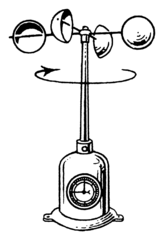
This weather instrument is an...
a)
wind vane
b)
anemometer
c)
barometer
d)
thermometer
55.

This weather instrument is a...
a)
anemometer
b)
barometer
c)
wind vane
d)
thermometer
56.

This weather instrument is a...
a)
anemometer
b)
Christmas ornament
c)
wind vane
d)
barometer
57.
This instrument measures air pressure.
a)
anemometer
b)
barometer
c)
rain gauge
d)
thermometer
58.
A high pressure system means we might have this weather.
a)
Snow blizzard
b)
Sunny and dry
c)
Rain storm
d)
Tornado
59.
A low pressure system means we might have this weather.
a)
Sunny
b)
A clear sky
c)
Dry day
d)
Stormy or wet
60.
Which term describes a circulation of air or water that is caused by uneven heating?
a)
convection current
b)
conduction current
c)
radiation current
d)
emission current
61.

White, thin, feathery clouds, usually made of ice crystals are...
a)
Stratus
b)
Cumulus
c)
Cirrus
62.

Which type of pressure system is pictured?
a)
high
b)
low
c)
medium
d)
none
63.

Which type of pressure system is pictured?
a)
high
b)
low
c)
medium
d)
none
64.
In _________ pressure systems, air sinks:
a)
high
b)
low
c)
medium
d)
none
65.
In _______ pressure systems, air rises
a)
high
b)
low
c)
medium
d)
none
66.
_____________ has the same temperature and moisture content throughout.
a)
convection current
b)
front
c)
air mass
67.

Which statement best describes the difference between weather and climate?
a)
Weather is the conditions when you look outside while climate is the conditions you can expect for the next 6 months.
b)
Climate is the current condition outside while weather is what you can expect for the next 6 months.
68.
Rain, sleet, hail, and freezing rain are all...
a)
precipitation
b)
condensation
c)
evaporation
d)
perspiration
69.
____________ air sinks/falls because it is ____________dense.
a)
Cold, More
b)
Warm, Less
c)
Cold, Less
d)
Warm, More
70.
____________ air rises because it is ____________dense.
a)
Cool, Less
b)
Warm, Less
c)
Cold, More
d)
Warm, More
71.
The weight of air as it presses down on Earth's surface
a)
front
b)
air pressure
c)
air mass
d)
evaporation
100 %

