Wayground logo

Free Printable Worksheets

Font size

S
M
L
XL
Worksheets

DNSMPT Test Review

Total questions: 68

Worksheet time: 57mins

Name
Class
Date
1.

What is the line running down the center of Earth called?

a)

Equator

b)

Axis

c)

North Pole

d)

South Pole

2.
Period of 24 hours or the time it takes Earth to make one complete spin on its axis
a)
Rotation
b)
Compass
c)
Sundail
d)
Movement
3.
What 2 things cause seasons on Earth?
a)
axis and orbit
b)
Winter and Fall
c)
Summer and Spring
d)
Sun and Moon
4.
The Earth revolves around the Sun every...
a)
month
b)
year
c)
day
d)
3 years
5.
The Sun moves around the Earth and the Earth stays still.
a)
True
b)
False
6.
As the Earth rotates, the part of the Earth facing the sun has ________.
a)
an axis
b)
darkness (night)
c)
daylight
d)
winter
7.
As the Earth rotates, the part of the Earth facing away from the sun has ________.
a)
daylight 
b)
darkness (night)
c)
summer 
d)
nice weather
8.
Earth is tilted on its _______. 
a)
side
b)
axis
c)
hemisphere
d)
equator
9.
The orbit is the same as ____________.
a)
Rotating
b)
Revolving
c)
Spinning
10.

Rotation and sunlight causes ___________.

a)
Day and Night
b)
Seasons
c)
The Earth to be tilted
11.
What does the Earth orbit around?
a)
axis
b)
sun
c)
orbit
d)
moon
12.
If the earth didn't rotate on its axis.  What natural cycle would this affect?
a)
seasons
b)
tides
c)
day and night
d)
moon phases
13.
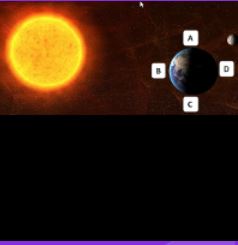
Which part of Earth is experiencing night?
a)
B
b)
D
14.
If the earth rotated slower, how would that affect the length of the day?
a)
longer day
b)
shorter day
c)
same time,  24 hours
15.
Earth's axis is tilted at - 
a)
23.5 degrees
b)
33.5 degrees
c)
28 degrees
d)
90 degrees
16.
The diagram shows the Earth's movement around its' axis. What is this diagram demonstrating? 
a)
day and night
b)
seasons
17.
Which answer correctly labels each letter as day and night? 
a)
X = night
Y = day
b)
X = day
Y = night
18.

A student wants to use a spinning basketball to model the day-and-night cycle on Earth.


What should the student do in order to best model the cause of the day-and-night cycle?

a)

Spin the ball in different directions

b)

Tilt the ball while it is spinning

c)

Paint one half of the ball black and the other half white

d)

Shine a bright light on one side of the ball

19.

Which of these locations on Earth experiences the least change in the number of daylight hours throughout the year?

a)

Equator

b)

North Pole

c)

Tropic of Cancer

d)

Tropic of Capricorn

20.
Shadows growing longer and shorter are evidence of  ____________
a)
Earth's rotation
b)
Earth's tilt
c)
Earth's revolution
d)
Earth's weather
21.
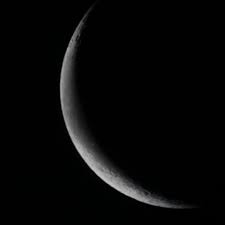
Name the moon phase
a)
waning crescent
b)
waxing crescent
c)
waning gibbous
d)
waxing gibbous
22.
What phase comes AFTER this one?
a)
Waning Crescent
b)
Waning Gibbous
c)
Waxing Crescent
d)
Third Quarter
23.

6. Identify the phase of the moon that is shown

a)

new moon

b)

first quarter

c)

third quarter

d)

waxing crescent

24.
What phase comes BEFORE this one?
a)
Full Moon
b)
Third Quarter
c)
New Moon
d)
First Quarter
25.

The moon around the Earth.


(a)  
Choose from the below words
Orbits
Rotates
Revolves
26.

Use the calendar to predict the moon phase on March 9th.

a)

New Moon

b)

Full Moon

c)

Third Quarter

d)

First Quarter

27.

Which lunar phase would you observe 4 days after this phase?


(a)  
Choose from the below words
waxing gibbous
waning gibbous
waning crescent
new moon
28.

What happens as the moon revolves around the earth?

a)

The shadow gets darker and darker.

b)

The illuminated (lit) side gets lighter and lighter.

c)

The shadow slowly disappears until it's fully lit, then the lit part slowly disappears until it's completely dark.

29.

If today is a full moon, which phase would we have observed two days ago?


(a)  
Choose from the below words
waxing gibbous
waning gibbous
waxing crescent
waning crescent
30.

8. Identify the phase of the moon that is shown


(a)  
Choose from the below words
third quarter
new moon
waxing crescent
first quarter
31.

What phase is this?


(a)  
a)

Waning gibbous

b)

Waxing gibbous

c)

Waning crescent

d)

Full moon

32.
What Moon phase is this?
(a)  
Choose from the below words
New Moon
Full Moon
Invisible Moon
Waxing Gibbous
33.
The Moon orbits Earth in a direction
(a)  
Choose from the below words
counterclockwise
clockwise
upwards
downwards
34.

What phase is this?

a)

Waning gibbous

b)

Waxing crescent

c)

Waning crescent

d)

Waxing gibbous

35.

7. Identify the phase of the moon that is shown

a)

new moon

b)

waxing crescent

c)

full moon

d)

waning crescent

36.

Which lunar phase would you expect to see 12 days after this phase?

a)

waning gibbous

b)

third quarter

c)

waning crescent

d)

new moon

37.

What phase is this?

a)

First Quarter

b)

Full Moon

c)

New Moon

d)

Third Quarter

38.

8. Identify the phase of the moon that is shown


(a)  
Choose from the below words
first quarter
new moon
waxing crescent
third quarter
39.

How long does it take for the moon to go to the next phase?​ (a)  

Choose from the below words
3.5 days
24 hours
7 days
40.

How long does it take for the moon to go from a full moon to a first quarter moon?​ (a)  

Choose from the below words
7 days
24 hours
3.5 days
3.5 hours
41.
A[n] ___________ tide occurs when the sun, Earth, and the moon are nearly in a line. 
a)
spring
b)
high
c)
low
d)
neap
42.
What is a difference between spring and neap tides?
a)
Spring tides occur when the earth and sun are IN LINE with the new or full moon. 
b)
Spring tides occur when moon in 3rd or 1st quarter phases
c)
Spring tides are LOWER than neap tides
d)
Spring tides occur in Spring and neap tides can occur in any season
43.
Which body has the greater effect on Earth's tides?
a)
Sun
b)
Saturn
c)
Moon 
d)
Venus
44.
What happens when there is a spring tide
a)
Short Tides and semi-short tides
b)
High tides and very low tides
c)
low tides and medium tides
d)
small tidal ranges
45.
What do we call a tide that has a large range?
a)
gravity
b)
wind
c)
spring
d)
neap
46.
What do we call tides that have a smaller range that happen when the sun and moon are at right angles to each other?
a)
Neap Tide
b)
Spring Tide
c)
Larger Change
d)
Smaller Change
47.
What type of tides would this arrangement of earth-moon-sun create?
a)
neap tide
b)
spring tide
c)
new moon tide
d)
full moon tide
48.
What type of tide would this arrangement of earth-moon-sun create?
a)
full moon tide
b)
new moon tide
c)
neap tide
d)
spring tide
49.
Which moon phase is shown in this diagram?
a)
new moon
b)
first quarter
c)
full moon
d)
last quarter/3rd quarter
50.
What causes tides?
a)
gravity
b)
wind
c)
spring
d)
neap
51.
Which body has the greater effect on Earth's tides?
a)
Sun
b)
Saturn
c)
Moon 
d)
Venus
52.
At the same time the sea is drawn to the moon, another tidal bulge takes place on other side of Earth.  True or False?
a)
True
b)
False
c)
Maybe
d)
I don't know!
53.
If tides alternate from high to low and there are two of each type of tide a day, about how many hours will generally be between each different tide?
a)
2 hours
b)
6 hours
c)
12 hours
d)
24 hours
54.
What type of tides would this arrangement of earth-moon-sun create?
a)
neap tide
b)
spring tide
c)
new moon tide
d)
full moon tide
55.

What phase occurs on the designated part of the graph?

a)

Waxing Crescent

b)

Waxing Gibbous

c)

Waning Crescent

d)

Waning Gibbous

56.

What phase occurs on the 28th of the month?

a)

Waxing Gibbous

b)

1st Quarter

c)

3rd Quarter

d)

Waning Gibbous

57.

Name the phase that the selected images represent.

a)

Waxing Gibbous

b)

Waxing Crescent

c)

1st Quarter

d)

3rd Quarter

58.

Where would the Sun need to be in this diagram to cause these phases of the moon?

a)

On the Left

b)

At the bottom

c)

At the top

d)

At the right

59.

What phase occurs on the designated part of this graph?

a)

New Moon

b)

Full Moon

c)

Waning Crescent

d)

Waxing Crescent

60.

The image shows how the moon looks during the lunar cycle. The moon will look this way again in about -

a)

one week

b)

one month

c)

one year

d)

one century

61.

About how long does it take for the moon to go from new moon to full moon?

a)

1 day

b)

7 days

c)

14 days

d)

1 month

62.

What phase of the moon is shown in the picture?

a)

first quarter

b)

new moon

c)

full moon

d)

last quarter

63.

What moon phase is shown in the picture?

a)

first quarter

b)

new moon

c)

last quarter

d)

full moon

64.

What direction does the moon orbit the earth from the top view?

a)

clockwise

b)

counter-clockwise

65.

What moon phase should be between the two shown?

a)

new moon

b)

full moon

c)

first quarter

d)

last quarter

66.
Which diagram shows the greatest difference in tides (extremely high tide and extreme low tide?)
a)
A
b)
B
67.

What will the phase of the moon be in the diagram?

a)

new moon

b)

waning gibbous

c)

first quarter

d)

full moon

68.

It will be a full moon on December 23, 2018. About what date will the next full moon occur?

a)

January 1, 2019

b)

January 10, 2019

c)

January 21, 2019

d)

February 1, 2019