Wayground logo

Free Printable Worksheets

Font size

S
M
L
XL
Worksheets

2nd 9wks Review

Total questions: 65

Worksheet time: 1hrs 25mins

Name
Class
Date
1.
What kind of energy is in a battery?
a)
Potential
b)
Kinetic
2.
Which is the best example that something has kinetic energy?
a)
a. a car parked on a steep hill 
b)
b. a tennis ball rolling across the court
c)
c. a picture hanging on the wall 
d)
d. a piece of coal before it's burned 
3.
When a pendulum swings, at which point is kinetic energy highest?
a)
1
b)
2
c)
3
d)
4
4.
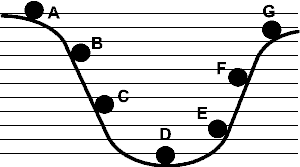
Which point has the most potential energy?
a)
G
b)
f
c)
b
d)
a
5.
Which 2 letters have the most kinetic energy
a)
W & Y
b)
X & Z
6.
At which point is potential energy greatest?
a)
W
b)
X
c)
Y
d)
Z
7.
As a pendulum swings from its highest to lowest position, what happens to its kinetic and potential energy? 
a)
Both the potential energy and kinetic energy decrease
b)
The potential energy decreases while the kinetic energy increases 
c)
The kinetic energy decreases while the potential energy increases 
d)
Bothe the potential energy and kinetic energy increase 
8.

Kinetic energy depends on

a)

mass and height

b)

height and speed

c)

mass and speed

d)

mass and force

9.

The sum of potential energy and kinetic energy equals

a)

work

b)

transformation

c)

total energy

d)

mechanical energy

10.
Gravitational potential energy depends on the ________ and ________ of the object. 
a)
Height and mass
b)
Friction and movement
c)
Mass and Movement
d)
Height and Friction 
11.

What is the energy transformation that occurs in an electric pencil sharpener?

a)

mechanical energy to electrical energy

b)

electrical energy to mechanical energy

c)

radiant energy to sound energy

d)

chemical energy to mechanical energy

12.

What type of energy transformation occurs in an electric hot that is turned on?

a)

thermal energy to electrical energy

b)

electrical energy to thermal energy

c)

thermal energy to mechanical energy

d)

mechanical energy to thermal energy

13.

When a car burns gasoline it creates hot air to move the pistons in the engine, which causes the car to move. What energy transformation occur from the fuel to the movement of a car?

a)

thermal energy to mechanical energy

b)

thermal energy to chemical energy to mechanical energy

c)

chemical energy to thermal energy to mechanical energy

d)

chemical energy to electrical energy

14.
What energy transformations take place when a battery-operated radio is in use?
a)
Electrical to chemical to light
b)
Sound to chemical to mechanical
c)
Chemical to electrical to sound
d)
Light to electrical to thermal
15.
If you increase the mass on an object, its acceleration
a)
decreases
b)
stays the same
c)
also increases
d)
stops
16.
In a car accident, a passenger not wearing a seat belt may crash through a windshield because of his or her inertia.
a)
False
b)
True
17.
Newton's law of motion describes the relationship of force, mass, and acceleration. Write the equation.
a)
M=F/A
b)
F=MA
c)
A= F/M
d)
All of the above
18.
If you increase the force on an object, its acceleration? 
a)
decreases
b)
stays the same
c)
also increases
d)
stops
19.

Look at this scenario, which law does this represent?

a)

Law of Inertia (1st law)

b)

Law of Force and Acceleration (2nd law)

c)

Law of Action-Reaction (3rd law)

20.

In this scenario, which law does this represent?

a)

Law of Inertia (1st law)

b)

Law of Force and Acceleration (2nd law)

c)

Law of Action-Reaction (3rd law)

21.

An 18-wheeler requires more time and distance to stop than a Mini-Cooper.

a)

Law of Inertia (1st law)

b)

Law of Force and Acceleration (2nd law)

c)

Law of Action-Reaction (3rd law)

22.

If two boxes are pushed with the same amount of total force, and one weighs 1kg and the other weighs 100kg, which one will accelerate faster?

a)

1kg box

b)

100 kg box

c)

they will accelerate at the same rate

23.
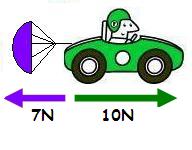
What is the magnitude (size) and direction of the net force?
a)
15 N to the left
b)
15 N to the right
c)
1 N to the left
d)
1 N to the right
24.
What is the magnitude (size) and direction of the net force?
a)
14 N Down
b)
14 N Up
c)
6 N Up
d)
6 N Down
25.
What is the magnitude (size) and direction of the net force?
a)
21 N to the Left
b)
3 N to the Left
c)
21 N to the Right
d)
3 N to the Right
26.
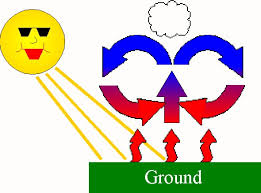
Warm air rises and the cool air sinks demonstrates this type of heat transfer. 
a)
conduction
b)
convection
c)
radiation
d)
Insolation 
27.
What kind of heat transfer happens when the sun is heating your body?
a)
Conduction
b)
Radiation
c)
Convection
d)
Density
28.
Ironing a shirt is an example of...
a)
condensation
b)
conduction
c)
convection
d)
radiation
29.
Warm air is __________ dense than cold air and rises creating convection currents.
a)
more
b)
less
30.
What happens when ice cubes melt in a glass?
a)
Heat travels from the ice to the warmer water.
b)
No energy is transferred.
c)
Heat is transferred from the warmer water to the ice cubes.
d)
The water warms up due to the humidity
31.
Transfer of thermal energy through "space"
a)
conduction
b)
convection
c)
radiation
32.
Which direction will the heat flow while this person holds a hot cup of tea?
a)
from the cup to her hand
b)
from her hand to the cup
c)
no heat is transferred
33.
Heat transfers from an area of ____temperature to an area of ___ temperature.
a)
high to low
b)
low to high
c)
high to high
34.
Electromagnetic energy (such as visible light waves, X-rays, gamma rays and radio waves) is called _______ energy.
a)
Thermal
b)
Radiant
c)
Sound
d)
Electrical
35.
What type of energy does this provide?
a)
thermal
b)
radiant
c)
sound
d)
mechanical
36.
Food, batteries, and fuel such as gasoline are similar because they are sources of _________ energy.
a)
chemical energy
b)
kinetic energy
c)
mechanical energy
d)
heat energy
37.
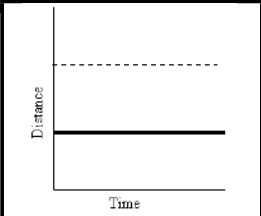
What does this graph represent?
a)
Constant Speed
b)
Acceleration
c)
Not moving
38.
What is happening at D?
a)
Stationary
b)
Accelerating
c)
Fast steady speed; moving away from the starting position
d)
Slower steady speed; moving away from the starting position
39.
What is happening at E?
a)
Stationary
b)
Accelerating
c)
Fast steady speed; moving away from the starting position
d)
Steady speed; returning to start position
40.
What is happening at A?
a)
Stationary
b)
Accelerating
c)
Slower steady speed; moving away from the starting position
d)
Steady speed; returning to start position
41.
What is the person doing from 5 seconds to 10 seconds?
a)
Walking 
b)
Running
c)
Standing Still 
d)
Walking Fast
42.
What does this graph represent?
a)
Constant speed
b)
Acceleration
c)
Not moving
43.
What does this graph represent?
a)
Constant speed
b)
Acceleration
c)
Not moving
44.

What is happening in this graph from point A to B?

a)

The object is accelerating.

b)

The object is not moving.

c)

The object is decelerating.

d)

The object is moving at a constant speed.

45.
A student runs two times around a running path at a local park.  Each lap is 3 km.  The student completes the first lap in 20 minutes.  The student then sits on a bench and rest for 5 minutes before completing the second lap in 25 minutes.  Which graph bests represents the student's motion?
a)
F
b)
G
c)
H
d)
J
46.

Assuming size indicates mass, would B or C have greater Potential Energy?

a)

B

b)

C

c)

They are the same

47.

Assuming size indicates mass, would A or C have greater Potential Energy?

a)

A

b)

C

c)

They are the same

48.
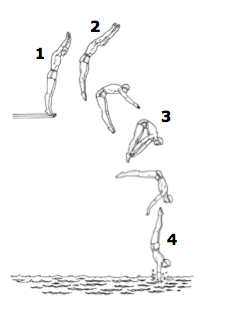
2. The diagram to the right represents a diver’s motion from the top of a high diving board into a pool of water. At what point does the diver have the greatest kinetic energy and the least potential energy?
a)
1
b)
2
c)
3
d)
4
49.

How would you describe the relationship between the mass of a car and its kinetic energy?

a)

As the mass of a car increases, its kinetic energy increases.

b)

As the mass of a car increases, its kinetic energy decreases.

c)

As the mass of a car decreases, its kinetic energy increases.

d)

There is no clear relationship between mass and kinetic energy.
50.

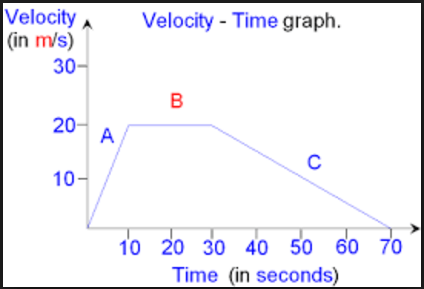
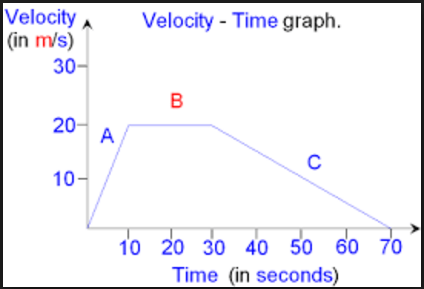
This is a velocity-time graph. What is the object doing in segment A?

a)

Speeding up

b)

Slowing down

c)

Constant Velocity

d)

Not moving

51.
This is a velocity-time graph.  What is the object doing in segment B?
a)
Positive acceleration
b)
Negative acceleration
c)
Constant Velocity
d)
Not moving
52.

This is a velocity-time graph. What is the object doing in segment C?

a)

Speeding up

b)

Slowing down

c)

Constant Velocity

d)

Not moving

53.
Which graph shows the object standing still?
a)
A
b)
B
c)
C
d)
D
54.
Which graph represents zero acceleration (constant velocity)?
a)
A
b)
B
c)
C
d)
D
55.
During which interval is the object traveling at a constant velocity?
a)
B to C
b)
D to E
c)
F to G
d)
it traveling at a constant velocity during all of the intervals shown.
56.

During which interval is the object speeding up?

a)

A to B

b)

B to C

c)

D to E

d)

E to F

57.
Which line represents an object moving at a faster speed?
a)
A
b)
B
58.
Which runner stopped for a rest?
a)
Albert
b)
Bob
c)
Charlie
59.
Which runner won the race?
a)
Albert
b)
Bob
c)
Charlie
60.

Students described the amount of force needed to change the motion for each ball from idle (stopped) to rolling. Which statement is true?*

a)

The beach ball has less mass, but it took more force to make it roll.

b)

The bowling ball has less mass, but it took more force to make it roll.

c)

The beach ball has more mass, therefore it took less force to make it roll.

d)

The bowling ball has more mass, therefore, it took more force to make it roll.

61.
If there are two forces going in the SAME direction, you would ...?
a)
(-) Subtract the forces
b)
(+) Add the forces
c)
Neither
d)
(x) Multiply
62.

If the net force is 0 the object will ...

a)

CHANGES motion

b)

STAY the SAME, NOT Move

63.
What is the net force?
a)
17 N Right
b)
3 N Right
c)
3 N Left
d)
17 N Left
64.
What is the net force?
a)
11 N left
b)
11 N right
c)
3 N left
d)
3 N right
65.
What kind of energy is in a moving skateboard?
a)
Potential
b)
Kinetic