wayground logo

Free Printable Worksheets

NEW

Font size

S
M
L
XL
Worksheets

Respiratory test

Total questions: 40

Worksheet time: 3hrs 20mins
Name
Class
Date
1.
The system of the body that brings oxygen into the body and releases carbon dioxide.
a)
respiratory​ ​system​
b)
skeletal system
c)
muscular system
d)
circulatory system
2.
Organs of the respiratory system that bring oxygen-rich air into​ ​the body and send oxygen-poor air out of the body.
a)
heart
b)
muscles
c)
lungs
d)
bones
3.
The process of taking in oxygen and releasing carbon dioxide from the body.
a)
transpiration 
b)
respiration 
c)
digestion
d)
relaxation
4.
The tube in the body through which air moves as it travels to and from the lungs;the windpipe.
a)
heart
b)
bone
c)
blood vessel
d)
trachea 
5.
Tiny air sacs in the lungs that are the site of gas exchange between the lungs and blood.
a)
alveoli​
b)
relax
c)
diaphragm​
d)
nose
6.
A wide muscle that separates the chest cavity from the abdominal cavity and aids in the inflation of the lungs.
a)
diaphragm​
b)
heart
c)
nose
d)
trachea
7.
When you breathe, your lungs take in ___ and remove ___. 
a)
air/oxygen
b)
oxygen/carbon dioxide 
c)
carbon dioxide/waste 
d)
waste/air 
8.
The air sacs that are covered with capillaries where gas exchange takes place
a)
bronchi
b)
lungs
c)
oxygen
d)
alveoli
9.

Flap of tissue that covers the opening to the windpipe during swallowing

a)

Pharynx

b)

Trachea

c)

Epiglottis

10.
What is the main function of the respiratory system?
a)
to provide oxygen and remove carbon dioxide from the body
b)
to bring oxygen to the body
c)
to break down food and absorb nutrients
d)
to remove oxygen from the body and deliver carbon dioxide
11.
Given the following structures:
1. larynx
2. nasal cavity
3. pharynx
4. trachea
Which of the following is the correct order that air would flow during inhalation. 
a)
1,2,3,4
b)
2,3,1,4
c)
2,1,3,4
d)
4,2,3,1 
12.
The left lung has three lobes and the right lung has two. 
a)
True
b)
False
13.

What is the site of gas exchange?

a)

alveoli

b)

nose

c)

lung

d)

bronchi

14.

Which lung has 2 lobes?

a)

Right

b)

Left

15.
What is the respiratory system ? 
a)
The respiratory system is the system that helps circulate our blood . 
b)
The respiratory system is the system that takes in oxygen and takes the unneeded particles and creates carbon dioxide. 
c)
The respiratory system is  a system that is similar to the circulatory system. 
d)
The respiratory system is a system that holds the heart as an internal organ. 
16.
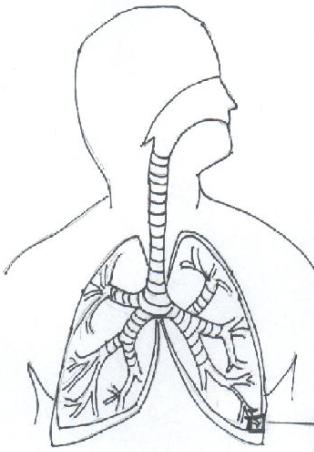
Letter B is pointing to which organ of the Respiratory System?
a)
Nose
b)
Trachea
c)
Lungs
d)
Diaphragm
17.
How is carbon dioxide released from the body? 
a)
When we exhale
b)
When we urinate
c)
When we sweat
d)
When we inhale
18.
During exhalation the diaphragm moves up and the volume of air decreases in the lungs.
a)
True
b)
False
19.
The tubes that go from the trachea into the lungs
a)
alveoli
b)
diaphragm
c)
epiglottis
d)
bronchial tubes
20.
cleans, moistens, and warms the air
a)
trachea
b)
larynx
c)
nasal passage
d)
windpipe
21.
Tiny tubes that branch off of bronchi
a)
capillaries
b)
alveoli
c)
bronchioles
d)
pluera
22.
To take in oxygen
a)
exhale
b)
cough
c)
hiccup
d)
inhale
23.
To release carbon dioxide
a)
exhale
b)
inhale
c)
cough
d)
hiccup
24.
The diaphragm is found:
a)
At the back of the throat.
b)
Below the larynx.
c)
Under the epiglottis.
d)
Under the rib cage.
25.
Name the two body parts that work together to force air IN and OUT of the body:
a)
Lungs and trachea
b)
Rib cage and diaphragm
c)
Rib cage and nasal passage
d)
Diaphragm and nasal passage
26.
What is the function of the bronchi?
a)
Transport air from nose to lungs
b)
Transport air from trachea to lungs
c)
Transport air from lungs to alveoli
d)
Transport air from alveoli to blood
27.
What are bronchi?
a)
connects the brain and spinal cord 
b)
number of protons
c)
part of earth and supports life
d)
2 short tubes that branch off of the lower end of the trachea and carry air to the lungs
28.
What is the pharynx?
a)
Outward physical appearance 
b)
Tube-like passage way for air, food, liquid
c)
Airway to vocal cords 
29.
Alveoli increase the surface area in the lungs to allow...
a)
More nutrients to be absorbed
b)
You to breathe faster
c)
You to breathe slower
d)
More O2 and CO2 to exchange
30.

Capillaries

a)

connect arteries to veins, gasses are exchanged

b)

connect heart valves together

c)

connect arteries to other arteries

31.

The respiratory system is made up of the trachea, the lungs, and the:

a)

Liver

b)

Diaphragm

c)

Esophagus

d)

Pancreas

32.

When you breathe in air, you bring oxygen into your lungs and blow out:

a)

Carbon dioxide

b)

Carbon monoxide

c)

Oxygen

d)

Hydrogen

33.

When you inhale, your lungs:

a)

inflate

b)

deflate

c)

turn purple

d)

do a dance

34.

_________ is not good for your lungs.

a)

Exercising

b)

Singing

c)

Yelling

d)

Smoking

35.

The tiny hairs that keep mucus and dirt out of your lungs are called:

a)

Lung hairs

b)

Stubble

c)

Bronchioles

d)

Cilia

36.

The voice box is also known as the:

a)

Alveoli

b)

Larynx

c)

Trachea

d)

Motormouth

37.

Bronchi are

a)

sac like organs where gas exchange occurs

b)

branching tubes that connect the lungs to the trachea

c)

where air is warmed

38.

The _________ is a cartilage-banded air passageway that is covered by the epiglottis and transports air to the bronchi.

a)

Nasal cavity

b)

Trachea

c)

Alveoli

39.

The path of oxygen through the respiratory system is:

a)

Mouth, Bronchioles, Bronchi, Trachea, Aveoli

b)

Bronchi, Trachea, Alveoli, Bronchioles, Mouth

c)

Mouth, Trachea, Bronchi, Bronchioles, Alveoli

d)

Alveoli, Bronchioles, Bronchi, Trachea, Mouth

40.

Which of the following parts connects the circulatory and respiratory systems?

a)

Bronchioles and Blood

b)

Trachea and Esophagus

c)

Alveoli and Arteries

d)

Alveoli and Capillaries